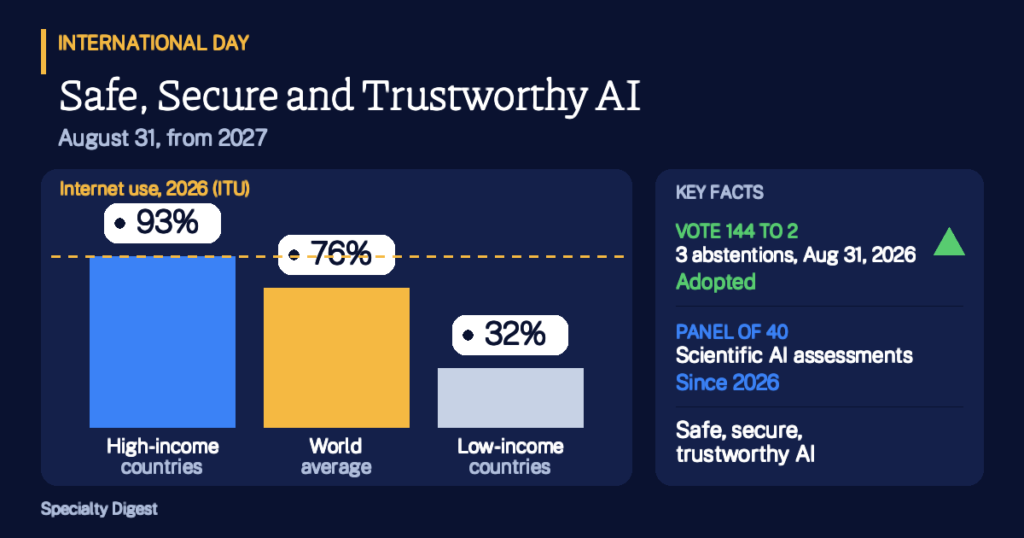
Some international days look back. This one looks ahead. On August 31, 2026, the United Nations General Assembly voted to designate August 31 as the International Day of Safe, Secure and Trustworthy Artificial Intelligence, to be observed every year beginning in 2027. It has never yet been marked, which makes this a good moment to understand why countries wanted it. The three words in its name are not decoration. They come from a chain of United Nations decisions that began with an ethics standard in 2021. This guide explains that chain, what the words ask of AI systems, and why the gap between people who are connected and people who are not decides who benefits. For a related observance, see World Telecommunication and Information Society Day.
How a day gets created
The designation is recent and the public record is short. According to the UN Photo description of the General Assembly’s 109th plenary meeting, dated August 31, 2026, the Assembly voted on a resolution under its agenda item on sustainable development. The resolution decides to designate August 31 as the Day, to be observed annually beginning in 2027, and it was adopted with 144 votes in favor, 2 against and 3 abstentions. This guide does not guess at the reasons behind individual votes, because the sources reviewed here do not state them.
The wording of the Day echoes an earlier text. In March 2024 the Assembly adopted, without a vote, a United States-led draft resolution on seizing the opportunities of safe, secure and trustworthy AI systems for sustainable development. UN News reported that more than 120 other Member States backed it and described it as the first time the Assembly had adopted a resolution on this emerging field. It is catalogued as A/RES/78/265, and it is the root of the language the new Day now carries.
What the three words ask
Safe, secure and trustworthy are three different demands. Safe asks whether a system can hurt people, whether it works as designed or fails. Secure asks whether it can be attacked, misused or have its data stolen. Trustworthy asks whether people have good reason to rely on it, which depends on honesty about what it can and cannot do. These plain readings are this guide’s own, offered to help; the resolutions carry the formal language.
The 2024 resolution is firm on one point. According to UN News, it highlighted respect, protection and promotion of human rights throughout the design, development, deployment and use of AI, and said that the same rights people have offline must also be protected online. It called on Member States and stakeholders to refrain from or cease using AI systems that cannot be operated in compliance with international human rights law or that pose undue risks to human rights. It also urged governments, the private sector, civil society, research organizations and the media to develop and support governance approaches for safe, secure and trustworthy AI. That human rights anchor links this Day to Human Rights Day.
A standard that came first
Before the 2024 resolution, UNESCO’s 193 Member States adopted the Recommendation on the Ethics of Artificial Intelligence in November 2021. UNESCO calls it the first global standard on AI ethics. It rests on four core values: human dignity and human rights; just, peaceful and interconnected societies; diversity and inclusiveness; and the flourishing of the environment and ecosystems. It then sets out ten principles, shown below. Several map neatly onto the Day’s three words, including safety and security, transparency and explainability, and human oversight. A Recommendation is not a treaty, so it guides countries rather than binding them.
Example 1: a hospital screening tool. Imagine a hospital uses an AI tool to flag scans for review. A doctor still checks a sample of the unflagged scans and finds that the tool missed 20 problems out of 1,000 scans. The numbers are round and illustrative. The lesson is that human oversight turns an imperfect tool into a safe process, because the 20 misses are caught only when a person remains responsible.
Building the machinery
Principles need institutions. In August 2025 the General Assembly adopted by consensus resolution A/RES/79/325, which established the Independent International Scientific Panel on Artificial Intelligence and the Global Dialogue on Artificial Intelligence Governance. According to the Panel’s FAQ, it builds on the 2024 Global Digital Compact and the recommendations of the Secretary-General’s High-Level Advisory Body on AI.
The Panel has 40 members from all five UN regions, 19 women and 21 men, appointed by the Assembly in February 2026 after an open call that drew over 2,600 applications from more than 140 countries. At its first meeting on March 3, 2026, it elected Yoshua Bengio and Maria Ressa as co-chairs. It produces an annual evidence-based assessment of AI’s opportunities, risks and impacts in the non-military domain, and the FAQ is clear that it is not a regulatory or enforcement body. The Global Dialogue was launched on September 25, 2025. Its first substantive session was scheduled for Geneva on July 6 and 7, 2026, and the next is planned for New York in 2027.
- 40experts on the UN scientific panel on AI
- 2,600+applications from over 140 countries
- 193states behind UNESCO’s 2021 ethics standard
- 144votes for the Day, with 2 against
Example 2: a loan app. Suppose a bank’s AI tool reviews 10,000 applications and approves 40 percent from one neighborhood but 60 percent from another with similar incomes. The numbers are made up. A 20-point gap proves nothing about intent, yet it is a question the bank should be able to answer. Transparency, explainability and fairness are what allow someone to ask it.
Who can use it: the connectivity gap
AI can only be as fair as its reach. ITU estimated in Facts and Figures 2026 that about 6.3 billion people, 76 percent of the world, use the Internet in 2026, up from a revised 6.1 billion in 2025. About 2 billion remain offline. Use is 93 percent in high-income countries and 32 percent in low-income countries. Globally, 82 percent of urban residents use the Internet compared with 63 percent in rural areas, and 79 percent of men compared with 74 percent of women.
One reasonable reading is that a system built mostly on the data and needs of connected people may serve others poorly, and that people who are offline cannot easily object when it errs. The 2024 resolution recognized that developing countries face unique challenges and urged cooperation to help them close the digital divide and increase digital literacy. ITU adds one hopeful figure: the global median price of a mobile data basket fell to 1.2 percent of gross national income per capita.
Example 3: a school tutor. A district tries an AI tutor with 500 students, but 100 lack a reliable home connection. If the program assumes online practice each evening, one student in five is left out before the tool is even judged. The numbers are illustrative. Access and digital literacy come before trust.
What to expect in 2027
Because the first observance falls in 2027, there is no established program of events, and this guide will not invent one. What the record supports is the purpose: to keep attention on AI that respects human rights, resists misuse and can be explained. Individuals can take part in simple ways, such as asking whether a service tells you when AI is involved, whether a person can review a decision about you, and how your data is used. These are suggestions, not part of any resolution.
Key Takeaways
- The Day is new. The Assembly designated August 31 in 2026, with the first observance in 2027.
- Support was broad. The vote was 144 in favor, 2 against and 3 abstentions.
- The words have roots. They come from resolution 78/265, adopted without a vote in March 2024.
- Human rights are the anchor. The same rights people have offline must be protected online.
- Ethics came first. UNESCO’s 193 Member States adopted a global AI ethics standard in 2021.
- Institutions are forming. A 40-member scientific panel and a global dialogue were created in 2025.
- Access shapes fairness. About 2 billion people are offline, and use is 93 percent in rich countries but 32 percent in poor ones.
How solid is this? The designation details come from the UN Photo description of the August 31, 2026 plenary; the resolution symbol and sponsors were not confirmed, so none is stated. Internet figures are ITU estimates for 2026. The panel and dialogue details come from the Panel’s FAQ, which uses future tense for the Geneva session. The three worked examples use round, made-up numbers. See also the International Days hub and the International Days Calendar.
More in Science
- UN Photo, General Assembly Holds 109th Plenary Meeting (August 31, 2026)
- UN News, General Assembly adopts landmark resolution on artificial intelligence (March 21, 2024)
- United Nations, A/RES/78/265
- United Nations, Independent International Scientific Panel on AI, FAQ
- UNESCO, Recommendation on the Ethics of Artificial Intelligence
- ITU, 6.3 billion people now online, yet digital divides persist (November 3, 2026)