Reading is so woven into daily life that it is easy to forget it is a learned skill. Street signs, medicine labels, text messages, contracts and ballots all assume that the person in front of them can read. For hundreds of millions of adults, that assumption fails every day. International Literacy Day, observed each September 8, asks the world to notice who is shut out of the written word, and what it would take to let them in. In 2026 the day marks its 60th anniversary, which makes it a good moment to look at what has changed and what has not.
A day proclaimed in 1966
UNESCO proclaimed International Literacy Day in 1966, during the 14th session of its General Conference. The first celebrations took place on September 8, 1967, and the date has been kept ever since. Unlike many observances that belong to the General Assembly, this one is led by UNESCO, the United Nations agency for education, science and culture, which also runs a family of international literacy prizes tied to the day.
The 2026 global celebration was convened by UNESCO together with the Government of Mexico on September 8 and 9, in the state of Chiapas. UNESCO reported that at least 7,000 people attended the opening ceremony in San Juan Chamula. The 2027 celebration is due to be hosted by Ghana. Each year the day carries a theme. The 2025 theme was “Promoting literacy in the digital era,” and the 2026 theme is “Literacy for people, the planet and prosperity.”
What “basic literacy” really means
Literacy is not an all or nothing gift. UNESCO’s data team, the UNESCO Institute for Statistics (UIS), describes the global yardstick for Sustainable Development Goal 4, Target 4.6, as the ability to read and write, with understanding, a short, simple sentence about one’s everyday life. That is a low bar on purpose. It separates people who can use written language for ordinary tasks from those who cannot, and it is why the figures in this article speak of basic literacy. Many people clear this bar and still struggle with a bank form or a news article, so the true need is larger than the headline count.
Example 1: the pharmacy shelf. Imagine a mother who cannot read picks up a bottle for her child and relies on the picture on the box. The label says to give one spoonful twice a day, but a similar bottle on the shelf says once a day. She guesses. The numbers here are made up for illustration, yet this is the quiet risk that low literacy creates in health care, farming, work and law: not one dramatic failure, but thousands of small guesses.
The numbers behind the day
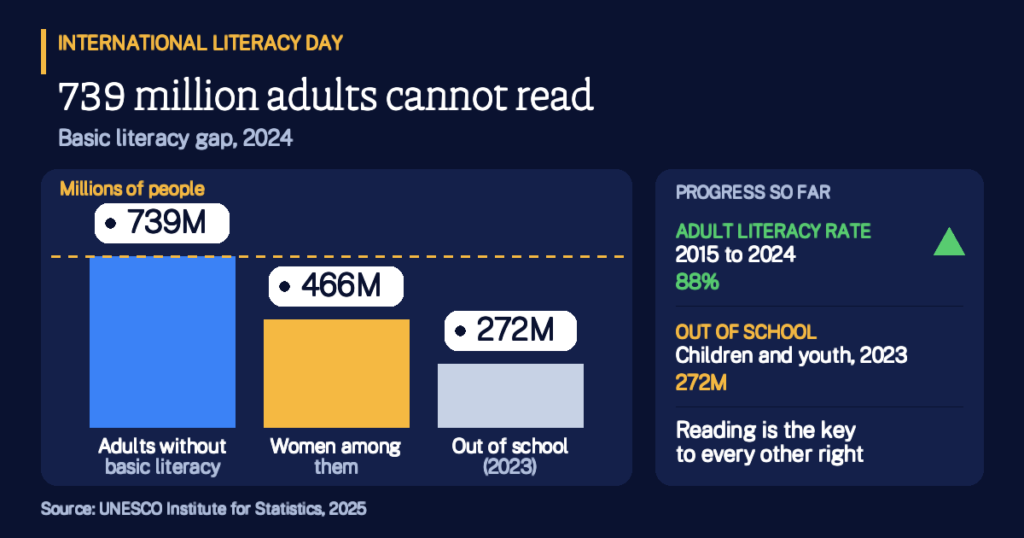
According to UIS data released in September 2025, 739 million adults worldwide lacked basic literacy skills in 2024, down from 754 million in 2023. UNESCO notes that part of that fall reflects revised population estimates and updated national data, not only new learners. Women made up nearly two thirds of the total, about 466 million. The global adult literacy rate rose from 86 percent in 2015 to 88 percent in 2024, and the youth literacy rate (ages 15 to 24) stood at 93 percent in 2024.
- 739 millionadults lacked basic literacy in 2024
- 466 millionof them were women, nearly two thirds
- 272 millionchildren, adolescents and youth out of school in 2023
- 93%global youth literacy rate in 2024
The problem is concentrated. UIS reports that nearly 77 percent of adults without basic literacy lived in two regions in 2024: sub-Saharan Africa (225 million) and Central and Southern Asia (347 million). Ten countries accounted for 441 million of the total.
Progress that is real but uneven
The good news is that literacy rates are rising nearly everywhere. The bad news is that population growth can outrun the gains. In sub-Saharan Africa, the adult literacy rate rose from 65 percent in 2015 to 69 percent in 2024, yet the number of adults without basic literacy grew from 196 million to 225 million over the same years, because the adult population grew faster than the rate improved. In Central and Southern Asia the rate climbed from 72 to 77 percent.
Example 2: why a rising rate can hide a rising count. Suppose a region has 100 adults, 65 of whom read, so 35 do not. Ten years later it has 130 adults and 90 read, a literacy rate of about 69 percent. The rate improved, yet 40 adults now cannot read, five more than before. The figures are round and invented, but they show why sub-Saharan Africa needs faster progress, not only steady progress.
Who is left behind
Illiteracy rarely falls evenly. Women carry the larger share, and the gap is widest among the old. UIS notes that in some sub-Saharan African countries only 31 percent of elderly women are literate, compared with 55 percent of elderly men. Schooling is the other main lever. UIS estimated that 272 million children, adolescents and youth were out of school in 2023, more than half of them in sub-Saharan Africa, and that 36 percent of school-aged children and youth in low-income countries were out of school, compared with 3 percent in high-income countries.
The pipeline problem begins early. The World Bank defines learning poverty as being unable to read and understand a simple text by age 10. In June 2022 it estimated that about 70 percent of 10-year-olds in low- and middle-income countries were in learning poverty, up from a revised 57 percent before the pandemic. That is an estimate for 2022 and the Bank has not been quoted here beyond that date. UIS also reported that only 58 percent of children worldwide reached minimum reading proficiency at the end of primary school in 2019. Adult literacy gaps of tomorrow are children who never learned to read today. The same link between schooling and reading is explored in International Day of Education.
How the day is marked
Literacy Day is a working day as much as a ceremony. UNESCO uses it to present its International Literacy Prizes, which in 2026 honored six programs. The UNESCO King Sejong Literacy Prize went to Escuelas LEO in Colombia, the Language Friendly School program in the Kingdom of the Netherlands, and Project PAL in Nigeria. The UNESCO Confucius Prize for Literacy went to an accelerated education program for displaced youth in Lebanon, the Chiapas Puede state literacy program in Mexico, and a program in Hat Yai, Thailand. In 2025 the focus on the digital era recognized that reading now includes screens, search results and information that must be judged for reliability.
Example 3: a village class. Imagine a village runs an evening class for 40 adults, two nights a week for six months. If 30 finish able to read a short notice and write their names and a simple message, three quarters have gained a basic skill. Each can now read a medicine label, help a child with homework and sign a document knowingly. The class size and results are round and illustrative, but they show why UNESCO pairs prizes with real programs rather than slogans.
Key Takeaways
- The day is 60 years old. UNESCO proclaimed it in 1966 and the first celebration was on September 8, 1967.
- 739 million adults lacked basic literacy in 2024. UIS data show about 466 million of them were women.
- The problem is concentrated. Nearly 77 percent live in sub-Saharan Africa and Central and Southern Asia.
- Rates are rising, counts are not always falling. Sub-Saharan Africa gained four points yet added about 29 million adults without basic literacy between 2015 and 2024.
- The child pipeline matters most. The World Bank estimated 70 percent of 10-year-olds in low- and middle-income countries were in learning poverty in 2022.
- Literacy is a basic yardstick, not a ceiling. Reading one simple sentence is the minimum, and modern life asks for more.
- You can act locally. Read with a child, support a local library or adult class, and share the day with someone who cares about schools.
How solid is this? Literacy counts come from UNESCO Institute for Statistics modeled estimates for 2024 and are revised with each data release, and learning poverty figures are World Bank estimates from 2022. The three worked examples use round, made-up numbers to show an idea. See also the International Days hub and the International Days Calendar.
More in Education