A school is meant to be the safest ordinary place in a child’s life. In war zones it is often neither safe nor ordinary. Classrooms are shelled, occupied by fighters, or emptied by fear, and teachers are threatened for doing their jobs. The International Day to Protect Education from Attack, observed every September 9, asks the world to treat this as a problem that can be solved. It follows the same logic as World Toilet Day: learning cannot happen unless the basic conditions for it are protected first.
From a declaration to a day
The day grew out of a decade of work by humanitarian agencies and researchers who documented attacks on schools and pressed governments to act. In May 2015, Norway hosted a conference in Oslo where the Safe Schools Declaration was opened for endorsement. It is a political commitment by states to protect education during armed conflict. Then, on May 28, 2020, the General Assembly adopted resolution 74/275 by consensus under a silence procedure and proclaimed September 9 as the day. The text was presented by Qatar, with 62 co-sponsors according to the UN Chronicle.
The resolution strongly condemns attacks on schools and the use of schools for military purposes when they breach international law. It reaffirms the right to education, invites governments, the UN, the private sector and civil society to observe the day, and invites UNESCO and UNICEF to facilitate it each year.
What counts as an attack on education
The term covers more than bombs. Researchers who track the issue count attacks on school buildings and universities, killings, injuries, abductions and arrests of students and teachers, and the use of schools by soldiers or armed groups as barracks, bases or detention sites. Each of these harms learning in its own way. A damaged building can be rebuilt. A teacher who flees may not return. A school used for military purposes can lose its protected civilian status and become a target.
The Global Coalition to Protect Education from Attack (GCPEA) publishes the main independent review, Education Under Attack. Its 2026 edition, the eighth in the series, covers 2024 and 2025 and profiles 28 countries.
The numbers behind the day
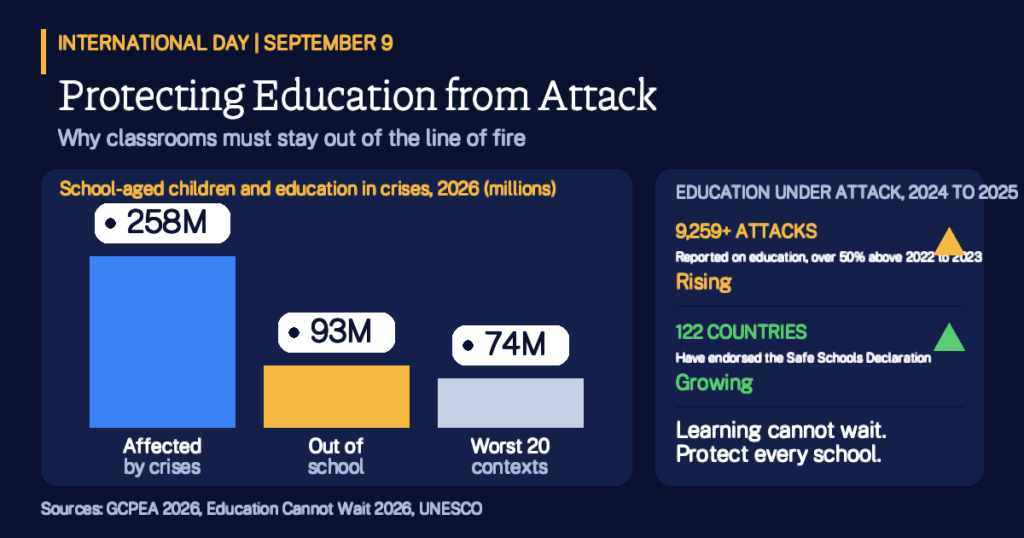
GCPEA reports at least 9,259 attacks on education across 2024 and 2025, more than a 50 percent increase over 2022 and 2023, including more than 3,600 attacks on schools. At least 10,600 students, teachers, professors and other education personnel were harmed, and over 7,000 were detained or arrested. Attacks were reported in 83 countries, and the highest incidence was in Colombia, the Democratic Republic of the Congo, Ethiopia, Haiti, Palestine and Ukraine. The report also found at least 1,200 attacks involving explosive weapons and at least 320 drone-related attacks.
The UN reports a similar direction. UNESCO notes that the UN verified 1,680 attacks on schools in 2025, a rise of 33 percent over 2024. The two counts differ because they use different methods and definitions, so they should be read as two views of one trend rather than added together.
Example 1: a district in conflict. Suppose a district has 40 schools and 6 of them are taken over by armed groups for part of a year. That is 15 percent of its schools. If each served 300 pupils, about 1,800 children lose their classrooms even if no one is hurt. The figures are round and illustrative, but they show how military use of schools spreads harm well beyond the people directly touched by violence.
Why it matters beyond the schoolyard
Education is a right, and the General Assembly resolution reaffirms it. It is also a protection. In a crisis, a school offers routine, adult supervision, and often meals and health services. When it closes, children lose all of these at once. The UN Chronicle noted in 2022 that children in conflict areas are twice as likely to be out of school.
Education Cannot Wait, the UN fund for education in emergencies, estimated in 2026 that 258 million school-aged children and adolescents have their education affected by crises, up by 21 million in 18 months. Of these, 93 million are entirely out of school. Attacks are not the only cause. Displacement, climate disasters and poverty play a part too. But each attack adds to a burden that is already heavy.
Who is left behind
Attacks do not fall evenly. The UN Chronicle reported that in 2020 and 2021 girls and women were targeted in 11 countries, and that more than 5,000 attacks and military-use cases harmed over 9,000 people in more than 85 countries. Teachers are at risk because they are visible, trusted figures in a community. Displaced children often lose years of schooling when they cross borders and cannot enroll. Students with disabilities depend most on specific buildings and trained staff, and they are the first to be shut out when either is lost.
Example 2: the cost of a gap. Imagine a girl whose school closes for two years during conflict. If her family cannot afford to send her back afterward, she may never recover those grades. Across a class of 50, even 10 such cases would remove a fifth of the class from the learning pipeline. The numbers are made up for illustration, and the pattern is the one aid agencies warn about: the longer the gap, the harder the return.
What protection looks like
The tools exist. The Safe Schools Declaration is now endorsed by 122 countries, according to GCPEA in 2026, up from 114 in 2022. Endorsing states commit to measures such as restraining the military use of schools and supporting the continuation of education during conflict. Security Council resolution 2601 in 2021 added weight at the highest level. Practical steps are modest and concrete: keeping soldiers out of classrooms, recording every attack so that it can be investigated, and getting children back to learning quickly after a shock.
Example 3: rebuild or protect. Say rebuilding 20 damaged schools costs $200,000 each, or $4 million. If agreements and monitoring prevented half of that damage, the saving would be $2 million, before counting the learning that would not be lost. The figures are illustrative, but the logic is why prevention is called the cheapest form of education aid.
The day itself is marked with events, statements and classroom activities led by UNESCO and UNICEF and joined by governments and civil society. The 2026 theme, “Can education survive attack? The resilience of human communities,” turns attention to how communities keep learning alive under pressure. Educators and families affected by violence can look to their education ministry, local child protection services and UN partners, and anyone in immediate danger should contact local emergency services.
Key Takeaways
- The day has a clear legal base. UN resolution 74/275 proclaimed September 9 in 2020, with UNESCO and UNICEF as facilitators.
- Attacks cover more than bombs. Killings, arrests, abductions and military use of schools all count.
- The trend is upward. GCPEA counts at least 9,259 attacks in 2024 and 2025, more than 50 percent above 2022 and 2023.
- People pay the highest price. At least 10,600 students and educators were harmed, and over 7,000 were detained or arrested.
- Crises already keep millions out. An estimated 93 million children are entirely out of school in crisis settings.
- Protection is practical. 122 countries have endorsed the Safe Schools Declaration, and keeping soldiers out of schools is a concrete step.
- Counting helps. Reliable records of attacks make accountability and prevention possible.
How solid is this? Attack counts come from GCPEA and the UN, which use different methods, and GCPEA totals have been updated since first publication, so figures may be revised. Crisis estimates from Education Cannot Wait are modeled. The three worked examples use round, made-up numbers to show an idea. See also the International Days hub and the International Days Calendar.
More in Education
- UN Press, General Assembly proclaims 9 September International Day to Protect Education from Attack (GA/12246, 2020)
- UNESCO, International Day to Protect Education from Attack
- GCPEA, Education Under Attack 2026
- GCPEA, Steep increase in violent attacks on education globally (2026)
- Education Cannot Wait, new global estimates (2026)
- UN Chronicle, Let’s Recommit to Protecting Students, Educators and Schools from Attack (2022)