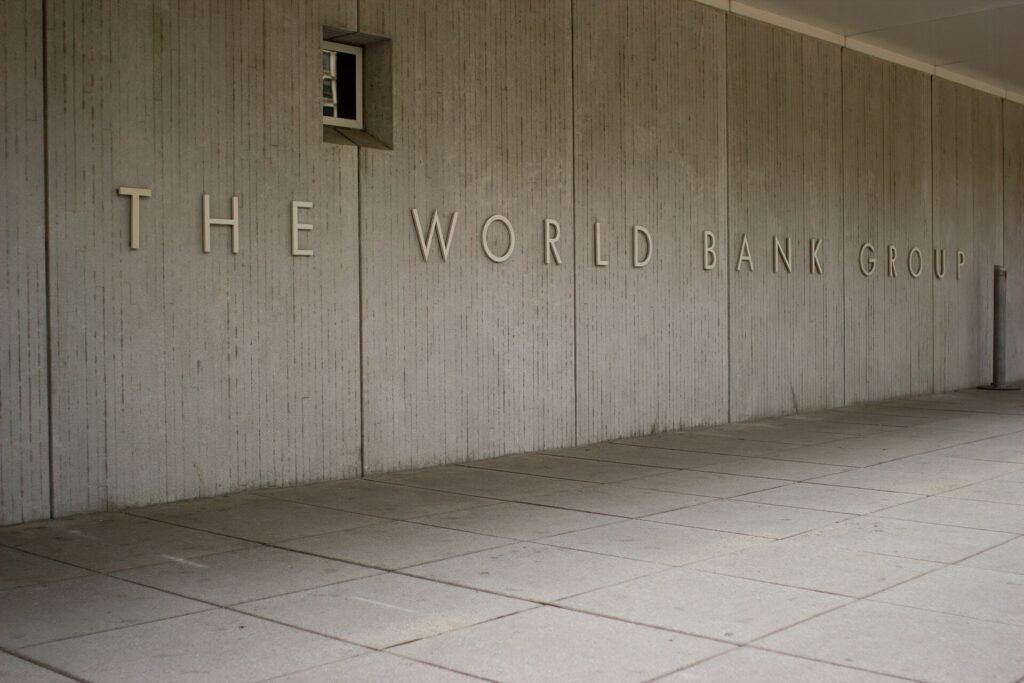
The World Bank is an international financial institution that lends money, gives grants and offers policy advice to governments of developing countries to reduce poverty and support economic development. It was created at the Bretton Woods conference in July 1944 as the International Bank for Reconstruction and Development, and as of 2026 it has 189 member countries. Its stated mission is a world free of poverty on a livable planet.
History of the World Bank
The World Bank grew out of the United Nations Monetary and Financial Conference, held at the Mount Washington Hotel in Bretton Woods, New Hampshire, in July 1944. Delegates from 44 countries met one year before the end of World War II to design a framework for postwar economic cooperation and reconstruction.
The conference produced two institutions, the International Monetary Fund and the International Bank for Reconstruction and Development. Most of the time at Bretton Woods went to the monetary side, and the work on the bank came in the last few days. Its articles of agreement, drafted mainly by the British economist John Maynard Keynes, called for rebuilding war-torn economies and raising development in poorer countries.
The bank’s first loan went to France, and other European loans followed. When the Marshall Plan took over European reconstruction in 1947, the bank shifted toward infrastructure projects around the world in power, irrigation and transportation. Its first loan to a non-European country was $13.5 million to Chile in 1948, for hydroelectric power.
Affiliates were added as needs changed. The International Finance Corporation, created in 1956, focuses on the private sector, and the International Development Association, created in 1960, provides resources to members that are less creditworthy. The Multilateral Investment Guarantee Agency followed in 1988 to offer political risk insurance and credit enhancement to investors and lenders.
Structure and membership
The bank reports 189 member countries. Its Board of Directors has 25 Executive Directors who work full time at the institution, and each is supported by an alternate. The board sets the institution’s vision, and its specialized committees review projects and oversee areas such as audits, budgets and ethics.
The wider World Bank Group combines the original bank with the International Finance Corporation, the International Development Association and the Multilateral Investment Guarantee Agency. The group says it works in 130 countries, and it describes its experts as a mix of local and global specialists.
What the World Bank does
Financing is the core activity. The bank has funded more than 15,000 development projects through traditional loans, interest-free credits and grants. Its public project database covers current and historical lending from 1947 to today, so anyone can look up what was financed in a given country or sector.
Money is only part of the offer. The bank also provides policy advice, research, analysis and technical assistance, and it says its analytical work often guides its financing and informs the investments countries make. It publishes flagship reports such as the World Development Report and Global Economic Prospects, and it runs a free and open collection of global development data.
Its priorities include jobs, agriculture and digital development. Projects range from schools and rural electricity to digital services in countries affected by fragility and conflict. Because the bank works alongside the United Nations, its goals have been tied to the Millennium Development Goals in 2000 and to the Sustainable Development Goals adopted in 2015.
How the World Bank’s mission has changed
The bank’s focus has shifted several times. By the 1970s, more than 40 percent of people in developing countries lived in absolute poverty. President Robert McNamara used the term in his 1973 Annual Meeting speech and set out the twin goals of accelerating economic growth and reducing poverty.
Lending to member countries grew twelve-fold between 1968 and 1981 and expanded into the environment, rural development, water, sanitation and education. The first environmental loan, in 1971, supported pollution control in Brazil, and the bank hired anthropologists, sociologists and environmental scientists alongside its economists.
The 1980s and 1990s brought oil shocks, debt crises and the breakup of the Soviet Union. Many newly independent states joined the bank, and in 1996 the Heavily Indebted Poor Countries initiative was approved to help poor nations focus on development. In the 2000s the bank began to describe itself as a knowledge institution, and by 2010 its Open Agenda pushed it toward greater transparency.
Financing tools and funding
The bank’s what-we-do page lists several financing and advisory tools, including loans, credits and grants, a treasury function, trust funds and programs, a crisis preparedness and response toolkit and a Private Sector Investment Lab. A credit in this context is a loan on interest-free terms, which is why the bank separates it from a traditional loan.
The institutions inside the group split the work. The International Development Association gives resources to less creditworthy members, while the International Finance Corporation lends exclusively to the private sector. This division lets the group serve both governments and companies within the same development effort.
Criticism and debate
The bank’s own history records two long-running debates. Structural adjustment loans of the 1980s and early 1990s carried policy conditions such as fiscal discipline, tax reform and liberalization of foreign direct investment. They were meant to improve the policy setting for lending, but their overall effectiveness was debated both inside the bank and among its client countries.
Corruption raised a second concern. President James Wolfensohn gave a speech on the “cancer of corruption” at the 1996 annual meetings, and the bank adopted an anti-corruption strategy that placed more weight on country accountability and ownership of development work.
Legacy and impact
The institution that began as a reconstruction lender for postwar Europe is now a development agency with a global reach. Its largest effect may be the model it set for pairing finance with advice, data and research, which many regional development banks and national agencies now follow. Its project records, open data and flagship reports also give researchers a long, public record of how development priorities have shifted since 1947.
More in Economics
Key facts
- The World Bank was formed at the July 1944 Bretton Woods conference, attended by delegates from 44 countries.1
- It has 189 member countries and a Board of Directors with 25 Executive Directors.2
- Its first loan went to France, and its first loan to a non-European country was $13.5 million to Chile in 1948.1
- The International Finance Corporation was created in 1956 and the International Development Association in 1960.1
- It has funded more than 15,000 projects through loans, interest-free credits and grants.3
Related concepts
In the news
Quick checkWhen and where was the World Bank created?Show answer
It was created at the Bretton Woods conference in New Hampshire in July 1944, alongside the International Monetary Fund, as the International Bank for Reconstruction and Development.
Sources
- World Bank, History, https://www.worldbank.org/en/about/history
- World Bank, Boards of Directors, https://www.worldbank.org/en/about/leadership/directors
- World Bank, What We Do, https://www.worldbank.org/en/about/what-we-do
- World Bank, Who We Are, https://www.worldbank.org/en/who-we-are
Editorially reviewed by Specialty Digest Editorial TeamLast reviewed November 4, 2026Researched and drafted with AI assistanceReport an issue