Democracy rarely makes headlines on the days it works. People vote, courts rule, newspapers publish, and life goes on. It is when those habits weaken that the value of the system becomes plain. The International Day of Democracy, observed every year on September 15, invites the world to look closely at the machinery that lets ordinary people have a say in how they are governed, and to ask who still does not. It sits naturally beside Human Rights Day, because the freedoms to speak, assemble and vote are the working parts of a democratic society.
A vote at the General Assembly
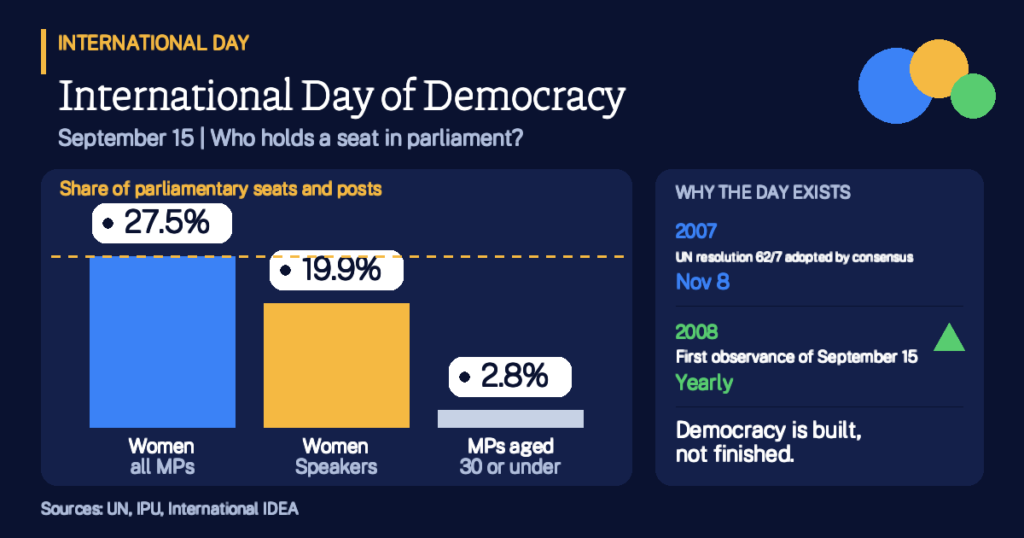
The day has a precise origin. On November 8, 2007, the United Nations General Assembly adopted resolution 62/7 by consensus. Its title is long, “Support by the United Nations system of the efforts of Governments to promote and consolidate new or restored democracies,” and the decision about the day sits inside it. The resolution welcomes the proposal for an international day and decides, with effect from the Assembly’s sixty-second session, to observe September 15 of each year as the International Day of Democracy.
It invites Member States, UN bodies, regional organizations, non-governmental organizations and individuals to mark the day in a way that raises public awareness. It also asks states to give parliamentarians and civil society groups a real chance to take part. The first observance followed in 2008. The Inter-Parliamentary Union (IPU), the global organization of national parliaments, encourages its member parliaments to mark the day and says hundreds of parliamentary events have been held since it began.
What democracy means in practice
Democracy is more than an election day. It is a way of making shared decisions in which people have a real voice, can change their leaders peacefully and are protected by rules that apply to everyone. Elections are the most visible part, but they rest on supporting pieces: a free press that can report without fear, courts that can say no to those in power, a parliament that can question the government, and a civil society free to organize. Take away enough of them and an election can shrink into a formality.
Note the resolution’s own wording, “new or restored democracies.” It treats democracy as something that is built, and sometimes rebuilt, rather than finished once and for all. That is why the day is framed as a chance to raise awareness and not as a victory lap.
Example 1: the winning side. In a town of 10,000 voters, a measure passes by 5,200 votes to 4,800. In a democracy the majority decides, but the 4,800 keep their rights to speak, to organize and to try to win next time. Without that protection, majority rule turns into rule by whoever happens to be ahead. The numbers are round and illustrative.
The numbers: how democracy is faring
Measuring democracy is hard, and no single number settles it. One widely used yardstick is the Global State of Democracy report from International IDEA, an intergovernmental organization that supports democracy worldwide. Its 2025 edition compared 2024 with 2019. It found that 94 countries, 54 percent of those assessed, declined in at least one key factor of democratic performance, while 55 countries, 32 percent, advanced in at least one.
The decline was widest for Freedom of the Press, which fell in 43 countries, or 24.9 percent, the broadest decline since 1975 according to the report. IDEA also found that Representation fell to its lowest level since 2001 during 2024, a year packed with elections. These are IDEA’s assessments, built on its own indicators, and other organizations use different methods and reach somewhat different results.
Whose voice is still missing
A democracy is only as representative as the people who sit in its chambers. IPU data show that as of January 1, 2026, women hold 27.5 percent of national parliamentary seats worldwide, up from 27.2 percent a year earlier. The IPU describes the 0.3 point gain as the slowest growth since 2017 for the second consecutive year. Women hold 19.9 percent of Speaker posts, which is 54 Speakers, down from 23.7 percent a year earlier.
Young people are scarcer still. In the IPU’s 2025 data covering 210 chambers, members aged 30 or under make up 2.8 percent of all MPs, unchanged from 2023 and the first time since 2014 that progress has halted. In 37.1 percent of chambers there is no MP aged 30 or under, and women in that age group hold 1.2 percent of seats. MPs aged 40 or under account for 19.2 percent.
- 27.5%of parliamentary seats held by women, January 2026
- 2.8%of MPs aged 30 or under, 2025 data
- 37.1%of chambers with no MP aged 30 or under
- 1,000+initiatives funded by the UN Democracy Fund over more than 20 years
Why does the makeup of a legislature matter? Lawmakers decide on schools, pensions, jobs and climate policy, and their choices can last for decades. When large groups are absent from the room, their experience and priorities are easier to overlook. The resolution itself asks states to give parliamentarians and civil society organizations an opportunity to contribute to the day.
Example 2: a 200-seat parliament. If a legislature of 200 seats matched the world averages above, about 55 members would be women and about 6 would be aged 30 or under. A chamber that looked like the whole population by age would look quite different. The seat counts are rounded and illustrative.
Beyond the ballot: citizens’ assemblies
Democracy is also being practiced in newer ways. For 2026, the UN Democracy Fund (UNDEF), working with the UN Office for Partnerships, is hosting an event titled “Raising Hands and Voices” on September 15 at UN Headquarters in New York, with a live webcast. It focuses on deliberative democracy and citizens’ assemblies. UNDEF is marking more than 20 years of work and says it has funded more than one thousand initiatives. The UN’s page for the day carries the headline “When every voice counts, democracy delivers.”
Deliberative democracy adds a step between opinion and decision. Instead of simply voting, a group of ordinary people learns about an issue from experts, discusses it with one another, and then makes recommendations. The goal is judgment that has time to mature, with voices that a campaign might never reach.
Example 3: a town assembly. A town sends 1,000 invitations at random, and 100 residents say yes. Organizers then choose 40 of them so the group mirrors the town by age and gender. Over several weekends the 40 hear from experts and debate a new bus route. They recommend one option and explain why. The numbers are round and illustrative.
How the day is marked, and how you can take part
The IPU says its member parliaments have marked the day with photo competitions, children’s workshops, televised debates, radio phone-in programs and meetings with civil society organizations. Schools, libraries and community groups can do much the same on a smaller scale.
Individuals have easy options too. You can check that you are registered where registration is required, attend a local council or school board meeting, read news from more than one outlet, or ask a candidate a question. Democracies also depend on honest public service, which is the theme of International Anti-Corruption Day, and on ordinary people taking part between elections as well as on voting day.
Key Takeaways
- The day has a clear legal basis. The General Assembly adopted resolution 62/7 by consensus on November 8, 2007, and September 15 has been observed since 2008.
- Democracy is more than voting. A free press, independent courts, working parliaments and an active civil society make elections meaningful.
- It is built, not finished. The resolution speaks of new or restored democracies because the work of consolidating democracy never ends.
- Measured trends are mixed. International IDEA found declines in at least one factor in 94 countries and gains in 55 between 2019 and 2024.
- Parliaments do not yet mirror people. Women hold 27.5 percent of seats and MPs aged 30 or under hold 2.8 percent.
- New forms of participation are growing. Citizens’ assemblies, the focus of the 2026 UN event, give ordinary people time to deliberate.
- You can take part year round. Attend a meeting, check your registration, read widely and ask questions.
How solid is this? The origin of the day comes from the text of resolution 62/7. Parliamentary figures are from the IPU’s 2026 releases, and the youth data cover 2025. Democracy indicators are IDEA’s own assessments for 2024 compared with 2019, and other indexes differ. The three worked examples use round, made-up numbers to show an idea. See also the International Days hub and the International Days Calendar.
More in Society
- United Nations, International Day of Democracy
- UN General Assembly, resolution A/RES/62/7 (2007)
- UN News, UN declares 15 September as International Day of Democracy (2007)
- Inter-Parliamentary Union, International Day of Democracy
- IPU, Women’s representation in parliament sees sluggish gains (2026)
- IPU, Youth representation in parliament flatlines (2026)
- International IDEA, The Global State of Democracy 2025