Most environmental stories end with a warning. This one ends with a repair. In the 1980s, scientists showed that everyday chemicals in refrigerators, spray cans and foam were thinning the thin gas shield that protects life from the Sun’s harshest rays. The world responded with a treaty, and the treaty worked. The International Day for the Preservation of the Ozone Layer, observed every year on September 16, celebrates that rare outcome and reminds us what it took. It pairs naturally with World Environment Day, since both days ask how people can live within the limits of the planet.
From a discovery to a treaty
The story runs through three agreements. The Vienna Convention for the protection of the ozone layer was adopted and signed by 28 countries on March 22, 1985. In September 1987 the Montreal Protocol followed, with binding limits on the chemicals responsible. In 1994 the United Nations General Assembly, in resolution 49/114, proclaimed September 16 as the International Day for the Preservation of the Ozone Layer, the date on which the Montreal Protocol was signed in 1987.
Two later milestones stand out. On September 16, 2009, the Vienna Convention and the Montreal Protocol became the first treaties in United Nations history to achieve universal ratification. And on October 15, 2016, at their 28th Meeting in Kigali, Rwanda, the parties agreed to phase down hydrofluorocarbons (HFCs), potent greenhouse gases that had replaced older chemicals. That agreement is the Kigali Amendment.
What the ozone layer does
Ozone is a gas made of three oxygen atoms. High in the stratosphere, it forms a thin veil that absorbs much of the Sun’s harmful ultraviolet (UV) radiation before it reaches the ground. Without it, exposure would rise for people, crops and ocean life. The chemicals that attack it are called ozone-depleting substances, or ODSs. Once released, chlorine and bromine from these compounds travel upward and destroy ozone molecules. Because the compounds last a long time, damage continues for decades after production stops.
Example 1: the slow bathtub. Imagine the stratosphere held 100 units of chlorine from these chemicals at the 1993 peak. By 2024 it would hold about 86. The tub is draining, but slowly, because the water leaves over decades. The units are round and illustrative, built from the 14 percent decline reported below.
The numbers behind the day
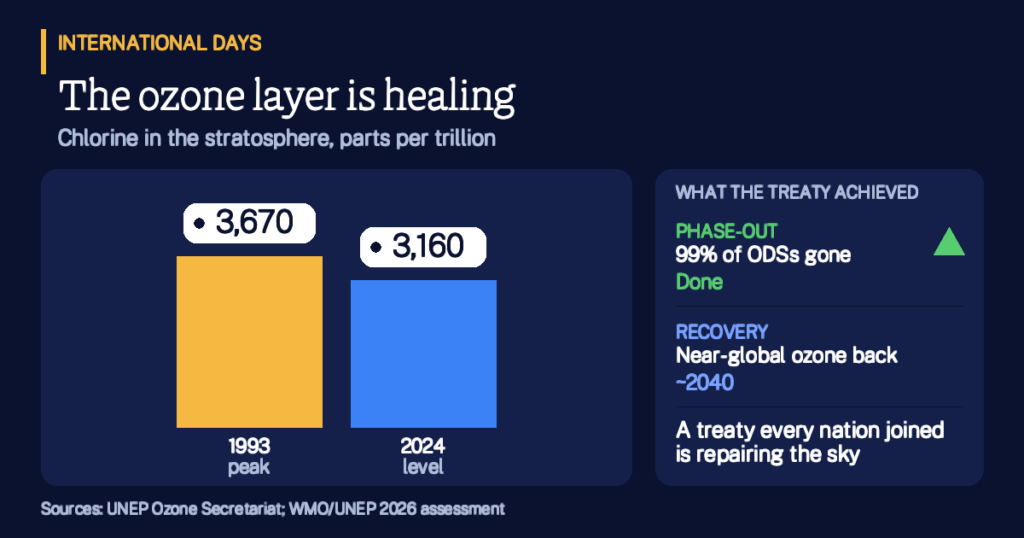
Implementation of the Montreal Protocol has phased out 99 percent of ODSs, which the Ozone Secretariat equates to roughly 1.8 million ozone depletion potential tonnes. Both the Vienna Convention and the Protocol have 198 parties. The 2026 Scientific Assessment of Ozone Depletion, published in October 2026, reports that total chlorine entering the stratosphere fell by about 14 percent from its 1993 peak, from 3,670 to 3,160 parts per trillion in 2024. Total bromine fell about 16 percent from its 1999 peak, from 22.0 to 18.4 parts per trillion. A combined measure of the two, called equivalent effective stratospheric chlorine, stood 18 percent below its 1998 mid-latitude peak in 2024.
- 198parties to the Vienna Convention and the Montreal Protocol
- 99%of ozone-depleting substances phased out
- 173parties to the Kigali Amendment, 172 states and the European Union
- 36.7 million tonspeak ozone mass deficit over Antarctica, September 29, 2025
A repair measured in decades
The Antarctic ozone hole is the most visible sign of the problem, and of progress. The WMO Ozone and UV Bulletin No. 4, issued in September 2026, reports that the depth and extent of the 2025 Antarctic ozone hole were significantly smaller than the 1990 to 2010 average, ranking as the fourth to fifth weakest since severe depletion was first observed in 1992. The maximum ozone mass deficit reached 36.7 million tons on September 29, 2025, more than 25 percent below the 1990 to 2010 mean of 50.1 million tons. Yearly results still swing with weather in the polar stratosphere, so scientists look at long trends rather than any single season.
The 2026 assessment projects that near-global ozone will return to 1980 values around 2040, and that Antarctic ozone will do so during the 2060s under a middle-of-the-road greenhouse gas scenario. The earlier 2022 assessment gave around 2066 for the Antarctic and around 2045 for the Arctic. Dates shift as models improve, which is why this article states them as projections, not promises.
Example 2: a lifetime view. A child born in 2026 will be about 14 when near-global ozone is projected to return to 1980 values, and in the middle of life, roughly 34 to 43, when Antarctic ozone is projected to do so. The ages are simple arithmetic on the projected years, and the point is that this repair is a gift to people now young.
Cooling, and why the Kigali Amendment matters
The 2026 theme, “Global action for a cooler planet,” celebrates 10 years of sustainable cooling under the Kigali Amendment. The reason is a twist in the story. Chemicals that replaced the ozone-damaging ones, the HFCs, spare the ozone layer but trap heat. Kigali, adopted in 2016 and in force since January 1, 2019, phases them down. The 2026 assessment cites avoided warming from the amendment of an additional 0.05 to 0.06 degrees Celsius by 2050 and up to 0.4 degrees Celsius by 2100. Earlier assessments gave slightly different ranges as scenarios were refined.
Cooling matters for health, food storage and comfort, especially in hot regions, so the challenge is to keep people cool without warming the planet further. The UNEP page for the day says the Protocol shows that science-based policy, universal participation, strong compliance, dedicated financing and effective partnerships can deliver real and measurable results.
Example 3: a cooling shop. Suppose a shop sells 1,000 air conditioners a year and 600 of them move to a low-warming refrigerant. Even without changing total sales, 60 percent of its yearly output now carries far less warming potential. The shop and its numbers are made up for illustration, but this is the kind of switch the amendment encourages.
Who is affected, and what you can do
Ozone protection touches everyone, but UV exposure matters most for people who work outdoors, children, and communities near the poles. The WMO bulletin notes that the global burden of UV-induced skin cancer rose significantly between 1990 and 2021, a reminder that UV protection remains important while the layer recovers. Seek shade at midday, wear a hat and sunglasses, and use sunscreen, especially when the UV index is high.
On the policy side, the day encourages governments, schools and communities to share what the treaty achieved. At home, you can ask technicians to recover refrigerants rather than vent them when servicing cooling equipment, and choose appliances with lower-warming refrigerants.
Key Takeaways
- Treaties can work. The Montreal Protocol has phased out 99 percent of ozone-depleting substances.
- The whole world joined. In 2009 the Vienna Convention and the Protocol became the first UN treaties to achieve universal ratification, and both now have 198 parties.
- The gases are falling. By 2024, chlorine was about 14 percent and bromine about 16 percent below their peaks.
- Recovery is slow. Near-global ozone is projected to return to 1980 values around 2040, and Antarctic ozone in the 2060s.
- The 2025 hole was among the weakest in decades. It ranked fourth to fifth weakest since 1992, though yearly results vary.
- Kigali links ozone and climate. The HFC phase-down adds avoided warming of up to 0.4 degrees Celsius by 2100.
- Protect your skin anyway. UV safety stays important while the layer heals.
How solid is this? Treaty dates and counts come from the UN and the UNEP Ozone Secretariat. Concentration figures are from the 2026 assessment executive summary and recovery dates are model projections that change between assessments. The three worked examples use round, made-up numbers to show an idea. See also the International Days hub and the International Days Calendar.
More in Nature
- United Nations, International Day for the Preservation of the Ozone Layer
- UNEP Ozone Secretariat, World Ozone Day 2026: Global action for a cooler planet
- UNEP Ozone Secretariat, Facts and Figures on Ozone Protection
- WMO/UNEP, Scientific Assessment of Ozone Depletion 2026, Executive Summary
- WMO, Ozone and UV Bulletin No. 4 (September 2026)
- NOAA CSL, Scientific Assessment of Ozone Depletion 2022, Executive Summary