A stroke rarely gives warning. One moment a person is talking, walking or reading, and the next, part of the brain has lost its blood supply and the clock is running. World Stroke Day, observed every October 29 and led by the World Stroke Organization, exists because that clock can sometimes be beaten. Many people do not know the signs, and every minute of delay can cost brain tissue. The day is also a reminder that stroke is largely preventable. It pairs naturally with World Diabetes Day, since high blood sugar is among the modifiable risk factors behind it.
A brain attack, in plain terms
A stroke happens when the blood supply to part of the brain is cut off, or when a vessel in the brain bursts. Brain cells need a constant flow of oxygen and nutrients, and without it they begin to die within minutes. When a clot or other blockage stops the flow, the event is called an ischemic stroke. When a vessel ruptures and bleeds in or around the brain, it is a hemorrhagic stroke. In both cases the damage depends on which part of the brain is affected and for how long. That is why the effects range from brief weakness to lasting loss of speech, movement or independence, and sometimes death.
Who leads the day, and this year’s message
World Stroke Day is led by the World Stroke Organization, an international body devoted to stroke, rather than by the United Nations. It belongs to the family of health awareness days that draw attention to a condition and what can be done about it. The 2026 campaign is titled “Every M1nute Counts,” with the tagline “Know the signs of stroke” and the hashtag #ActFAST. According to the organization, it focuses global attention on stroke symptom awareness and on seeking emergency medical care as soon as stroke is suspected.
- 2023Together we are #GreaterThan Stroke
- 2025#ActFAST campaign
- 2026Every M1nute Counts: know the signs of stroke
The numbers behind the day
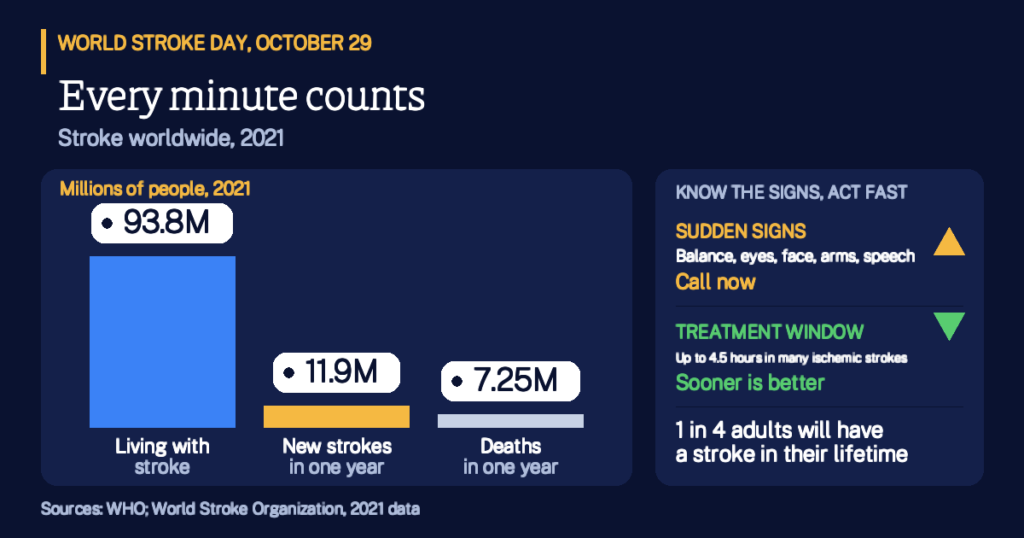
The scale is large. According to the World Health Organization (WHO), there were 11.9 million new cases of stroke in 2021, and stroke was the third leading cause of death and disability combined worldwide that year, with an estimated 93.8 million cases. The World Stroke Organization’s 2025 Global Stroke Fact Sheet, which draws on the Global Burden of Disease study for 2021, reports about 7.25 million deaths from stroke in the same year.
The risk over a lifetime has grown. WHO says the lifetime risk of stroke has increased by 50 percent over the past 20 years, with 1 in 4 adults predicted to have a stroke in their lifetime. The World Stroke Organization’s fact sheet states the same figure for people above age 25.
- 11.9 millionnew strokes worldwide in 2021
- 7.25 milliondeaths from stroke in 2021
- 93.8 millionpeople with stroke cases counted in 2021
- 1 in 4adults predicted to have a stroke in their lifetime
Example 1: what 1 in 4 looks like. Picture a town of 400 adults. If the 1 in 4 figure held exactly, about 100 of them would have a stroke at some point in their lives. The numbers are round and illustrative, but they show why even a small community is likely to know several families touched by stroke.
Know the signs, then act at once
WHO lists the warning signs as sudden changes in five areas: balance, eyes, face, arms and speech. Their first letters spell BE-FAST, a common memory aid. What links them is suddenness, and any one of them is reason enough to call for help.
Speed matters because treatment is time-limited. The World Stroke Organization explains that a clot-dissolving drug can be given up to 4.5 hours after symptom onset in many patients with ischemic stroke, that the earlier it is given the greater the effect, and that it can increase the chance of a good outcome by 30 percent. WHO says this treatment, called thrombolysis, should be carried out as soon as possible, within hours of symptom onset. It adds that thrombectomy, the physical removal of a clot, may be indicated depending on the severity and location of the stroke.
Example 2: the clock on a morning. Suppose symptoms begin at 8:00. A relative notices at 8:30 and calls an ambulance at 8:40. The patient reaches the hospital at 9:20 and is scanned by 9:50, so a decision on treatment is made around 10:30, two and a half hours after onset. Now suppose the family waits to see if it passes and arrives at 1:30 in the afternoon, five and a half hours after onset. The times are made up for illustration, but the first case is inside the 4.5-hour window for many patients and the second is not.
Who bears the burden, and what can be prevented
The burden falls unevenly. The 2025 fact sheet reports that low-income and low-middle-income countries (LMICs) accounted for 87.2 percent of stroke deaths in 2021, and 89.4 percent of the healthy years of life lost to stroke. Emergency transport, brain scanners and stroke units are harder to reach in many such settings, which is one reason the 2026 resolution described below puts so much weight on health system readiness.
The encouraging news is that much stroke can be prevented. WHO says most of the stroke burden is attributable to 10 modifiable risk factors: high blood pressure, air pollution, smoking, high LDL cholesterol, a high-sodium diet, high fasting blood glucose, kidney dysfunction, excess body weight, physical inactivity and harmful alcohol use. The World Stroke Organization’s fact sheet estimates that 84 percent of the 2021 stroke burden was attributable to 23 modifiable risk factors.
What governments agreed in 2026
On May 23, 2026, the World Health Assembly adopted resolution WHA79.10, “Reducing the burden of stroke: strengthening prevention, acute care, rehabilitation and health system readiness.” It urges member states to treat stroke as a major public health concern in their national plans and to strengthen emergency systems. That includes defining stroke-ready facilities with minimum standards for imaging, laboratories, trained staff and thrombolysis capacity. It also calls for scaling up acute treatment, including thrombolysis and thrombectomy, funding stroke units and rehabilitation, and building national stroke registries and surveillance. The resolution asks the WHO Director-General to develop guidance and tools, monitor stroke globally and report progress to the Assembly.
Example 3: a region gets stroke-ready. Imagine a region with 20 hospitals, only 5 of which have scanners, trained staff and the drugs needed to treat stroke. A stroke-ready plan would teach ambulance crews to recognize stroke and take patients straight to those 5, and would then work to bring more hospitals up to the same standard. The numbers are invented for illustration, but the idea matches what the resolution describes: pathways that carry the right patient to the right door quickly.
How the day is marked
On October 29, hospitals, patient groups and local organizations hold awareness events, and the World Stroke Organization lists many of them on its website. Individuals can mark the day simply: learn the signs, share them with family, and check blood pressure, which WHO lists first among modifiable risk factors. The most useful habit is also the simplest. If you or someone near you shows sudden signs of stroke, call emergency services right away instead of waiting.
Key Takeaways
- Stroke is common and deadly. WHO counted 11.9 million new strokes in 2021, and the World Stroke Organization reports about 7.25 million deaths.
- Know the sudden signs. Trouble with balance, eyes, face, arms or speech is a reason to call for help.
- Time is brain. A clot-dissolving drug can be given up to 4.5 hours after onset in many patients, and sooner is better.
- Prevention works. About 84 percent of the 2021 burden was linked to modifiable risk factors such as blood pressure, smoking and diet.
- The burden is uneven. Low-income and low-middle-income countries had 87.2 percent of stroke deaths in 2021.
- Governments have committed. Resolution WHA79.10 of May 2026 urges stronger prevention, emergency care and rehabilitation.
How solid is this? The figures are modeled estimates from the Global Burden of Disease study for 2021, reported by WHO and the World Stroke Organization, and they are revised as new data arrive. The campaign theme comes from the World Stroke Organization, and the resolution details come from the text adopted by the World Health Assembly. The three worked examples use round, made-up numbers to show an idea. This article is general information, not medical advice. See also the International Days hub and the International Days Calendar.
More in Health
- World Health Organization, Stroke fact sheet (December 19, 2025)
- World Health Assembly, Resolution WHA79.10: Reducing the burden of stroke (May 23, 2026)
- Feigin V. et al., World Stroke Organization: Global Stroke Fact Sheet 2025, International Journal of Stroke 2025;20(2):132-144
- World Stroke Organization, World Stroke Day 2026
- World Stroke Organization, World Stroke Day 2026: Every M1nute Counts #ActFAST
- World Stroke Organization, What is thrombolysis?