Lead is one of the oldest metals people have worked with, and one of the few that the body has no use for at any dose. It cannot be seen in a glass of water or a coat of paint, and the damage it does is quiet: a child who struggles to concentrate, an adult whose heart is slowly strained. International Lead Poisoning Prevention Week of Action is the world’s yearly attempt to make the invisible visible. Held every October and coordinated by the World Health Organization (WHO) and the United Nations Environment Programme (UNEP), it asks a simple thing of governments: find where lead enters daily life and shut the door.
What the week is, and where it comes from
This is a week of action, not a General Assembly day with a fixed calendar date. It is organized under the Global Alliance to Eliminate Lead Paint, which WHO describes as led by WHO and UNEP since 2011, and WHO describes the week as an initiative of that alliance. The week takes place every year in October. WHO listed 2025 as October 19 to 25 and 2026 as October 18 to 24, so readers should treat the exact dates as a rule (a week in October) and not a fixed day.
The week has three stated aims: to raise awareness of the health effects of lead exposure, to highlight global efforts to prevent exposure, particularly in children, and to urge countries to eliminate lead paint through regulation. Its weight grew on May 27, 2025, when the Seventy-eighth World Health Assembly adopted resolution WHA78.27, “Galvanizing global support for a lead-free future.” The resolution asks the WHO Director-General to develop a global action plan on lead mitigation, to be submitted to the Health Assembly in 2027, and it names the week as one of the communication campaigns WHO should strengthen.
Why there is no safe level
Lead is a toxic metal that enters the body by breathing in dust and fumes or by swallowing contaminated dust, soil, water or food. WHO’s position is blunt: there is no level of exposure to lead known to be without harmful effects, and no known safe blood lead concentration. Children are the most exposed to harm because their brains are still being built. Lead can permanently affect brain development and lower intelligence quotient (IQ), and WHO notes that even blood lead concentrations as low as 3.5 micrograms per deciliter (µg/dL) may be associated with decreased intelligence in children. In adults, the heavy toll is cardiovascular.
The 5 µg/dL figure appears often in this debate. It is not a safe limit. It is the level at which WHO’s 2021 clinical guidelines say the source of exposure should be identified and action taken to end it. WHO states that the harm from lead exposure is entirely preventable.
Example 1: what “1 in 3” looks like. Picture a district with 3,000 school-age children. If one in three had blood lead at or above 5 µg/dL, that would be about 1,000 children. The numbers are round and illustrative, but they show why testing comes first: without a test, no one knows which 1,000 children to help.
The numbers behind the week
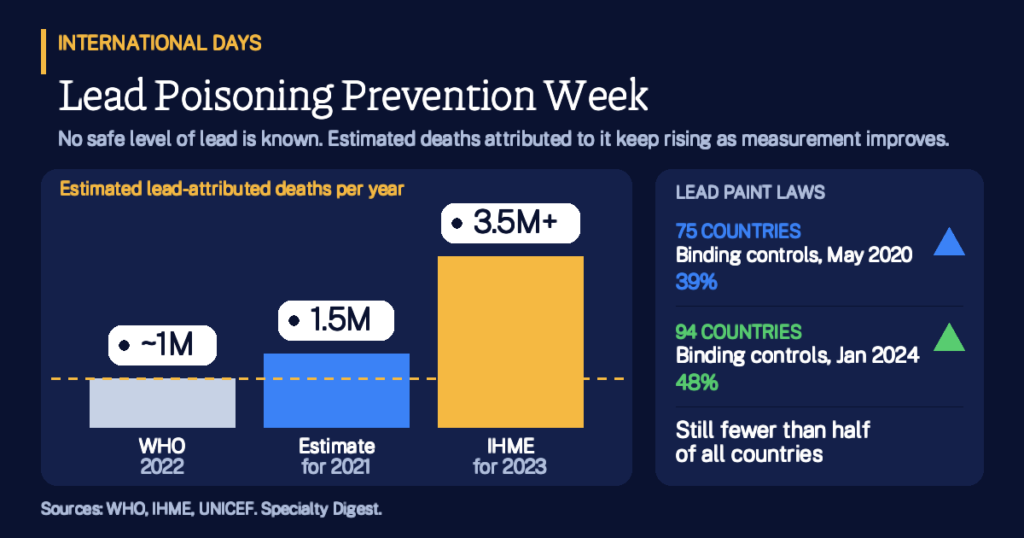
The size of the problem has been revised upward as measurement has improved. WHO said in 2022 that an estimated 1 million people die from lead poisoning each year. The World Health Assembly resolution cites an estimate of 1.5 million lead-associated deaths in 2021. WHO’s June 2026 fact sheet, drawing on the Institute for Health Metrics and Evaluation (IHME), now says lead exposure was attributed to more than 3.5 million deaths in 2023, primarily through cardiovascular effects, and more than 71.5 million years lost to disability (disability-adjusted life years, DALYs).
For children, the most cited count comes from a 2020 UNICEF and Pure Earth analysis, with IHME modeling: around 1 in 3 children, up to 800 million worldwide, had blood lead levels at or above 5 µg/dL. Nearly half of them lived in South Asia.
- 3.5 million+deaths attributed to lead, 2023 (IHME, WHO)
- 71.5 million+years lost to disability from lead, 2023
- 800 millionchildren at or above 5 µg/dL, up to, 2020 analysis
- 99%of affected children live in low- and middle-income countries
Where lead hides
WHO lists smelting, recycling and the stripping of leaded paint as sources of inhaled particles, and contaminated dust, soil, water or food as sources of swallowed lead. Products named include paint, solder, cosmetics, traditional medicines and toys, while lead pipes can contaminate drinking water, which links this week to World Water Day. The 2020 UNICEF analysis called the informal recycling of lead-acid batteries a leading contributor, with up to 50 percent of such batteries unsafely recycled in the informal economy.
Paint is the area where the clearest rule-making has happened. Lead in paint gives bright color and fast drying, and it flakes into household dust that young children swallow. The remedy is law. As of May 31, 2020, 75 countries had confirmed legally binding controls on lead paint, 39 percent of all countries. As of January 2024, that rose to 94 countries, or 48 percent. WHO’s latest assessment still shows fewer than half of countries covered.
Example 2: the repainted classroom. Suppose an old school is repainted over layers of leaded paint. Sanding creates fine dust on desks and floors, and young children touch surfaces and then their mouths. Wet cleaning and containing the dust costs far less than testing hundreds of children afterward. The scenario is illustrative.
Who is left behind
Lead’s burden is not spread evenly. The World Health Assembly resolution notes that 99 percent of affected children live in low- and middle-income countries. The 2020 UNICEF analysis put the lost lifetime economic potential in lower- and middle-income countries at almost $1 trillion, a modeled estimate that shows why finance ministers, not only health ministers, have a stake.
Example 3: the cost of waiting. Imagine a country spends $2 million a year on blood lead testing and paint enforcement, and 20,000 children avoid losing even a few IQ points. A lifetime of lower earnings across that many children would plainly exceed the price. The numbers are round and illustrative.
How the week is marked and what progress needs
During the week, health ministries, UN agencies, clinics and civil society groups publish guidance and press governments for lead paint laws. WHO’s recent themes show the arc: “Say no to lead poisoning” in 2022, “No Safe Level: act now to end lead exposure” in 2025, and “From Detection to Prevention” in 2026. In October 2026, WHO said countries had mandated it to develop a Global Action Plan on Lead Mitigation for the 2027 World Health Assembly, and that it would launch a PREVENT Technical Package on Lead Poisoning Prevention in 2027.
- 2022Say no to lead poisoning
- 2025No Safe Level: act now to end lead exposure
- 2026From Detection to Prevention
If you are worried about exposure in your home or community, a health professional or your local poison control or public health service can arrange a blood lead test and advise on removing the source.
Key Takeaways
- No safe level is known. WHO says no blood lead concentration is known to be safe, and effects on children’s IQ appear at very low levels.
- It is a week of action, not a fixed date. It runs every October, and WHO listed October 18 to 24 for 2026.
- The toll is large and the estimates are rising. IHME and WHO attribute more than 3.5 million deaths to lead in 2023.
- Children carry the heaviest load. A 2020 analysis estimated up to 800 million children at or above 5 µg/dL, nearly half in South Asia.
- Paint laws work, but coverage is partial. 94 countries, 48 percent, had binding controls as of January 2024.
- Testing leads to prevention. The 2026 theme, From Detection to Prevention, links finding exposure to stopping it.
- The next milestone is 2027. WHO plans a global action plan and a PREVENT package that year.
How solid is this? Death and DALY figures are modeled estimates from IHME as reported by WHO, and different years use different models, so they are not a trend. The 800 million children figure is a 2020 estimate. Dates for the week are listed by WHO and shift each year. The three worked examples use round, made-up numbers to show an idea. See also World Water Day, the International Days hub and the International Days Calendar.
More in Health
- WHO, Lead poisoning fact sheet (June 2026)
- WHO, International Lead Poisoning Prevention Week 2026
- WHO, Countries move to accelerate action against lead poisoning (October 15, 2026)
- World Health Assembly, Resolution WHA78.27 (2025)
- UNICEF, A third of the world’s children poisoned by lead (2020)
- WHO, Global progress toward eliminating lead paint (2020)
- WHO, Almost 1 million people die every year due to lead poisoning (2022)