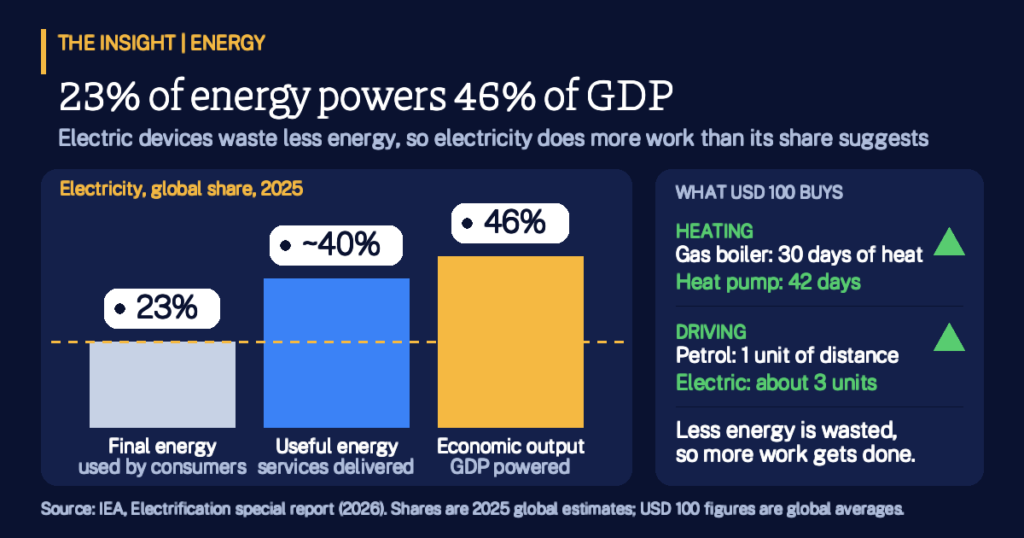
Electricity supplies only about 23 percent of the energy the world uses, according to the International Energy Agency (IEA). That electricity share of energy sounds small, yet it powers activities that make up nearly half of world economic output, measured as gross domestic product (GDP). The reason is not size but waste: electric devices lose much less energy before it does useful work.
How can 23 percent matter so much?
Energy can be counted at two points. Final energy is what reaches the user: fuel in a tank, gas in a pipe, power in a socket. Useful energy is what the user gets: movement, light, warmth. Electric devices convert more of their input into those services, so electricity’s share rises from 23 percent of final energy to nearly 40 percent of useful energy services. The IEA adds that it powers activities worth about 46 percent of GDP. Since 2019, electricity demand has grown more than twice as fast as overall energy use, driven by electric vehicles, heat pumps, air conditioning and data centres.
Electricity covers 23% of final energy but nearly 40% of useful energy services and about 46% of GDP. Source: IEA, Electrification special report and factsheet (2026), figures for 2025.
Where does the energy go?
Burning fuel turns much of its energy into waste heat. The IEA reports that around three quarters of the energy used in transport, mostly oil, is lost as waste. Electric technologies avoid much of this. An electric vehicle is two to four times more efficient than a petrol or diesel one. A heat pump moves heat instead of making it, and typically delivers three to five units of heat for each unit of electricity.
Example 1: one journey. Suppose a petrol car needs 100 units of fuel energy for a trip. An electric car making the same trip would need only 25 to 50 units of electricity. These round figures simply apply the IEA range of two to four times.
There is a catch. Power stations that burn fuel also lose heat, typically 50 to 65 percent of the fuel energy, and around 40 percent of all energy supply feeds electricity generation. So the full benefit depends on how the electricity is made.
Burning fuel wastes most of the energy it carries, while electric devices waste far less. Source: IEA, Electrification special report (2026). Power station loss is a typical range.
What does it mean for your costs?
Electricity usually costs more than other fuels for each unit of energy delivered, because grids are expensive to build. Efficiency changes the sum, as the IEA global averages show.
Example 2: driving. USD 100 of electricity moves a car about three times as far as USD 100 of petrol.
Example 3: heating. USD 100 of electricity for a heat pump gives about 42 days of heating. USD 100 of fuel in a gas boiler gives 30 days.
USD 100 of electricity delivers more heating and driving than USD 100 of fuel. Source: IEA, Electrification special report (2026), global averages.
How solid is this? The shares are IEA estimates for 2025, and its reports differ slightly: 23 percent of final energy in the Electrification report, 21 percent in Electricity 2026, because methods differ. Cost comparisons are global averages and vary by country. Example 1 uses round, illustrative figures.
Key Takeaways
Compare services, not units. A small share of energy can do a large share of the work.
Ask what each unit delivers. The fuel that is cheaper per unit is not always cheaper per journey or warm day.
Check how power is made. The benefit depends on generation as well as on the device.
Read statistics by definition. Final energy, useful energy and GDP tell different stories, and estimates differ slightly between reports.
Test local prices. Global averages are a guide; your own tariffs and climate decide your result.