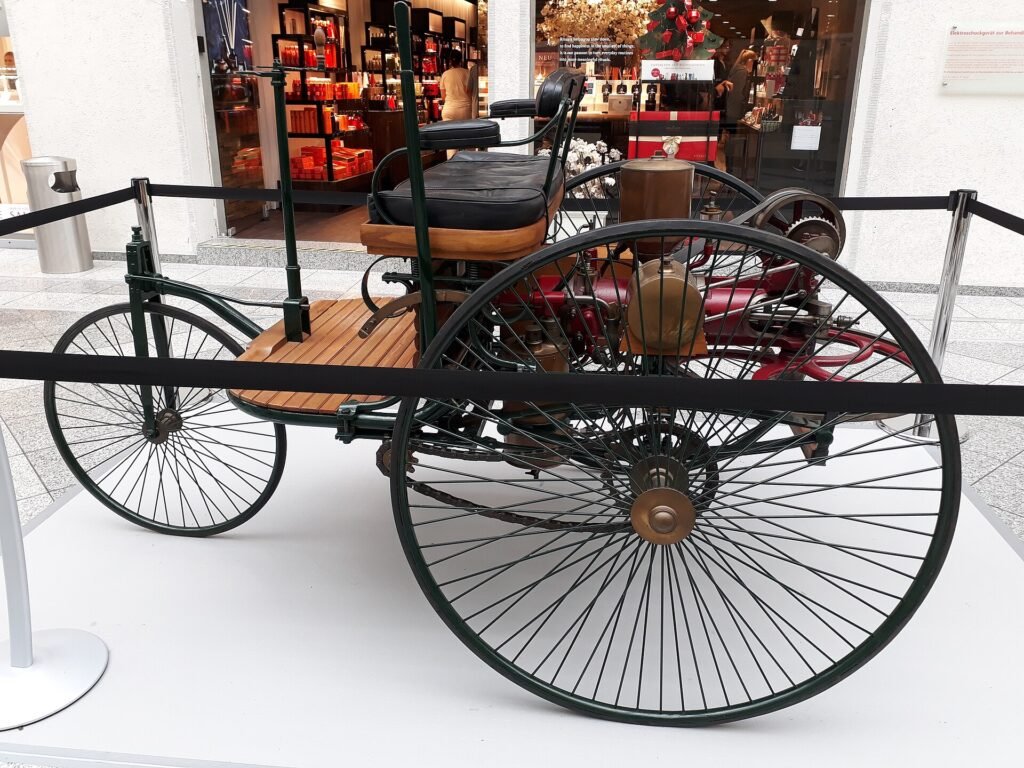
An automobile, or car, is a self-propelled road vehicle designed to carry people, usually with four wheels and its own engine or motor. The Benz Patent-Motorwagen, patented by Karl Benz in 1886, is widely recognized as the first practical automobile, and Henry Ford’s moving assembly line later made cars affordable to millions.
History of the automobile
Karl Benz built his first stationary engine in 1880 and, after a troubled few years in business partnerships, formed Benz and Cie in Mannheim, supported by his wife Bertha and financed by Max Rose and Friedrich Esslinger. Sales of his stationary engines gave him the time to develop a light engine for horseless carriages.
He applied for a German patent on 29 January 1886, and it was granted on 2 November 1886. The Motorwagen was a lightly built three-wheeled vehicle with a single-cylinder petrol engine, and it has electric ignition. Bertha Benz’s long-distance trip in 1888 showed that it worked on the road, and in 1889 Emile Roger of Paris became the first Benz sales agent.
Sixty miles away in Bad Cannstatt, two former employees of the Deutz engine company, Gottlieb Daimler and Wilhelm Maybach, were working on the four-wheeled Daimler Motorwagen, which was also patented in 1886. The two firms later merged into Daimler-Benz in 1926.
The museum calls the January 1886 patent application the birth certificate of the automobile, and it keeps a working replica of the Motorwagen at Beaulieu in England.
Henry Ford brought mass production. From 1908 to 1927 the Ford Motor Company built over 15 million Model T cars, and the price fell from 850 dollars to as little as 260 dollars. The moving assembly line introduced in 1913 began crudely, with workers pushing or pulling cars from station to station, and was soon replaced by chain-driven delivery.
To keep Model T production in step with demand, Ford engineers borrowed ideas from other industries. Sometime in 1913 they realized that the disassembly line used in slaughterhouses could be adapted to build automobiles on a moving line.
By early 1914 the separate production lines had been fused into three continuous lines able to produce a finished Model T every 93 minutes, compared with 12.5 hours under the older stationary method.
Who invented the automobile?
Credit is usually given to Benz, but the answer depends on the definition. A petrol internal combustion engine was nothing new in 1886, as the National Motor Museum notes. Benz was the first person to successfully match the technology to a road vehicle, and his machine was the first car to go into series production and be sold commercially.
Daimler and Maybach developed a rival vehicle at the same time, and self-propelled steam vehicles had been tried on roads much earlier. The idea of the car had several roots, and what Benz offered was a practical, patented combination.
How an automobile works
A conventional car burns fuel in an internal combustion engine, which turns a crankshaft. A transmission and drive shafts pass that rotation to the driven wheels, while steering, brakes and suspension control the vehicle on the road.
An electric car replaces the engine and fuel tank with a battery pack and one or more electric motors. It still needs the same wheels, steering, brakes and suspension, but its drive system has far fewer moving parts.
An electrical system supplies lighting, instruments and ignition. Benz’s design included electric ignition in 1886, a feature that still has a descendant in modern spark ignition.
Types of automobiles
Cars are grouped by power source and by body style. Petrol and diesel cars use internal combustion engines, while hybrid vehicles combine an engine with an electric motor, and electric vehicles run on batteries alone. Fuel cell cars make electricity from hydrogen on board.
Early in the 20th century, steam-powered and electric cars competed with petrol cars, and the petrol car came out ahead in most markets for the next hundred years.
Body styles include sedans, hatchbacks, station wagons, sport utility vehicles and pickups. A newer category, the autonomous vehicle, uses sensors and software to carry out some or all of the driving.
Impact of the automobile
Ford’s methods spread. The Henry Ford museum notes that productivity gains and price cuts led manufacturers of every type to adopt his production methods, and many of the same foundational methods are still used today.
Cars changed where people live and work. They encouraged suburbs and highways, created demand for fuel, repair and insurance services, and made personal travel on demand a normal expectation. Governments responded with road rules, licensing and safety and emissions standards.
The costs are real too. Road crashes remain a major cause of death and injury, and vehicles contribute to air pollution, noise and greenhouse gas emissions. These problems drive work on safer designs, cleaner fuels and public transport.
Automobiles today
The car is now a global industry with factories on every inhabited continent, and designs differ by market. Two trends dominate current development: electrification, which replaces fuel with batteries, and automation, which hands some driving tasks to software.
The basic layout of Benz’s machine, an engine or motor driving wheels under a driver’s control, remains recognizable more than a century and a third later.
FAQs about the automobile
What was the first car? The Benz Patent-Motorwagen of 1886 is generally recognized as the first practical automobile, though Daimler built a competing vehicle in the same year.
Who was Bertha Benz? She was Karl Benz’s wife and supporter, and her long-distance trip in 1888 helped show that the Motorwagen was viable.
Why was the Model T important? It was produced in large numbers on a moving assembly line, which lowered its price and made car ownership possible for many more people.
More in Transport
Key facts
- Array
Related concepts
In the news
Quick checkWho invented the automobile?Show answer
Karl Benz is usually credited for his 1886 patented Motorwagen, the first practical car, but Daimler and Maybach built a rival vehicle at the same time, and the answer depends on how a car is defined.
Sources
- Array
Editorially reviewed by Specialty Digest Editorial TeamLast reviewed November 4, 2026Researched and drafted with AI assistanceReport an issue