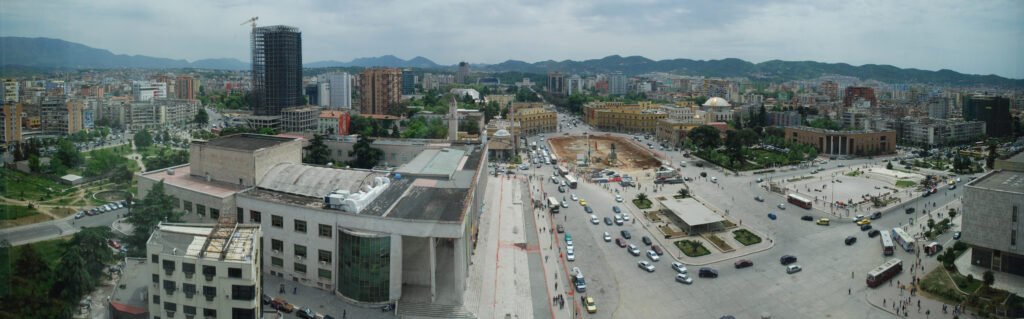
Albania is a country in Southeastern Europe on the Balkan Peninsula, bordered by Montenegro, Kosovo, North Macedonia and Greece, with a coastline along the Adriatic and Ionian Seas facing Italy. Its capital is Tirana. Once one of Europe’s most isolated states under a strict communist government, Albania has spent the past three decades opening its economy and, more recently, pursuing membership in the European Union.
Where Is Albania Located?
Albania sits on the western edge of the Balkan Peninsula in Southeastern Europe, directly across the Adriatic Sea from Italy. Its short but dramatic coastline, mountainous interior and mix of Mediterranean and continental climates give it a varied geography within a relatively small territory. Tirana, the capital, is the country’s political and economic center.
A Brief History
Albania declared independence from the Ottoman Empire in 1912 after centuries of Ottoman rule. Following the Second World War, it became one of the most rigidly isolated communist states in Europe under Enver Hoxha, cutting itself off from both the Western and Soviet blocs for decades. Communist rule ended in the early 1990s, and Albania has since transitioned to a free-market economy and multiparty democracy. It became an upper-middle-income country in 2011 and formally opened European Union accession talks in October 2024, a milestone the World Bank describes as a driver of continued reform (World Bank).
Government and Economy Today
Albania is a parliamentary republic. Its economy grew 3.4 percent year-on-year in the first quarter of 2025, supported by strong foreign demand, with the World Bank reporting that inflation has stayed below 3 percent, poverty has declined amid stronger labor markets, and public debt has continued on a downward path. Government priorities now center on tourism, agriculture, digitization and building resilience, alongside sustaining the pace of structural reform tied to EU accession (World Bank).
Culture and People
Albanian is the official language, and the population is predominantly ethnic Albanian, with Islam, Orthodox Christianity and Catholicism all historically present. Decades of communist-era isolation left a distinctive architectural legacy, including thousands of small concrete bunkers built under Hoxha’s government, alongside Ottoman-era old towns and a rugged, mountainous countryside that has increasingly drawn international visitors.
What Is Albania Known For?
Albania is best known internationally for its dramatic Adriatic and Ionian coastline, its decades of Cold War-era isolation under one of Europe’s strictest communist governments, and its more recent transformation into a fast-growing tourism destination and EU candidate country. Its mountainous interior, historic old towns and rapidly developing coastal resorts have made it one of the more closely watched economies in the Western Balkans.
Key Takeaways
- Albania is a Southeastern European country on the Balkan Peninsula, facing Italy across the Adriatic Sea, with Tirana as its capital.
- It spent decades as one of Europe’s most isolated communist states before transitioning to democracy and a market economy after 1990.
- It became an upper-middle-income country in 2011 and opened EU accession talks in October 2024.
- The World Bank reports steady growth, falling poverty and declining public debt through 2025, with tourism, agriculture and digitization as government priorities.
- Its communist-era bunkers and Ottoman-era old towns sit alongside a rapidly growing tourism sector along its coastline.
Key facts
Quick checkWhat made Albania distinctive among European countries for much of the 20th century?Show answer
It was one of the most rigidly isolated communist states in Europe under Enver Hoxha, cut off from both the Western and Soviet blocs.
Sources
- World Bank. Albania Overview. Undated, accessed 2026 (accessed 2026)
Editorially reviewed by Specialty Digest Editorial TeamLast reviewed September 22, 2026Researched and drafted with AI assistanceReport an issue