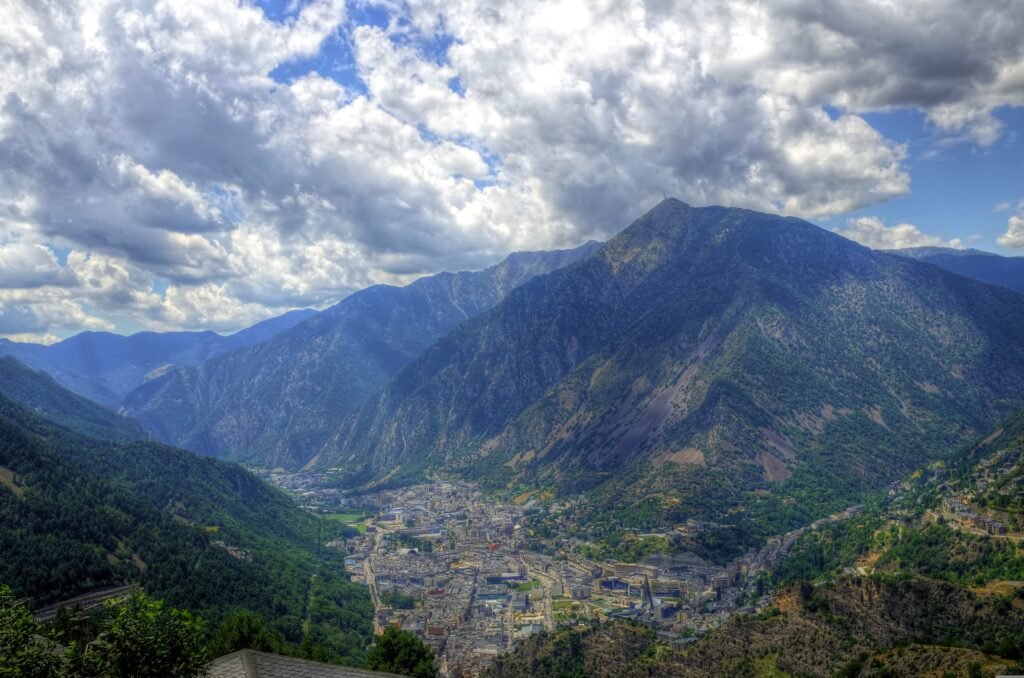
Andorra is a small landlocked co-principality in the eastern Pyrenees mountains, wedged between France and Spain. Its capital is Andorra la Vella, the highest capital city in Europe by elevation. Andorra is unusual among the world’s states in having two co-princes as joint heads of state: the President of France and the Bishop of Urgell in Spain, an arrangement with roots stretching back to the thirteenth century.
Where Is Andorra Located?
Andorra sits entirely within the eastern Pyrenees, sharing its northern border with France and its southern border with Spain. The country’s terrain is almost entirely mountainous, with narrow valleys carved by rivers feeding into the Ebro basin. Its small size, roughly 468 square kilometers, and high elevation have long shaped both its economy and its relative isolation from its larger neighbors.
A Brief History
Andorra’s unusual political structure dates to a 1278 agreement, the Pareatges, which settled a dispute between the Count of Foix and the Bishop of Urgell over control of the territory by establishing joint sovereignty. The right of the Count of Foix eventually passed to the French head of state, so that today the President of France and the Bishop of Urgell serve jointly as Andorra’s co-princes, making Andorra one of the world’s few co-principalities. The country’s official government portal describes this shared-sovereignty structure as still central to Andorran governance today (Govern d’Andorra).
Government and Economy Today
Andorra is a parliamentary co-principality: the two co-princes serve as joint heads of state, while an elected General Council and a head of government handle day-to-day governance. Andorra is not a World Bank borrowing member and does not maintain a World Bank country program, reflecting its status as a small, high-income economy. Historically built on duty-free retail and winter tourism drawing visitors from France and Spain, Andorra has more recently worked to diversify into banking, finance and digital services, alongside continued reliance on its Pyrenean ski resorts.
Culture and People
Catalan is Andorra’s sole official language, reflecting its historical and cultural ties to Catalonia, though French and Spanish are also widely spoken given the country’s position between the two larger nations. The population is a mix of Andorran nationals and residents from Spain, Portugal and France, drawn in part by the country’s tax structure and mountain lifestyle. Andorra’s culture blends Catalan traditions with the practical realities of a small state sandwiched between two much larger neighbors.
What Is Andorra Known For?
Andorra is best known internationally for its unique co-principality system of government, its Pyrenean ski resorts and mountain scenery, and its long-standing reputation as a duty-free shopping destination. Its small size and high elevation, along with its position as one of the few countries in the world with two foreign co-princes as joint heads of state, make it a distinctive case study in European microstate governance.
Key Takeaways
- Andorra is a landlocked microstate in the eastern Pyrenees, between France and Spain, with Andorra la Vella as its capital.
- It is governed as a co-principality, with the President of France and the Bishop of Urgell serving jointly as heads of state under an arrangement dating to 1278.
- Its economy has traditionally centered on duty-free retail and winter tourism, with more recent diversification into banking and finance.
- Catalan is the sole official language, though French and Spanish are widely spoken.
- Andorra la Vella is the highest-elevation national capital in Europe.
Key facts
- Capital: Andorra la Vella, the highest-elevation national capital in Europe1
- Governed as a co-principality since a 1278 agreement, the Pareatges1
- Co-princes: the President of France and the Bishop of Urgell, Spain1
- Sole official language: Catalan1
- Economy historically built on duty-free retail and winter tourism1
Quick checkWho serves as Andorra's joint heads of state?Show answer
Two co-princes: the President of France and the Bishop of Urgell in Spain, under a shared-sovereignty arrangement dating to 1278.
Sources
- Govern d'Andorra (official Andorran government portal). Govern d'Andorra. Undated, accessed 2026 (accessed 2026)
Editorially reviewed by Specialty Digest Editorial TeamLast reviewed September 22, 2026Researched and drafted with AI assistanceReport an issue