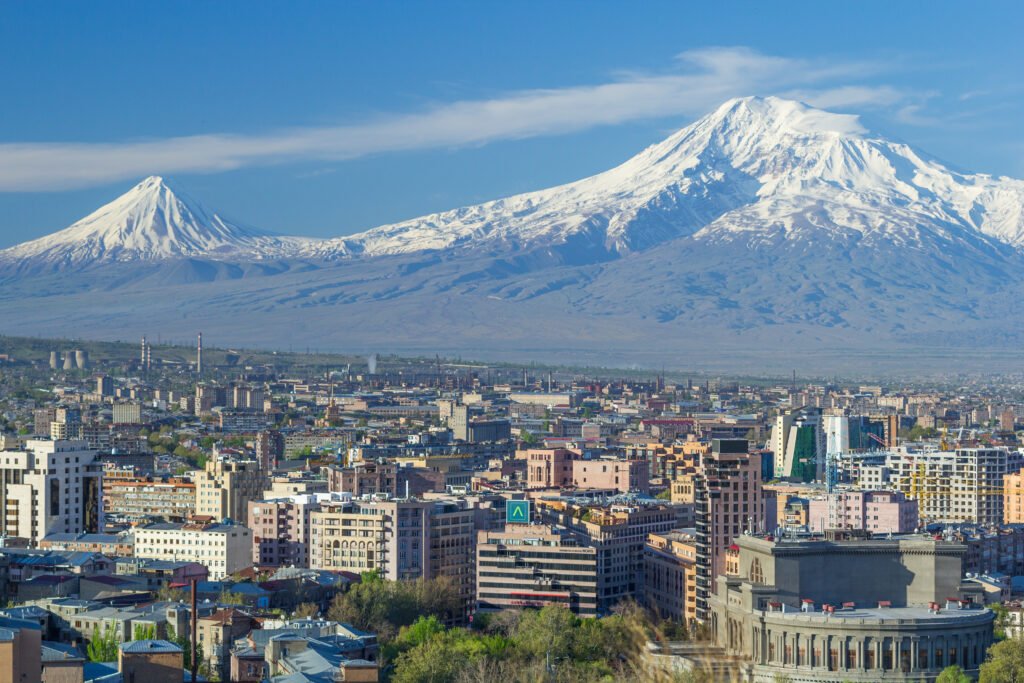
Armenia is a landlocked country in the South Caucasus, at the crossroads of Europe and Asia, bordered by Georgia, Azerbaijan, Iran and Turkey. Its capital, Yerevan, is one of the world’s oldest continuously inhabited cities. Despite regional connectivity challenges and a history marked by conflict and upheaval, Armenia has built a reputation for digital innovation, education and, more recently, a fast-growing tourism sector.
Where Is Armenia Located?
Armenia sits in the South Caucasus mountain region, a landlocked country bordered by Georgia to the north, Azerbaijan to the east, Iran to the south and Turkey to the west. Its terrain is dominated by rugged mountains and highland plateaus, including the slopes near Mount Ararat, historically significant to Armenian identity though the peak itself lies across the border in Turkey. This mountainous, landlocked position has long shaped both Armenia’s culture and its economic and trade challenges.
A Brief History
Armenia is home to one of the world’s oldest Christian civilizations, having adopted Christianity as a state religion in the early fourth century. The twentieth century brought the Armenian Genocide of 1915 to 1923 under the Ottoman Empire, followed by decades as a Soviet republic until independence in 1991. Since then, Armenia has navigated a series of shocks, including a military conflict with Azerbaijan in 2020 and a refugee crisis at the end of 2023, while working to deepen ties with both Western partners and regional neighbors (World Bank).
Government and Economy Today
Armenia is a parliamentary republic and an upper-middle-income country. According to the World Bank, the economy has shown notable resilience despite recent shocks, supported by prudent macroeconomic management, inflation targeting and sound financial oversight. Armenia became a donor to the International Development Association in March 2023, just nine years after graduating from its support. The country is pursuing deeper engagement with the European Union, including an active visa liberalization dialogue, alongside new regional connectivity initiatives such as the Trump Route for International Peace and Prosperity launched in early 2026, which establishes transit links through Armenian territory (World Bank).
Culture and People
Armenian is the official language, written in its own distinct alphabet developed in the early fifth century. The Armenian Apostolic Church remains central to national identity, and Armenia is often cited as the first state to adopt Christianity officially. A large global diaspora, dating substantially from the genocide era, maintains strong cultural and economic ties to the homeland, and Armenian cuisine, music and khachkar stone-cross carving are recognized markers of its heritage.
What Is Armenia Known For?
Armenia is best known internationally for being one of the world’s oldest Christian nations, its distinctive alphabet and monastic architecture, and the view of Mount Ararat from Yerevan. It is also increasingly known for a growing tourism sector centered on ancient monasteries, mountain landscapes and its capital’s cafe culture, alongside a technology and digital innovation scene that has expanded rapidly in recent years.
Key Takeaways
- Armenia is a landlocked South Caucasus country bordered by Georgia, Azerbaijan, Iran and Turkey, with Yerevan as its capital.
- It was among the first nations to adopt Christianity as a state religion, in the early fourth century.
- The twentieth century brought the Armenian Genocide and decades as a Soviet republic before independence in 1991.
- The World Bank reports economic resilience despite the 2020 conflict with Azerbaijan and a 2023 refugee crisis, with Armenia now an IDA donor.
- Ancient monasteries, a distinct alphabet and a growing tourism and technology sector define its modern identity.
Key facts
- Capital: Yerevan
- Independence: 1991, from the Soviet Union
- Adopted Christianity as a state religion in the early 4th century
- Became an IDA donor in March 2023, per World Bank1
Quick checkWhat makes Armenia significant in the history of Christianity?Show answer
Armenia is widely regarded as one of the first nations to adopt Christianity as a state religion, in the early fourth century.
Sources
- World Bank. Armenia Overview. Accessed 2026 (accessed 2026)
Editorially reviewed by Specialty Digest Editorial TeamLast reviewed September 22, 2026Researched and drafted with AI assistanceReport an issue