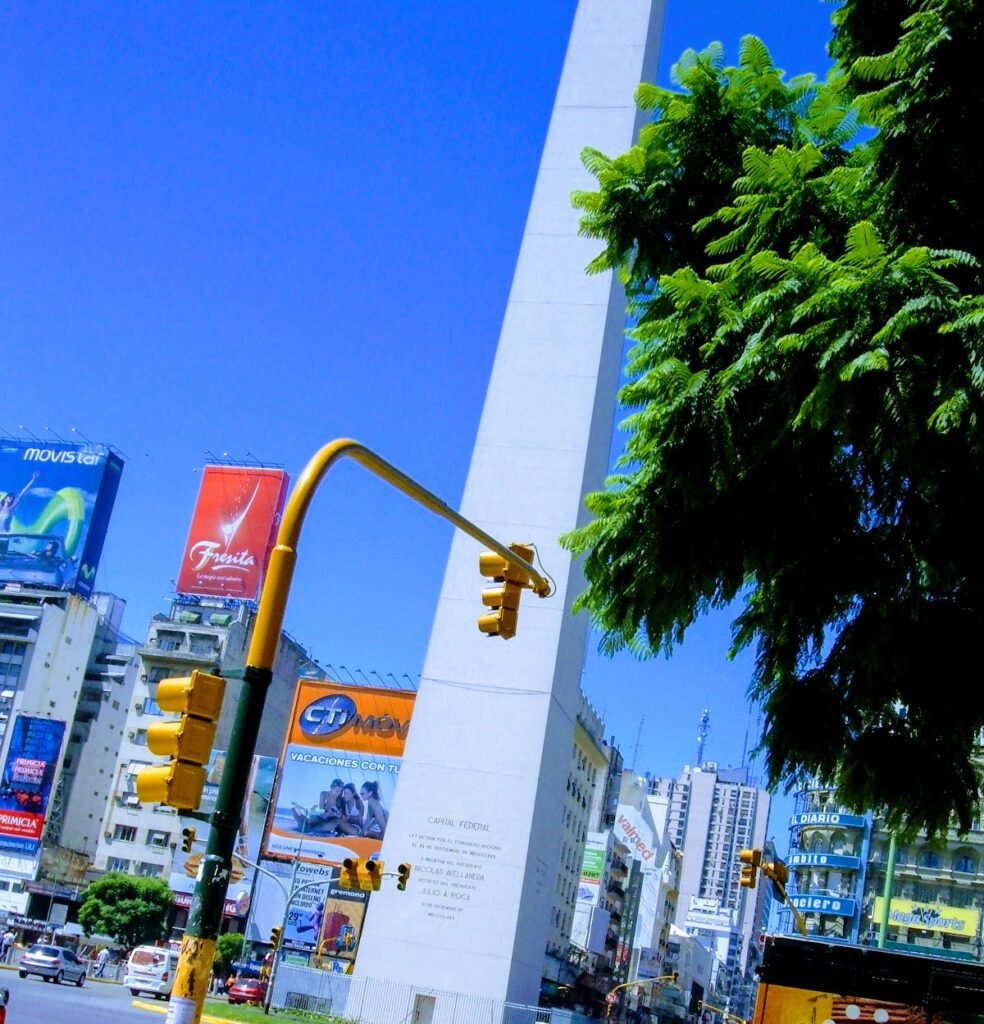
Argentina is the second-largest country in South America by area, stretching from subtropical lowlands in the north to the glaciers of Patagonia in the south. Its capital, Buenos Aires, is one of Latin America’s largest and most culturally influential cities. Rich in energy and agricultural resources, Argentina has long been one of the region’s major economies, though it has also weathered repeated cycles of financial instability.
Where Is Argentina Located?
Argentina occupies most of the southern half of South America, bordered by Chile along the Andes to the west, and by Bolivia, Paraguay, Brazil and Uruguay to the north and east, with the South Atlantic Ocean along its eastern coast. Its territory spans an extraordinary range of climates and landscapes, from the subtropical Gran Chaco and the fertile Pampas grasslands to the arid Patagonian steppe and the glaciers and fjords of Tierra del Fuego in the far south.
A Brief History
Argentina declared independence from Spain in 1816, following a wave of independence movements across South America. Waves of European immigration, particularly from Italy and Spain, shaped the country’s population and culture through the late nineteenth and early twentieth centuries, when Argentina was among the wealthiest nations in the world on a per capita basis. The twentieth century brought recurring political instability, including periods of military rule, most notably the 1976 to 1983 dictatorship, followed by a return to democracy and decades of alternating economic crisis and recovery.
Government and Economy Today
Argentina is a federal presidential republic comprising 23 provinces and the autonomous city of Buenos Aires. According to the World Bank, the economy grew 4.4 percent in 2025, with growth of 3.6 percent projected for 2026, driven by macroeconomic stability, energy-sector investment and a strong agribusiness sector. A stabilization program launched in late 2023 has sharply reduced inflation, from more than 20 percent per month to roughly 2.5 to 3 percent per month, while country risk has fallen substantially, though it remains elevated compared with regional peers. In April 2025, Argentina entered a US$20 billion program with the International Monetary Fund, and the World Bank has provided US$1.5 billion in budget support alongside it (World Bank).
Culture and People
Spanish is the official language, and Argentine culture reflects deep Italian and Spanish immigrant influence alongside Indigenous and other European heritage. Buenos Aires is renowned for tango, its European-style architecture and a vibrant literary and cafe culture, while the country as a whole is closely associated with beef, wine from the Mendoza region and a passionate football culture that has produced some of the sport’s most celebrated players.
What Is Argentina Known For?
Argentina is best known internationally for the tango, its beef and Malbec wine, the vast Pampas grasslands that anchor its agricultural economy, and natural landmarks including Iguazu Falls and the Perito Moreno Glacier in Patagonia. It is equally known for its football tradition and for cycles of economic volatility that have made it a closely watched case study in macroeconomic policy.
Key Takeaways
- Argentina is South America’s second-largest country by area, with Buenos Aires as its capital and largest city.
- It declared independence from Spain in 1816 and later became one of the world’s wealthiest countries per capita during a period of mass European immigration.
- The World Bank reports 4.4 percent growth in 2025 amid a stabilization program that has sharply cut inflation and country risk since 2023.
- Its landscapes range from the fertile Pampas to Patagonian glaciers, supporting a major agricultural and energy economy.
- Tango, beef, Malbec wine and football are central to Argentina’s global cultural identity.
Key facts
Quick checkWhat economic reforms has Argentina pursued since 2023?Show answer
A stabilization program launched in late 2023 has sharply cut monthly inflation and country risk, supported by an IMF program and World Bank budget support.
Sources
- World Bank. Argentina Overview. Accessed 2026 (accessed 2026)
Editorially reviewed by Specialty Digest Editorial TeamLast reviewed September 22, 2026Researched and drafted with AI assistanceReport an issue