Where Is Bahrain Located?
Bahrain is an archipelago nation in the Persian Gulf, positioned between the Qatar peninsula and the eastern coast of Saudi Arabia. Its capital, Manama, lies on the northeastern tip of the main island, near latitude 26.2 degrees North and longitude 50.5 degrees East. A causeway links Bahrain directly to the Saudi Arabian mainland, a road connection that is unusual among the world’s island states. The World Bank classifies Bahrain as a high income economy within the Middle East, North Africa, Afghanistan and Pakistan region.
The Geography of Bahrain
The country is made up of a main island, Bahrain Island, together with a scattering of smaller islands across the surrounding gulf waters. The terrain is low and largely flat, shaped by a hot, arid climate typical of the Arabian Peninsula’s coastal lowlands, with no permanent rivers. Fresh water has historically come from underground aquifers, supplemented in the modern era by desalination. Land reclamation has expanded the coastline considerably in recent decades, reshaping the original islands.
A Brief History of Bahrain
Ancient Dilmun and the Origins of Settlement
Bahrain’s recorded history stretches back further than almost anywhere else in the Gulf. At Qal’at al-Bahrain, on the main island, archaeologists have documented continuous human presence from around 2300 BC to the sixteenth century AD, layered into an artificial mound, or tell, roughly 300 by 600 meters across. The site served as the capital of Dilmun, an ancient trading civilization that the UNESCO World Heritage Centre describes as containing the richest inventoried remains of a culture previously known mainly through Sumerian written references. West of the main settlement, the Dilmun Burial Mounds, a separate UNESCO listed site built between roughly 2200 and 1750 BC, preserve close to 11,774 individual burial mounds spread across 21 archaeological areas, among them 17 royal tombs built as two story sepulchral towers. Together, the two sites make Bahrain one of the best documented locations for studying the early Dilmun civilization anywhere in the region.
A Crossroads of Outside Powers
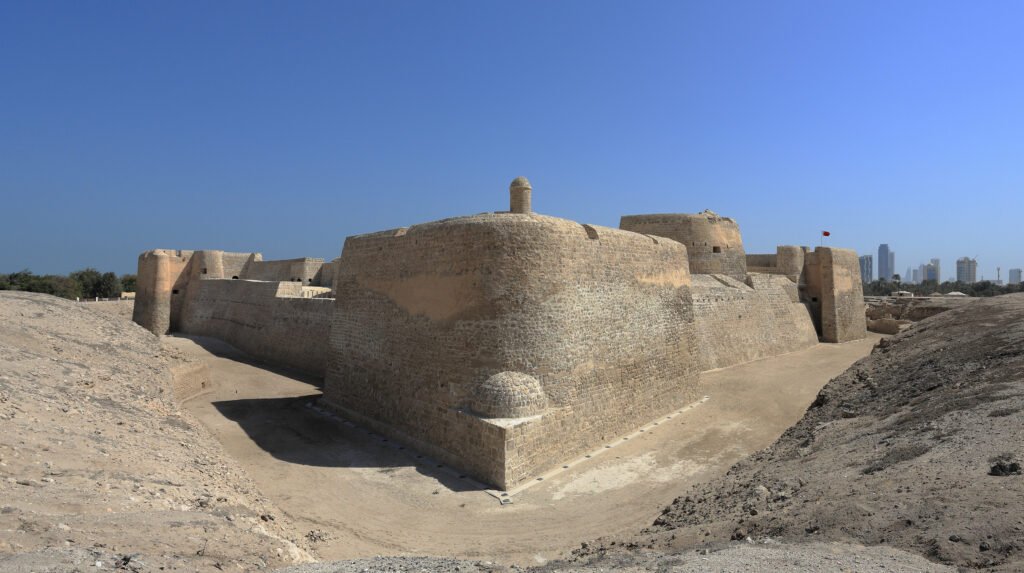
Centuries after Dilmun’s decline, Bahrain’s position at the mouth of the Gulf kept it valuable to successive outside powers. A fort still stands atop the ancient tell at Qal’at al-Bahrain, built during a period of Portuguese occupation; the structure gave the entire site its Arabic name, qal’a, meaning fort. Control of the islands changed hands repeatedly over the following centuries among regional and European powers before the Al Khalifa royal family, which continues to rule Bahrain today, established authority over the archipelago. Bahrain later entered treaty relationships with Britain that shaped its foreign affairs into the twentieth century, before the country gained independence and joined the United Nations in 1971, one of five states, alongside Bhutan, Oman, Qatar and the United Arab Emirates, admitted to the UN that year. Bahrain joined UNESCO the following year, in 1972.
The Pearling Economy
For close to two thousand years, the waters off Bahrain’s northern coast anchored one of the Gulf’s defining industries. UNESCO’s Pearling, Testimony of an Island Economy site, inscribed as a World Heritage property in 2012, documents how the harvesting of pearls from offshore oyster beds shaped the island’s economy from the second century AD to the 1930s, when the arrival of Japanese cultured pearls ended the trade’s dominance of the regional economy. The listed site today comprises seventeen buildings in Muharraq City, including merchants’ residences, storehouses and a mosque, along with three offshore oyster beds and the Qal’at Bu Mahir fortress, from which pearling boats once set out to sea.
Government and Economy in Brief
Bahrain is a constitutional monarchy, with the Al Khalifa royal family serving as the country’s hereditary head of state. As of 2025, the World Bank recorded Bahrain’s population at approximately 1.6 million people and classified the country among the world’s high income economies, with a gross domestic product of roughly 49.0 billion US dollars and a GDP per capita near 30,600 US dollars. Having built its early modern economy on pearling and later on oil, Bahrain has since diversified substantially, developing into one of the Gulf’s established banking and financial services centers.
Culture and People of Bahrain
Bahrain’s population reflects centuries of contact across the Gulf, combined with a large community of foreign residents who now make up a substantial share of the people living on the islands. Arabic is the official language, and Islam is the majority religion, practiced across both Sunni and Shia communities whose long coexistence has shaped the country’s religious and social life. Bahraini craft traditions, including pearl diving heritage and traditional boatbuilding, draw directly on the maritime economy documented at the Muharraq pearling sites, while Manama today functions as a modern regional hub, with a skyline of contemporary towers set alongside its historic core.
What Is Bahrain Best Known For?
Internationally, Bahrain is best recognized for Qal’at al-Bahrain, the fortified archaeological mound that UNESCO recognizes as the ancient capital of Dilmun and one of the most extensively documented tell sites in the Gulf. The country is also closely associated with the region’s historic pearling economy, with hosting the annual Bahrain Grand Prix on its Formula One circuit, and, more broadly, with its role as one of the Gulf’s earliest and most established financial centers. With three UNESCO World Heritage Sites for a country of its size, Bahrain holds an unusually dense concentration of internationally recognized cultural heritage.
Why Bahrain Matters Globally
Bahrain’s significance extends well beyond its small land area. Its position near the western shore of the Gulf made it a maritime crossroads for millennia, evidenced by the Dilmun era trade documented at Qal’at al-Bahrain and by the pearling economy that once supplied some of the world’s most valued pearls before cultured alternatives emerged. As one of the Gulf states admitted to both the United Nations and UNESCO in the early 1970s, Bahrain has long participated in the international institutions that shape global governance, trade and cultural preservation. Its modern economy, built on finance and, historically, on oil, continues to link the country to global energy and banking markets, while its concentration of UNESCO World Heritage Sites keeps it a reference point in the study of the ancient Gulf.
Key Takeaways
- Bahrain is an archipelago nation in the Persian Gulf, connected to Saudi Arabia by causeway, with its capital at Manama.
- Qal’at al-Bahrain documents nearly continuous human occupation from around 2300 BC to the sixteenth century AD and served as the capital of the ancient Dilmun civilization.
- Bahrain is home to three UNESCO World Heritage Sites: Qal’at al-Bahrain, the Dilmun Burial Mounds and the Pearling, Testimony of an Island Economy site in Muharraq.
- Bahrain joined the United Nations in 1971 and UNESCO in 1972.
- The World Bank classified Bahrain as a high income economy in 2025, with a population of approximately 1.6 million and a GDP of roughly 49.0 billion US dollars.
- Bahrain’s pearling economy dominated regional trade from roughly the second century AD until the 1930s, when Japanese cultured pearls ended its global dominance.
Sources
- World Bank | Bahrain, World Bank Open Data | Undated, data current as of 2025 | https://data.worldbank.org/country/bahrain | Accessed September 22, 2026
- UNESCO World Heritage Centre | Qal’at al-Bahrain, Ancient Harbour and Capital of Dilmun | Undated | https://whc.unesco.org/en/list/1192/ | Accessed September 22, 2026
- UNESCO World Heritage Centre | Pearling, Testimony of an Island Economy | Undated | https://whc.unesco.org/en/list/1364/ | Accessed September 22, 2026
- UNESCO World Heritage Centre | Dilmun Burial Mounds | Undated | https://whc.unesco.org/en/list/1542/ | Accessed September 22, 2026
- UNESCO | Bahrain, Member States Profile | Undated | https://en.unesco.org/countries/bahrain | Accessed September 22, 2026
- United Nations | Growth in United Nations Membership, 1945-present | Undated | https://www.un.org/en/about-us/growth-in-un-membership | Accessed September 22, 2026
Key facts
Quick checkWhat ancient civilization was Bahrain the capital of, as documented at Qal'at al-Bahrain?Show answer
Dilmun, an ancient Gulf trading civilization, with Qal'at al-Bahrain serving as its capital from roughly 2300 BC to the sixteenth century AD.
Sources
- World Bank. Bahrain, World Bank Open Data. Undated, data current as of 2025 (accessed Accessed September 22, 2026)
- UNESCO World Heritage Centre. Qal'at al-Bahrain, Ancient Harbour and Capital of Dilmun. Undated (accessed Accessed September 22, 2026)
- UNESCO World Heritage Centre. Pearling, Testimony of an Island Economy. Undated (accessed Accessed September 22, 2026)
- UNESCO World Heritage Centre. Dilmun Burial Mounds. Undated (accessed Accessed September 22, 2026)
- UNESCO. Bahrain, Member States Profile. Undated (accessed Accessed September 22, 2026)
- United Nations. Growth in United Nations Membership, 1945-present. Undated (accessed Accessed September 22, 2026)
Editorially reviewed by Specialty Digest Editorial TeamLast reviewed September 22, 2026Researched and drafted with AI assistanceReport an issue