Where Is Benin Located?
Benin is a narrow, north-south country in West Africa, stretched along the Gulf of Guinea between Togo to the west and Nigeria to the east, with Burkina Faso and Niger along its northern border. The country has just 121 kilometers of coastline, and its position at the meeting point of two major regional trade corridors, the Abidjan-Lagos coastal corridor and the Cotonou-Niamey corridor running north into the Sahel, makes it a commercial crossing point for goods moving between the Atlantic coast and landlocked neighbors further inland.
Porto-Novo is Benin’s official capital, but Cotonou, the largest city and main port, functions as the seat of government and the country’s economic center.
Geography of Benin
Benin’s landscape rises gradually from a low, sandy coastal plain in the south to a central plateau region and then to the Atacora mountain range in the northwest, the country’s most rugged terrain. The climate shifts along that same north-south axis, from a humid, two-season tropical climate near the coast to a drier, single-rainy-season climate typical of the Sahel toward the north. The Oueme River, the country’s longest, drains much of central and southern Benin into Lake Nokoue near Cotonou. In the far north, Benin shares the W-Arly-Pendjari transboundary protected area with Burkina Faso and Niger, a savanna wildlife reserve recognized internationally for its natural heritage.
Borders and Neighbors
- Togo to the west
- Nigeria to the east
- Burkina Faso to the northwest
- Niger to the northeast
- The Gulf of Guinea, part of the Atlantic Ocean, to the south
A Brief History of Benin
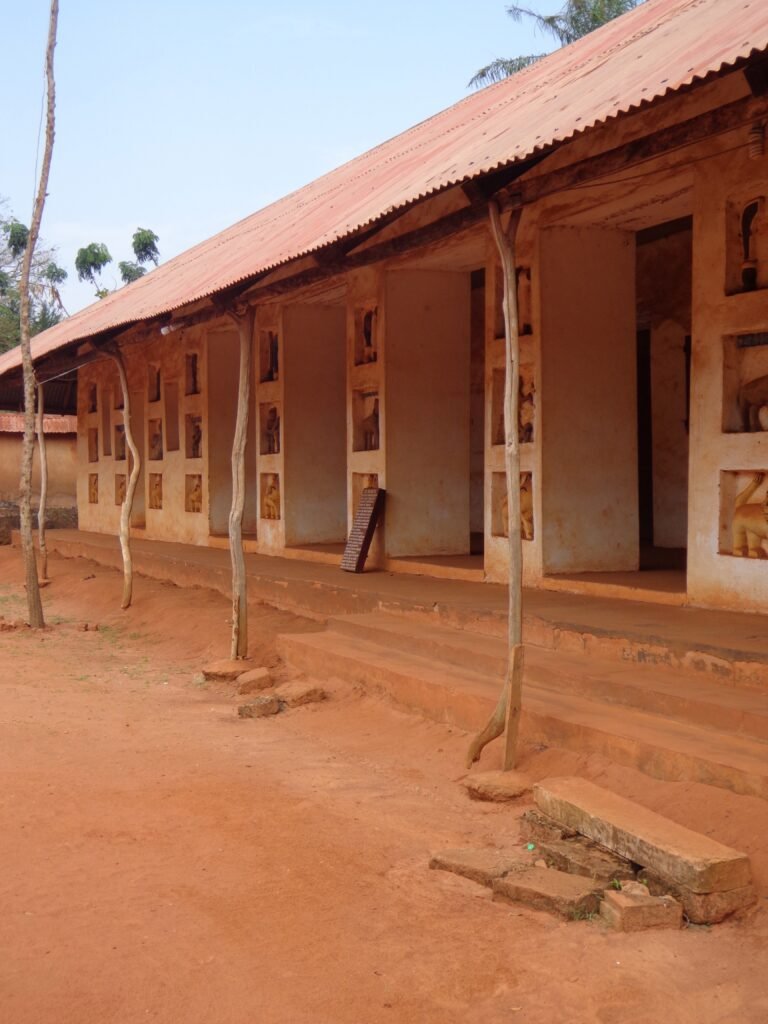
The territory now called Benin was home to several precolonial states, the most powerful of which was the Kingdom of Dahomey, centered on the city of Abomey. Twelve kings ruled Dahomey in succession between 1625 and 1900, and each built his own palace within a shared walled compound rather than replacing his predecessor’s residence. That complex, the Royal Palaces of Abomey, survives today as Benin’s only UNESCO World Heritage Site and stands as, in UNESCO’s words, a unique reminder of the vanished kingdom.
Dahomey was also a major participant in the transatlantic slave trade, and the coastal town of Ouidah became one of West Africa’s principal points of embarkation for enslaved people forced across the Atlantic, a history the town marks today with historic sites and memorials.
France established a protectorate over Dahomey in the late nineteenth century and folded it into French West Africa. The country gained independence on August 1, 1960, as the Republic of Dahomey. Political instability and a series of military governments followed until 1972, when Mathieu Kerekou took power and, in 1975, renamed the country the People’s Republic of Benin under a Marxist-Leninist one-party system. A severe economic crisis in the late 1980s forced Kerekou’s government to convene a national conference in 1990 that dismantled one-party rule, adopted a new constitution, and restored multiparty elections. That transition is widely cited as one of the earliest and most peaceful shifts from authoritarian to democratic government in postcolonial Africa, and the country has held regular elections since.
Government and Economy in Benin
Benin is a presidential republic. As of early 2026, Patrice Talon holds the presidency, and parties supporting him won all 109 seats in the National Assembly in legislative elections held on January 11, 2026, after opposition parties fell short of the national vote threshold required to be seated. A presidential election is scheduled for April 12, 2026.
According to the World Bank, Benin’s economy grew strongly through 2025, with growth reaching about 8 percent over the year’s first three quarters, up from 7.5 percent in 2024. Services, particularly trade and transport tied to the Port of Cotonou, drove much of that expansion, alongside gains in construction, manufacturing, and export-oriented agriculture. Inflation eased to 1.1 percent even as fiscal consolidation brought the government’s budget deficit down to the regional target of 3 percent of GDP. Despite that growth, poverty remains widespread: the national poverty rate stood at 36.2 percent in 2021-2022, and roughly 90 percent of workers are employed in the informal sector. Between 1990 and 2023, Benin’s Human Development Index rose from 0.351 to 0.515, an increase of nearly 47 percent, reflecting gains in life expectancy, schooling, and income over that period.
Culture and People of Benin
Benin’s population, estimated at 14.5 million in 2024, is ethnically diverse. The Fon people are concentrated in the south around Abomey and Cotonou, the Yoruba live mainly in the southeast near the Nigerian border, and the Bariba, Fulani, and other groups predominate across the north. French is the official language, inherited from the colonial period, while Fon, Yoruba, Bariba, and dozens of other indigenous languages remain in everyday use.
Benin, and the Abomey-Ouidah region in particular, is widely regarded by historians and anthropologists as a historical origin point of the Vodun religious tradition, which spread to the Americas through the transatlantic slave trade and shaped related traditions such as Haitian Vodou, Cuban Santeria, and Brazilian Candomble. Vodun remains an officially recognized religion in Benin today, practiced alongside, and often blended with, Christianity and Islam, and the country marks National Vodun Day each January 10 with public celebrations centered on Ouidah.
What Is Benin Known For?
Internationally, Benin is best known for the Royal Palaces of Abomey, the clearest surviving monument to the Kingdom of Dahomey and the country’s only UNESCO World Heritage Site. The country is equally well known as a spiritual homeland of Vodun, a status that draws scholars, practitioners, and visitors to Ouidah’s annual Vodun Day festival. Ouidah’s role in the transatlantic slave trade, memorialized along a route leading to the coast, is another defining and difficult part of how the country is understood historically. Benin is also known for Ganvie, a village built on stilts over Lake Nokoue that has been inhabited for centuries and is often cited as one of Africa’s largest lake-dwelling settlements.
Why Benin Matters
Benin’s significance extends beyond its size. Geographically, it functions as a commercial gateway linking Nigeria, the region’s largest economy, with landlocked Sahelian states further north, making the Port of Cotonou an important node in West African trade. Politically, Benin’s 1990 transition from one-party Marxist rule to multiparty democracy is frequently studied as an early model for peaceful democratic change in Africa, achieved through negotiation rather than conflict. Culturally, the region’s role as a source of the Vodun tradition connects Benin to millions of people across the African diaspora in the Americas, giving a country of modest size and population an outsized place in the shared cultural history of the Atlantic world.
Key Takeaways
- Benin is a narrow West African country on the Gulf of Guinea, bordered by Togo, Nigeria, Burkina Faso, and Niger.
- Between 1625 and 1900, twelve successive kings of the Kingdom of Dahomey built the Royal Palaces of Abomey, now Benin’s only UNESCO World Heritage Site and its most iconic landmark.
- Benin gained independence from France in 1960, was renamed from Dahomey in 1975 under Marxist-Leninist rule, and carried out one of Africa’s earliest peaceful transitions to multiparty democracy after a 1990 national conference.
- The economy grew by roughly 8 percent over the first three quarters of 2025, driven largely by trade and transport through the Port of Cotonou.
- Benin is widely regarded as a historical origin point of the Vodun religion, which is officially recognized in the country and marked annually with National Vodun Day on January 10.
- The coastal town of Ouidah was a major point of departure during the transatlantic slave trade, a history central to how Benin is remembered today.
Sources
- World Bank, Benin Overview, accessed September 22, 2026: worldbank.org/en/country/benin/overview
- UNESCO World Heritage Centre, Royal Palaces of Abomey, accessed September 22, 2026: whc.unesco.org/en/list/323
Key facts
- Benin borders Nigeria, Togo, Burkina Faso, and Niger, with 121 kilometers of coastline on the Gulf of Guinea1
- Population was estimated at 14.5 million in 20241
- Twelve kings ruled the Kingdom of Abomey from 1625 to 1900; the Royal Palaces of Abomey are Benin's only UNESCO World Heritage Site2
- The economy grew about 8 percent over the first three quarters of 2025, led by services and industry1
- Benin's Human Development Index rose from 0.351 in 1990 to 0.515 in 20231
Quick checkWhat UNESCO World Heritage Site in Benin was built by twelve successive kings of the Kingdom of Abomey?Show answer
The Royal Palaces of Abomey, a walled palace complex constructed between 1625 and 1900.
Sources
- World Bank. Benin Overview. Undated, accessed 2026 (accessed 2026-09-22)
- UNESCO World Heritage Centre. Royal Palaces of Abomey. Undated (accessed 2026-09-22)
Editorially reviewed by Specialty Digest Editorial TeamLast reviewed September 22, 2026Researched and drafted with AI assistanceReport an issue