What Is Belarus?
Belarus is a landlocked country in Eastern Europe, bordered by Russia [INTERNAL LINK NEEDED: Russia] to the east and northeast, Ukraine [INTERNAL LINK NEEDED: Ukraine] to the south, Poland [INTERNAL LINK NEEDED: Poland] to the west, and Lithuania [INTERNAL LINK NEEDED: Lithuania] and Latvia [INTERNAL LINK NEEDED: Latvia] to the northwest. The World Bank describes Belarus as an upper middle income country in Eastern Europe with a mixed economy and a large state owned enterprise sector, and World Bank data lists Minsk as its capital and largest city. Officially the Republic of Belarus, the country is a presidential republic whose government, economy, and international relationships remain closely tied to Russia.
Key Takeaways
- Belarus is a landlocked Eastern European country bordered by Russia, Ukraine, Poland, Lithuania, and Latvia, with its capital at Minsk.
- Its population was approximately 9.09 million people in 2025, living across a land area of about 202,983 square kilometers (78,372 square miles).
- The territory passed through the Grand Duchy of Lithuania, the Polish-Lithuanian Commonwealth, and the Russian Empire before becoming the Byelorussian Soviet Socialist Republic and, in 1991, an independent state.
- Belarus is a presidential republic; its government structure and the disputed 2020 presidential election remain defining features of its recent politics.
- The World Bank classifies Belarus as an upper middle income country whose major exports include fertilizers, petrochemicals, agricultural and timber products, and heavy machinery.
- Belarus has four UNESCO World Heritage sites, most famously the Mir Castle Complex, and is closely associated internationally with the aftermath of the 1986 Chernobyl disaster.
Where Is Belarus Located? Geography of Belarus
Belarus sits in Eastern Europe with no direct access to the sea, sharing borders with Russia to the east and northeast, Ukraine to the south, Poland to the west, and Lithuania and Latvia to the northwest. Its land area is approximately 202,983 square kilometers (78,372 square miles), according to World Bank data. The capital and largest city, Minsk, lies near the geographic center of the country.
The terrain is dominated by low, gently rolling plains, extensive pine and mixed forests, and one of Europe’s largest surviving expanses of wetland, concentrated in the southern Polesia region along the Pripyat River. Thousands of lakes and rivers, including the Neman, the Dnieper, and the Pripyat, drain the country. Belarus has a continental climate, with cold, snowy winters and mild, humid summers.
A Brief History of Belarus
From Medieval Principalities to the Russian Empire
The territory of present day Belarus was settled by East Slavic tribes and later formed part of Kyivan Rus. From the thirteenth century it became a core territory of the Grand Duchy of Lithuania, and later of the Polish-Lithuanian Commonwealth. Following the late eighteenth century partitions of Poland, the territory was absorbed into the Russian Empire, where it remained until the Russian Revolution of 1917.
The Soviet Era and Independence
After the revolution, the territory became the Byelorussian Soviet Socialist Republic, one of the founding republics of the Soviet Union, and, alongside the Ukrainian Soviet Socialist Republic, one of two Soviet republics granted their own separate seat at the founding of the United Nations in 1945. Belarus suffered enormous losses during the Second World War, when much of Minsk was destroyed and a large share of the population did not survive the occupation. In April 1986, the Chernobyl nuclear power plant, located just across the border in Ukraine, exploded, and a disproportionate share of the resulting radioactive fallout settled over southern and southeastern Belarus, an event that shaped the country’s public health, agriculture, and land use for decades afterward.
The Byelorussian Soviet Socialist Republic informed the United Nations on September 19, 1991 that it had changed its name to Belarus, shortly before the dissolution of the Soviet Union later that year, and the country emerged as a fully independent state for the first time in the modern era.
Government and Economy in Belarus
Belarus is a presidential republic with executive, legislative, and judicial branches of government, as described on the official Internet portal of the President of the Republic of Belarus. The president serves as head of state; the portal’s own biography page identifies the incumbent as Alexander Lukashenko, who has held the office continuously since 1994.
Belarus held a presidential election in August 2020 whose official result was disputed. Opposition candidates and large numbers of citizens who took to the streets in Minsk and other cities in the weeks that followed rejected the outcome, while the European Union and a number of other governments and international observers raised concerns about the vote’s fairness and transparency and withheld recognition of the result, positions the Belarusian government has rejected as unfounded interference in its internal affairs. The dispute reshaped relations between Belarus and Western governments, including a series of sanctions imposed by the European Union and other countries, and it remains a contested and unresolved feature of the country’s recent political history.
Economically, the World Bank classifies Belarus as an upper middle income country, with a mixed economy in which state owned enterprises play a large role. Major exports include fertilizers, petrochemicals, agricultural and timber products, and heavy machinery. Belarus joined the International Bank for Reconstruction and Development, part of the World Bank Group, in July 1992, but the World Bank Group has not approved any new loans to the country since mid-2020 and suspended its programs there entirely as of March 2, 2022, following Russia’s invasion of Ukraine. The World Bank projects Belarus’s real GDP to grow by 1.1 percent in 2026 and by 0.7 to 0.8 percent in 2027 and 2028, with growth relying heavily on state supported construction while industrial output is expected to weaken as demand from Russia, the country’s principal trading partner, moderates.
Culture and People of Belarus
Population and Language
Belarus had a population of approximately 9.09 million people in 2025, according to World Bank data, a figure that has declined gradually over the past decade. Belarusian and Russian are both official languages; Russian is the language most commonly used in daily life, government, and media, while Belarusian retains a central place in national identity, education, and cultural life.
Religion and Traditions
Most Belarusians who identify with a religion belong to the Eastern Orthodox Church, with a Roman Catholic minority concentrated mainly in the western part of the country. Folk traditions rooted in the countryside, including seasonal rituals and traditional textile and straw crafts, remain part of Belarusian cultural life and are reflected in several elements inscribed on UNESCO’s Representative List of the Intangible Cultural Heritage of Humanity, which recognizes seven Belarusian cultural practices.
What Is Belarus Known For?
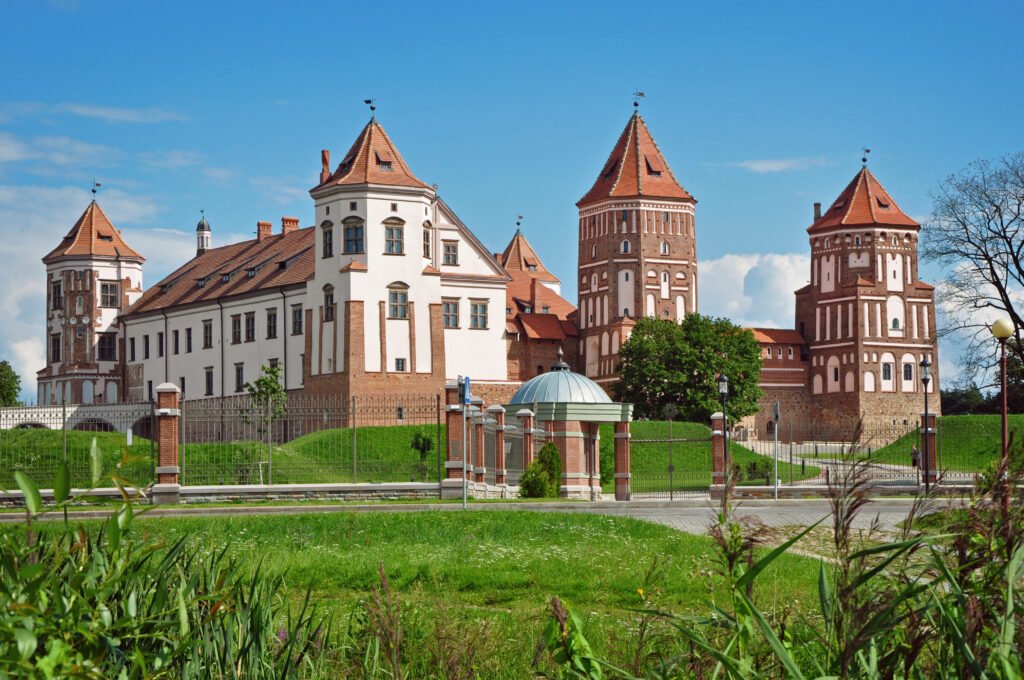
Belarus is best known internationally for the Mir Castle Complex, a fortified castle in the town of Mir that blends Gothic, Baroque, and Renaissance architecture across several centuries of construction and renovation. It is one of four properties in Belarus inscribed on UNESCO’s World Heritage List, a list the country joined when it ratified the World Heritage Convention on October 12, 1988. The other three are the Architectural, Residential and Cultural Complex of the Radziwill Family at Nesvizh, the transboundary Struve Geodetic Arc, and Bialowieza Forest [INTERNAL LINK NEEDED: Bialowieza Forest], one of the last and largest remaining fragments of the primeval forest that once covered much of the European Plain and a sanctuary for the European bison, shared with neighboring Poland.
Belarus is also widely associated internationally with the aftermath of the Chernobyl disaster, since a disproportionate share of the accident’s radioactive contamination fell on Belarusian territory rather than on Ukraine, where the plant itself stood. The country’s recent political history, including the disputed 2020 presidential election and the large protest movement that followed, has also become a defining reference point in international coverage of Belarus.
Why Belarus Matters
Belarus’s location between the European Union and Russia gives it outsized geopolitical significance relative to its size and population. Energy and transport corridors linking Russia to Western Europe run through Belarusian territory, and the country’s close political, economic, and military ties to Russia, including a Union State framework between the two countries, shape wider regional security dynamics in Eastern Europe. Its role as a staging area during Russia’s 2022 invasion of Ukraine drew renewed international attention to this relationship.
Belarus also matters as a reference point in the history of nuclear safety, since the long-term public health and environmental consequences of the Chernobyl disaster were felt most heavily on its territory, and as a site of exceptional cultural and natural heritage, from the fortified architecture of Mir Castle to the ancient woodland of Bialowieza Forest.
Sources
- World Bank, Belarus Overview, undated (continuously updated), accessed September 22, 2026
- World Bank Open Data, Population, Total: Belarus, 2025 data, accessed September 22, 2026
- World Bank Open Data, Land Area: Belarus, 2023 data, accessed September 22, 2026
- World Bank Open Data, Country Data: Belarus, undated, accessed September 22, 2026
- UNESCO World Heritage Centre, States Parties: Belarus, undated, accessed September 22, 2026
- UNESCO, Belarus Member State Profile, undated, accessed September 22, 2026
- United Nations, Belarus, undated, accessed September 22, 2026
- Official Internet Portal of the President of the Republic of Belarus, undated, accessed September 22, 2026
Key facts
- Population approximately 9.09 million as of 20252
- Land area approximately 202,983 square kilometers (78,372 square miles) as of 20233
- Capital and largest city: Minsk4
- Four properties inscribed on UNESCO's World Heritage List, including the Mir Castle Complex5
- Classified as upper middle income by the World Bank, with major exports including fertilizers, petrochemicals, and heavy machinery1
Quick checkWhat is Belarus's most iconic landmark, and how many UNESCO World Heritage sites does the country have?Show answer
The Mir Castle Complex is Belarus's most iconic landmark; the country has four UNESCO World Heritage sites in total.
Sources
- World Bank. Belarus Overview. Undated (continuously updated) (accessed Accessed 2026-09-22)
- World Bank Open Data. Population, Total: Belarus. 2025 (accessed Accessed 2026-09-22)
- World Bank Open Data. Land Area: Belarus. 2023 (accessed Accessed 2026-09-22)
- World Bank Open Data. Country Data: Belarus. Undated (accessed Accessed 2026-09-22)
- UNESCO World Heritage Centre. States Parties: Belarus. Undated (accessed Accessed 2026-09-22)
- UNESCO. Belarus Member State Profile. Undated (accessed Accessed 2026-09-22)
- United Nations. Belarus. Undated (accessed Accessed 2026-09-22)
- Official Internet Portal of the President of the Republic of Belarus. President of the Republic of Belarus. Undated (accessed Accessed 2026-09-22)
Editorially reviewed by Specialty Digest Editorial TeamLast reviewed September 22, 2026Researched and drafted with AI assistanceReport an issue