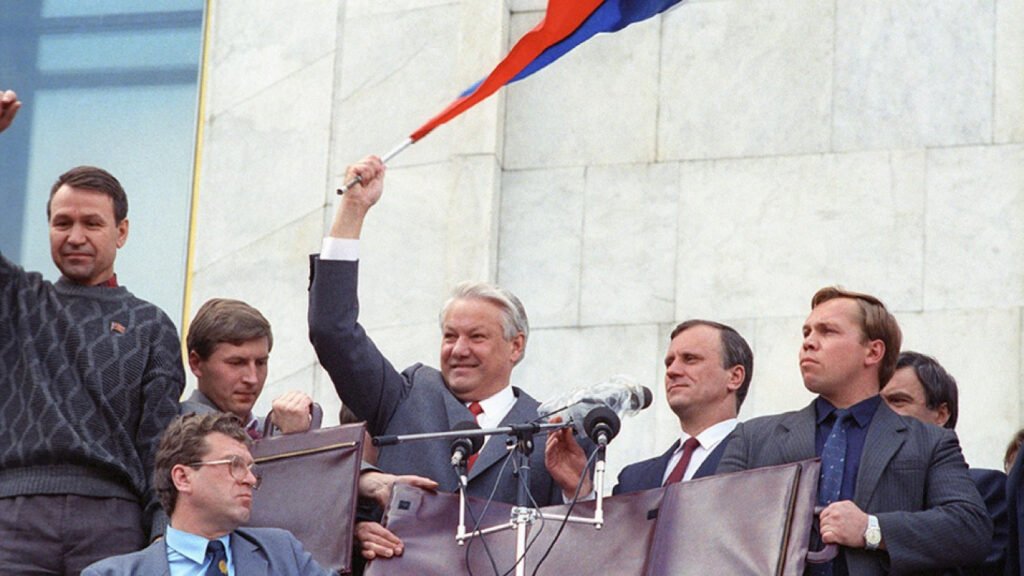
The dissolution of the Soviet Union was the breakup of the Union of Soviet Socialist Republics into independent countries in 1991. It was marked by Mikhail Gorbachev’s resignation as Soviet president on 25 December 1991, when the Soviet flag was lowered over the Kremlin for the last time. Fifteen national republics became separate states, and the end of the USSR brought the Cold War to a close.
Background of the Soviet collapse
In 1985, the Soviet Union seemed likely to last forever. As historian David Hoffmann describes it in Origins, the Communist Party held a monopoly on political power, the state controlled the economy, a large security apparatus watched the population, and the country had the largest military in the world.
Gorbachev and other reformers believed the system had lost the confidence of its people. According to Gorbachev’s own account, he and his future foreign minister, Eduard Shevardnadze, agreed in 1984 on a simple formula: perestroika, meaning restructuring, glasnost, meaning openness, and democratization. The aim was to renew belief in communist ideals, not to end the system.
The reforms had unintended effects. Openness and democratization released a flood of criticism, and shortages worsened. Nationalist movements grew, and the leaders of Estonia, Latvia and Lithuania demanded independence. In 1989, a human chain called the Baltic Way linked the three Baltic capitals in a protest for independence.
Events abroad added to the pressure. The Office of the Historian notes that Gorbachev’s decision to loosen the Soviet hold on Eastern Europe set off a momentum that led to the fall of the Berlin Wall in November 1989, and then to the overthrow of communist rule across the region. His decision to allow multiparty elections and to create a Soviet presidency began a slow democratization that weakened Communist control. After the May 1990 elections, Gorbachev faced Boris Yeltsin, who pushed for rapid reform, and hard-line Communists, who wanted to block it.
Course of the dissolution
In January 1991, violence broke out in Lithuania and Latvia when Soviet tanks intervened against democratic uprisings. Gorbachev then negotiated a new union treaty that offered the republics limited autonomy in return for staying in the Soviet state. Hard-liners saw that once autonomy was granted, central control would be much harder to restore.
On 19 August 1991, one day before the new treaty was due to be signed, Communist hard-liners launched a coup attempt. They declared a state of emergency, placed Gorbachev under house arrest in Crimea and sent tanks onto the streets of Moscow. Yeltsin climbed on a tank outside the Russian parliament building and denounced the move. The coup failed within days.
The failed coup destroyed what remained of the Communist Party’s credibility, and many people now wanted to end the Soviet system and not reform it. Gorbachev resigned as head of the party, the Central Committee was dissolved and Yeltsin banned party activities. A few days later, Ukraine and Belarus declared their independence, and the Baltic States, which had already declared theirs, sought international recognition.
In early December 1991, Yeltsin and the leaders of Ukraine and Belarus met in Brest and agreed to form the Commonwealth of Independent States, which effectively declared the Soviet Union dead. On 25 December, Gorbachev resigned as president of a state that no longer existed. The Russian tricolor replaced the hammer-and-sickle flag above the Kremlin, and Yeltsin remained as president of Russia.
Aftermath of the dissolution
The transition was relatively peaceful, which surprised many observers around the world. The main concern of the United States was stability and security in the former Soviet states, especially the control of their nuclear arsenal.
On 4 September 1991, Secretary of State James Baker set out five principles to guide U.S. policy toward the new republics. They were self-determination consistent with democratic principles, recognition of existing borders, support for democracy and the rule of law, preservation of human rights and minority rights, and respect for international law.
The United States recognized the 12 remaining independent republics, and opened diplomatic relations first with Russia, Ukraine, Belarus, Kazakhstan, Armenia and Kyrgyzstan. Relations with Uzbekistan, Moldova, Azerbaijan, Turkmenistan and Tajikistan were established in February 1992, and a civil war in Georgia delayed recognition of that country until May 1992.
The Nunn-Lugar Act of November 1991 created the Cooperative Threat Reduction Program, which funded the dismantling of weapons in the former Soviet Union under the START and INF treaties and other agreements. Yeltsin met President George H. W. Bush at Camp David in February 1992 and made a state visit to Washington in June, and leaders from Kazakhstan and Ukraine visited in May. Washington also worked with the World Bank and the International Monetary Fund to provide financial help to Russia.
Significance and legacy
The dissolution ended a state that had existed since the early twentieth century and removed one side of the Cold War. It followed the revolutions of 1989 in Eastern Europe, including the fall of the Berlin Wall, which Gorbachev’s policies had allowed to proceed.
Historians disagree about the causes. Hoffmann writes that the breakup reflected a lack of ideological commitment among the population, but he adds that popular disillusionment with communism does not fully explain the collapse. The article also notes that not all Soviet elites shared the idealism of the reformers, since some in the bureaucracy, the military and the KGB were mainly concerned with keeping their power.
The end of the USSR also changed the political map of Eurasia. Russia became the largest successor state, while Ukraine, Belarus, Kazakhstan and the others became sovereign countries. Hoffmann argues that the way the Cold War ended left seeds of the later hostility between Russia and the West.
Key facts
- The failed hard-liner coup began on 19 August 1991.2
- Yeltsin and the leaders of Ukraine and Belarus met in Brest in early December 1991 and formed the Commonwealth of Independent States.1
- Gorbachev resigned as president of the Soviet Union on 25 December 1991.12
- Fifteen national republics became separate countries.2
- The Nunn-Lugar Act of November 1991 created the Cooperative Threat Reduction Program to dismantle weapons in the former Soviet Union.1
Related concepts
Quick checkWhen did the Soviet Union officially end?Show answer
Gorbachev resigned as Soviet president on 25 December 1991, and the Soviet flag was lowered over the Kremlin that day. By then the union's fifteen republics were becoming independent countries.
Sources
- U.S. Office of the Historian, Milestones 1989-1992, The Collapse of the Soviet Union, https://history.state.gov/milestones/1989-1992/collapse-soviet-union
- Origins (Ohio State University and Miami University), The Soviet Collapse: Gorbachev, Yeltsin, and Russia, https://origins.osu.edu/article/soviet-collapse-yeltsin-putin-gorbachev-russia
Editorially reviewed by Specialty Digest Editorial TeamLast reviewed November 4, 2026Researched and drafted with AI assistanceReport an issue