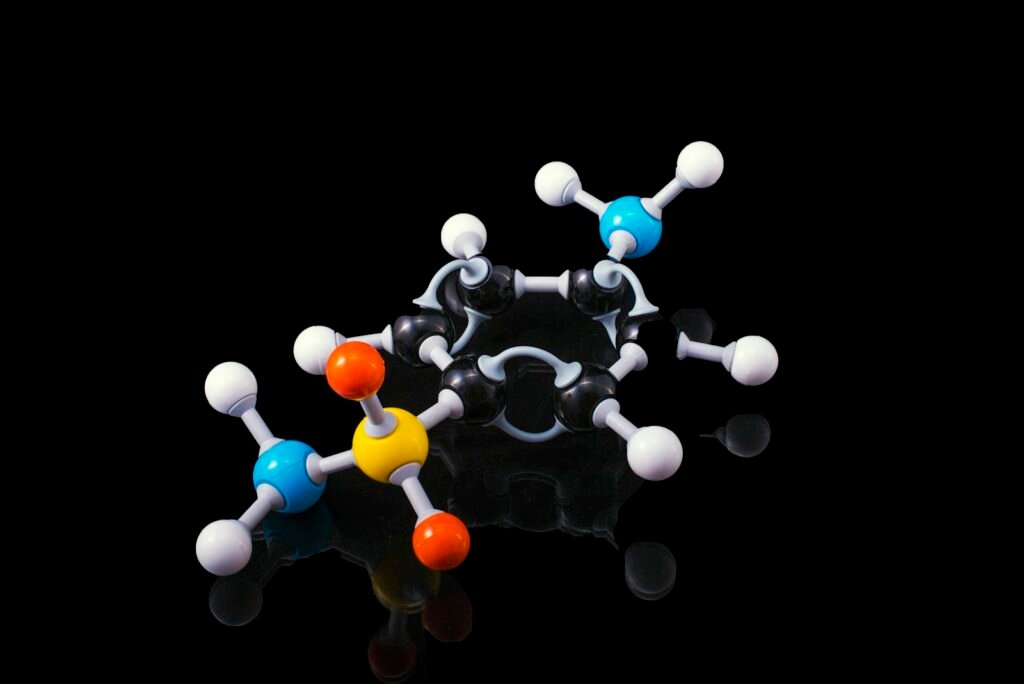
In simple terms
A molecule is a group of atoms bonded together and behaving as one unit.
Water is the familiar case: hydrogen and oxygen atoms joined into a single particle. The atoms on their own are gases with nothing watery about them.
How it works
IUPAC, the body that sets chemical terminology, defines a molecule as an electrically neutral entity consisting of more than one atom. Neutral is part of the definition, so a charged particle is an ion rather than a molecule.
The rigorous version is stricter. IUPAC adds that the entity must correspond to a depression on the potential energy surface deep enough to confine at least one vibrational state, which is a precise way of saying the atoms are genuinely bound rather than passing one another.
Size varies enormously. A molecule may hold two atoms or many thousands, as in a protein.
The count is what separates it from an atom. Because IUPAC requires more than one atom, a single free atom is not a molecule.
Why it matters
The molecule is the level at which chemistry becomes recognizable. Britannica describes it as the smallest identifiable unit of a pure substance that keeps that substance composition and chemical properties.
Medicine, materials, fuels and food all turn on which atoms are joined and in what arrangement, which is why chemical names and structural diagrams carry so much weight.
Where you will see it
- Drug labels and chemical names on product packaging.
- Climate reporting on greenhouse gases such as methane and carbon dioxide.
- Biology, where proteins and DNA are described as large molecules.
- Astronomy, where telescopes detect molecules in interstellar clouds.
Example
The oxygen we breathe travels as a molecule of two oxygen atoms bonded together, not as single loose atoms.
Often confused with
An atom is a single building block. A molecule is two or more of them bonded together, and IUPAC definition turns on exactly that count.
Key facts
- IUPAC defines a molecule as an electrically neutral entity consisting of more than one atom.1
- The rigorous IUPAC form requires the entity to correspond to a depression on the potential energy surface deep enough to confine at least one vibrational state.1
- The IUPAC definition is drawn from the 1994 Glossary of terms used in physical organic chemistry.1
- Britannica defines a molecule as a group of two or more atoms forming the smallest identifiable unit of a pure substance that retains its composition and chemical properties.2
- Because the definition requires more than one atom, a single free atom is not a molecule.12
Related concepts
In the news
Quick checkHow many atoms does a molecule need?Show answer
More than one. IUPAC definition requires at least two atoms, and the entity must be electrically neutral.
Sources
- IUPAC. molecule, entry M04002, Compendium of Chemical Terminology (Gold Book). 1994 (accessed 23 September 2026)
- Encyclopaedia Britannica. Molecule. Undated (accessed 23 September 2026)
Editorially reviewed by Specialty Digest Editorial TeamLast reviewed September 23, 2026Researched and drafted with AI assistanceReport an issue