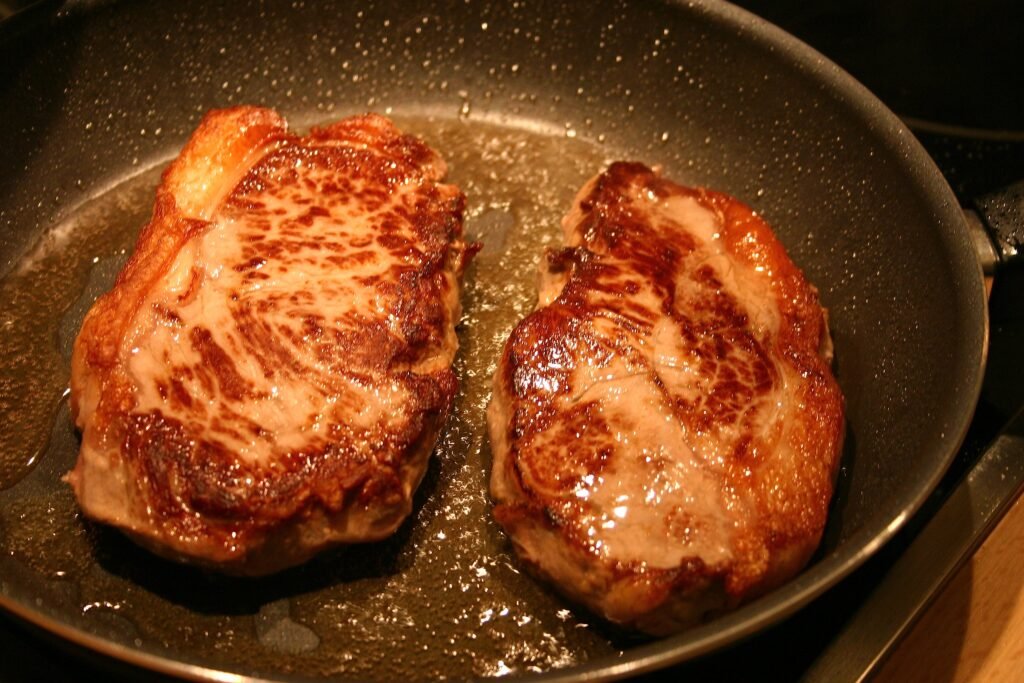
The Maillard reaction is a kind of browning that happens when heat makes amino acids react with reducing sugars. Enzymes do not cause it. Food scientists at the University of Guelph say it creates the color and flavor of seared meat, bread crust, roasted coffee, chocolate and fried dumplings.
What happens in the pan
A reducing sugar is a sugar, such as glucose or fructose, that can bond with an amino acid. Table sugar (sucrose) is not one. Heat pushes the two to react. They form unstable compounds that rearrange and break into many smaller molecules. Some of these give off aromas that range from meaty to toasted to buttery. Others join into brown pigments called melanoidins. So the reaction makes both the color and the smell of cooked food.
The reaction needs amino acids. It happens in foods that have protein or free amino acids plus a reducing sugar. Meat, dough, coffee beans and cocoa beans all qualify. The mix of sugars and amino acids in each food changes the flavors you get.
Why dry, hot surfaces brown and boiled food stays pale
The reaction gives off water as it goes, so a wet setting slows it. Water on a food’s surface also holds that surface near 100 °C, the boiling point, until the water is gone. That is why cooks pat meat dry before searing. It is also why boiled or steamed food stays pale. The reaction can run slowly at lower temperatures. In ordinary cooking, though, it shows up when a drying surface gets well above boiling.
How it differs from caramelization
Caramelization is sugar browning on its own. It happens in both reducing and non-reducing sugars. The heat needed depends on the sugar. The University of Guelph lists about 110 °C for fructose, 150 °C for glucose and 170 °C for sucrose. The Maillard reaction needs both a reducing sugar and an amino acid. In high-heat cooking, both add to browning and flavor.
The trade-off: acrylamide
The same chemistry can form acrylamide. The U.S. Food and Drug Administration (FDA) says acrylamide forms from sugars and the amino acid asparagine. It happens during high-heat cooking such as frying, roasting and baking. FDA says it is found mainly in plant foods such as potato products, grain products and coffee. It does not form, or forms at lower levels, in dairy, meat and fish. It builds up more when cooking lasts longer or runs hotter.
FDA says acrylamide caused cancer in animals exposed to very high doses. A 2010 FAO/WHO expert committee judged that margins of exposure in the human diet were low for a compound that can damage DNA and cause cancer. It said this may indicate a human health concern. FDA says it is not clear exactly what risk acrylamide poses to people. So the evidence on risk at normal diet levels is uncertain, not settled.
FDA’s advice is modest. Cook potato and bread products to a golden yellow or light brown, not dark brown. The darkest areas hold the most acrylamide. FDA also says people do not need to stop eating fried, roasted or baked foods. FDA is a U.S. agency, and other regulators may word their advice differently. For related terms, see the entries on the Maillard reaction, baking science, sous vide, coffee roasting and food processing.
FAQs
Is the Maillard reaction the same as caramelization? No. Caramelization is sugar browning alone. The Maillard reaction needs a reducing sugar and an amino acid.
Why does boiled meat look gray? Boiling keeps food wet and near 100 °C. Moisture slows the reaction, so little browning occurs.
Which foods depend on it? Food scientists give seared meat, bread crust, roasted coffee, chocolate and fried dumplings as examples.
Is browned food harmful? Not in itself. The concern is acrylamide, which forms in some high-heat plant foods. FDA advises cooking to a lighter brown and eating a varied diet. It does not advise avoiding browned foods.
More in Science
- University of Guelph, Rogers Lab, “Caramelization and Maillard Reaction,” Introduction to Food and Nutritional Sciences. rogerslab.uoguelph.ca
- U.S. Food and Drug Administration, “Acrylamide Questions and Answers.” fda.gov/food/chemicals/acrylamide-questions-and-answers
- U.S. Food and Drug Administration, “Acrylamide and Diet, Food Storage, and Food Preparation.” fda.gov/food/process-contaminants-food
- U.S. Food and Drug Administration, “Acrylamide.” fda.gov/food/chemicals/acrylamide
- World Health Organization, JECFA database entry for acrylamide (FAO/WHO Expert Committee on Food Additives evaluations, including 2010). apps.who.int