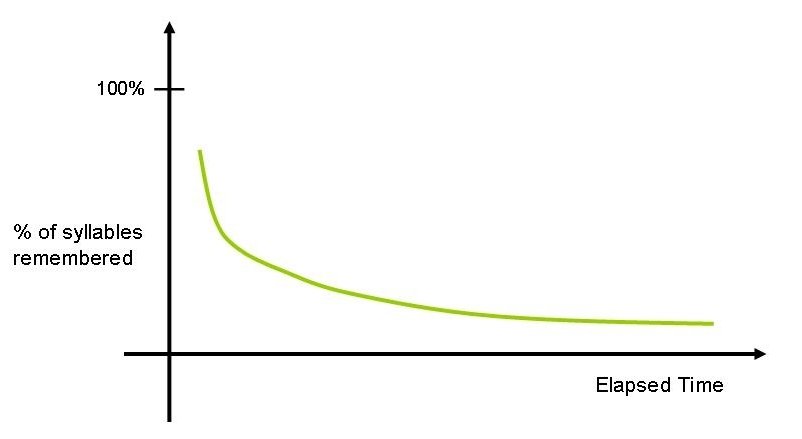
The spacing effect is the well-documented finding that people remember information better and for longer when study sessions covering that information are spread out over time rather than crammed into a single, concentrated session. The effect was first documented experimentally by psychologist Hermann Ebbinghaus in the late nineteenth century through his pioneering studies of memory using lists of nonsense syllables, and it has since been replicated across a very wide range of subjects, age groups, and types of material.
Why spacing improves retention
Researchers have proposed several explanations for why spaced study outperforms cramming, including the idea that retrieving a memory after some forgetting has begun to occur strengthens that memory more than retrieving it while it is still fresh, since the retrieval effort itself reinforces the learning. Spacing also appears to encourage a learner to re-encode information in a slightly different context each time, creating more varied and robust memory associations than repeatedly studying the same material in the same mental state during one sitting.
Classroom and real-world applications
Despite strong and consistent research support, the spacing effect is frequently ignored in practice, since cramming tends to feel more effective in the moment and students often judge their own learning by how fluent the material feels immediately after studying rather than by how well they will remember it days or weeks later. Educators and software developers have built spaced repetition systems, which schedule review sessions at increasing intervals based on how well a learner has previously recalled each piece of information, directly applying the spacing effect to vocabulary learning, medical education, and other memorization-heavy fields.
The forgetting curve and optimal spacing
Ebbinghaus also documented what is now called the forgetting curve, showing that memory for newly learned material declines rapidly at first and then more slowly over time, and spaced repetition systems are designed around this curve by scheduling review sessions to occur just before a learner is likely to forget a given piece of information. Finding the truly optimal spacing interval for a specific learner and specific material remains an active area of research, since intervals that are too short waste study time on material already well remembered, while intervals that are too long risk the information being forgotten entirely before the next review.
The spacing effect is frequently discussed alongside the related testing effect, which finds that actively retrieving information through practice testing strengthens memory more than simply re-reading the same material, and many effective study techniques combine both principles by spacing out retrieval practice sessions rather than spacing out passive review alone.
Spacing in formal education systems
Despite strong research support, most traditional school curricula are organized around a unit-by-unit structure that moves on to new material shortly after a topic is tested, which runs counter to the spacing effect’s recommendation of revisiting older material periodically throughout a course rather than only at the time it is first taught. Some newer curriculum designs have begun deliberately incorporating cumulative review built on spaced retrieval principles, mixing older material into practice sets and quizzes well after a unit has formally concluded rather than treating each unit as closed once its test is complete.
Spacing across different types of material
While the spacing effect has been demonstrated across many types of learning, the ideal spacing interval appears to vary depending on how complex or interconnected the material is, with some research suggesting that simple factual recall benefits from relatively short spacing intervals while more complex conceptual material may benefit from somewhat longer gaps between review sessions. This variation has made it difficult to offer one universal rule for optimal spacing that applies equally well across every subject and every type of learner.
Spacing effect and standardized test preparation
Test preparation companies and tutoring services have increasingly built spacing principles into their study plans, scheduling review of earlier material throughout a preparation period rather than concentrating all study time in the days immediately before an exam, a shift at least partly driven by the accumulating research evidence on how much more durable spaced learning tends to be compared with last-minute cramming.
Practical obstacles to applying the spacing effect
Despite being one of the most replicated findings in cognitive psychology, the spacing effect faces a persistent gap between research evidence and everyday practice, since both students and sometimes teachers continue to favor concentrated review before a test based on how effective it feels in the moment, a mismatch researchers refer to as an illusion of competence that spaced practice, by contrast, does not always produce as strongly even though it leads to better long-term retention.
Language-learning applications are among the most visible commercial uses of the spacing effect, with several popular platforms built explicitly around algorithms that schedule vocabulary review at expanding intervals calculated from a learner’s own past recall performance on each specific word or phrase.
Spacing effect and skill-based learning
While much spacing research has focused on factual and verbal memory, later studies have extended the finding to motor and procedural skills as well, showing that practice sessions for skills such as playing a musical instrument or performing a surgical procedure are generally retained better when spread across multiple sessions over days or weeks rather than compressed into one long practice block, reinforcing that the spacing effect applies well beyond simple fact memorization alone.
Ebbinghaus conducted his original memory experiments entirely on himself as the sole subject, a methodology considered unusual by later research standards but one that nonetheless produced findings about forgetting and spacing that have held up remarkably well under modern replication.
FAQs
More in Learning Science
Related concepts
Editorially reviewed by Specialty Digest Editorial TeamLast reviewed November 2, 2026Researched and drafted with AI assistanceReport an issue