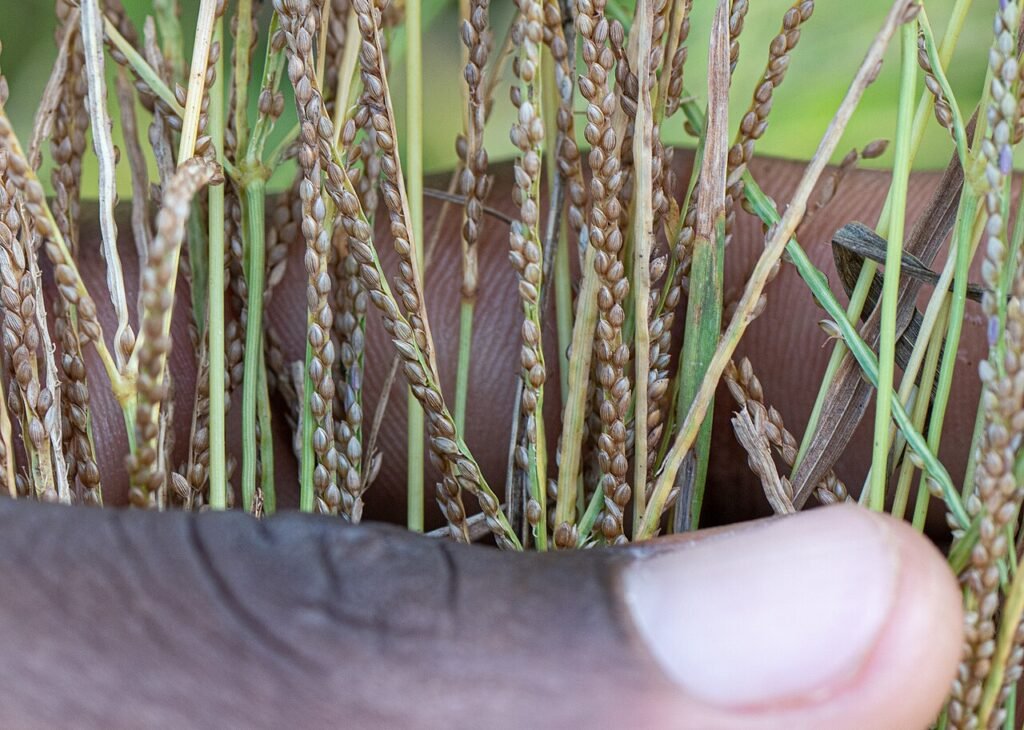
Fonio is a cereal grown across West Africa for its tiny grains, each less than a millimeter across. It is the smallest of the millets, it grows on soils where many other cereals struggle, and it is a staple for about four million people in 15 West African countries, according to a 2026 review in the journal Agriculture. After centuries as a largely local crop, it is now drawing attention from the Food and Agriculture Organization of the United Nations (FAO), plant geneticists and chefs.
History of fonio
Fonio is among the oldest crops in West Africa, but sources disagree on how old. The Crop Trust, an international organization that conserves crop diversity, says it was domesticated more than 5,000 years ago. Recent genetic evidence, summarized in the 2026 review, points instead to Nigeria around 250 to 450 AD.
The crop carries cultural weight. A 1996 report from the U.S. National Research Council recorded that some communities reserved fonio for chiefs, royalty and special occasions, and that it formed part of the traditional bride price. In the cosmology of the Dogon people of Mali, the whole universe emerged from a fonio seed.
The English nickname “hungry rice” is misleading. According to the same report, Europeans coined it without understanding the crop: West Africans harvested fonio because they liked its taste, not because they were hungry.
Types of fonio
Two species are cultivated. White fonio (Digitaria exilis) is the more widely used and grows in farmers’ fields from Senegal to Chad. Black fonio (Digitaria iburua) is mostly limited to Nigeria’s Jos-Bauchi Plateau and to northern Togo and Benin, the National Research Council reported. The two are distinguished by the color of their spikelets, the small flower units on the plant: light in white fonio, dark in black fonio.
How fonio is grown
Fonio is usually grown on poor, sandy or ironstone soils considered too infertile for pearl millet or sorghum. In the Fouta Djallon plateau of Guinea, the National Research Council noted, it grows in acidic clay soils whose aluminum content is toxic to most food crops. Some varieties produce grain just 6 to 8 weeks after planting, while others take 165 to 180 days.
The fast types matter because they ripen before other grains, when the previous year’s stores have run out. The 2026 review describes this as relief from mid-season hunger, which runs from June to September in the Sahel, the semi-arid belt south of the Sahara.
Fonio is often described as resistant to drought. The National Research Council took a more careful view in 1996: it is not as drought resistant as pearl millet, but its fast-maturing types suit areas where rains are brief and unreliable. The 2026 review adds that fonio can also survive waterlogged conditions.
In Sierra Leone, the same report found, farmers often plant fonio after wetland rice, or instead of it, when a season turns too dry for good rice harvests, so it acts as insurance against total crop failure. The report also describes a farmer near Bo who grew fonio for sale in 1990, where it sold cup for cup at a better price than rice.
Fonio nutrition
Whole-grain fonio is mostly starch, about 80 percent of dry weight, with 4.4 to 8.5 grams of protein per 100 grams, the 2026 review reports. Both the review and the Crop Trust describe it as naturally gluten-free.
Its distinctive feature is its amino acid mix. Fonio protein is rich in methionine and cystine, sulfur-containing amino acids that are scarce in wheat and white rice. In one white fonio sample analyzed in the National Research Council report, the two together made up 7.3 percent of the protein. Fonio is low in lysine, however, and the review notes that its phytate content may limit how much iron the body absorbs.
The review also raises a safety concern: one study found aflatoxin, a toxin produced by fungi, in nearly 80 percent of samples from Nigerian markets, and it calls for better handling after harvest.
Where fonio is grown
Production is concentrated. The 2026 review says 75 percent of all fonio is produced in Guinea, and the Crop Trust lists Guinea, Nigeria, Mali, Côte d’Ivoire and Burkina Faso as countries where it is an important subsistence crop. The National Research Council reported that fonio was not grown for food outside West Africa. FAO data cited in the review show the planted area more than doubling, from 0.45 million hectares in 2008 to 0.97 million hectares in 2024, while average yields fell from 1.1 to 0.7 metric tons per hectare.
Advantages and disadvantages of fonio
The advantages are speed, hardiness and strong local demand: according to the review, fonio can fetch double the price of rice in West African markets.
The disadvantages are practical. The Crop Trust lists low yields, small grains, lodging (plants falling over), seed shattering and uneven ripening, and says breeding efforts are very limited. Genesys, its information platform for seed collections held in genebanks, listed only 608 samples of white fonio as of October 2026.
Processing is the largest barrier. It is carried out almost entirely by women, the Crop Trust says, and FAO reported in September 2026 that processing 60 kilograms of fonio by traditional methods can take nearly two weeks.
Why fonio is getting attention now
Several developments point the same way. In 2020, researchers from King Abdullah University of Science and Technology, French institutes including IRD, INRAE and CIRAD, and other partners published a chromosome-scale reference genome of fonio in Nature Communications. They described it as an orphan crop, one that has received little research, with great potential for dryland agriculture, and found that two genes linked to seed size and shattering show signs of selection.
In July 2026, University of Guelph researchers published a review in Agriculture arguing that white fonio could serve as a model for fully domesticating ancient crops and adapting them to climate change. In early September, FAO set up a fonio tasting stand at a diplomatic event in Ghana‘s capital, Accra, and said that it and its partners have trained about 100 women fonio producers in Chereponi, in the North East Region. A study of Ghana’s fonio supply chain is due soon.
The picture is not settled. FAO says fonio remains underutilized and unfamiliar to many consumers, and the review concludes that sustained investment is needed to improve yields and protect the crop’s genetic diversity.
FAQs
Is fonio a millet?
Yes. The 2026 review calls it the smallest of the millets.
What is fonio called?
The National Research Council lists acha in Nigeria, fini in Bambara, and findi or fundi in Senegal.
Is fonio gluten-free?
Yes. Both the Crop Trust and the 2026 review describe it as naturally gluten-free.
More in Nature
- National Research Council, “Fonio (Acha),” in Lost Crops of Africa: Volume I: Grains, National Academies Press, 1996. nationalacademies.org
- Crop Trust, “Fonio,” Knowledge Hub, accessed November 2026. croptrust.org
- Pudasaini, R. and Raizada, M. N., “A Systems-Based Review of White Fonio (Digitaria exilis), an Ancient Millet That Reduces Mid-Season Hunger Across West Africa,” Agriculture 16(15), 1608, 28 July 2026, University of Guelph. mdpi.com
- Food and Agriculture Organization of the United Nations, Regional Office for Africa, “A taste of fonio: FAO puts an ancient African grain in the spotlight in Accra,” 8 September 2026. africa-newsroom.com
- Abrouk, M. et al., “Fonio millet genome unlocks African orphan crop diversity for agriculture in a changing climate,” Nature Communications 11, 4488, 2020. doi.org