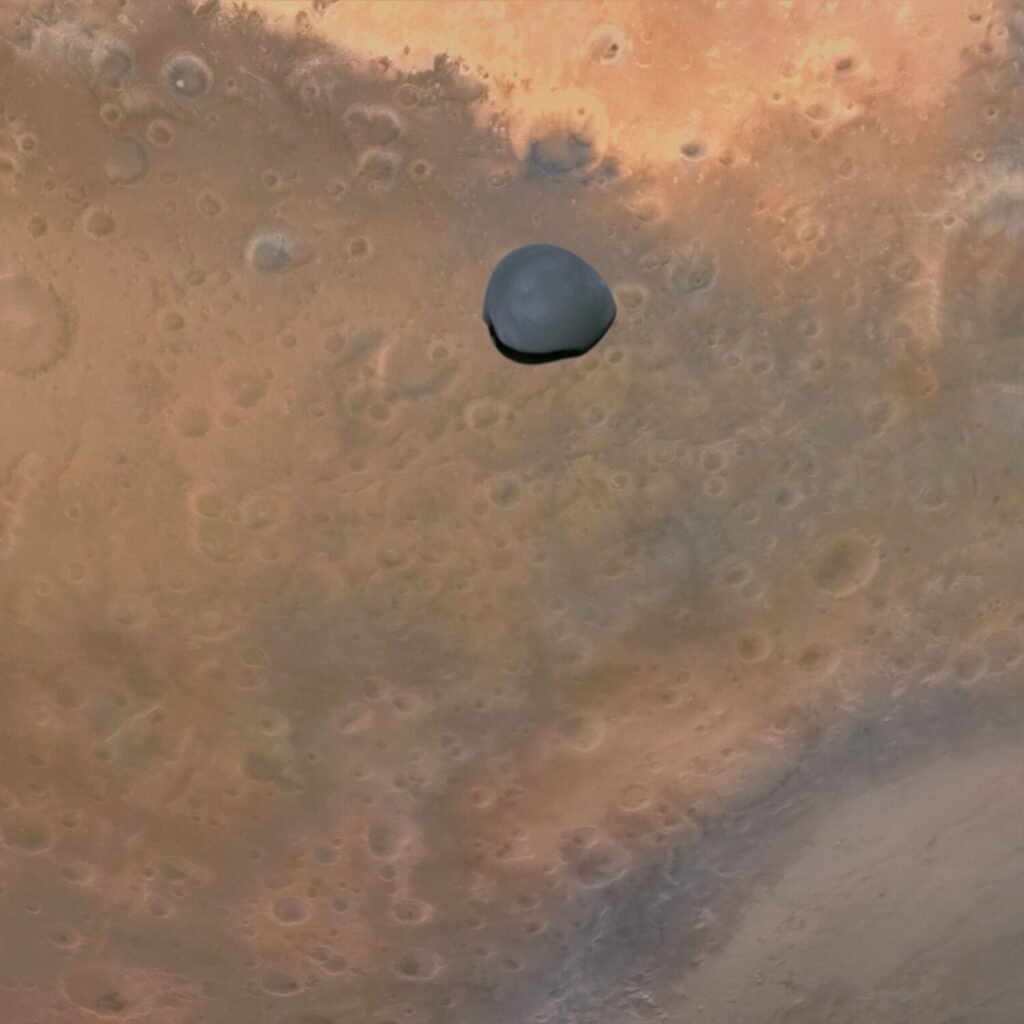
ESA’s Hera spacecraft is on track to arrive at the Didymos asteroid system in November 2026, a month earlier than first planned, according to ESA. Hera will study what happened when NASA’s DART spacecraft struck Dimorphos, the small moon of Didymos, in 2022. This article summarizes ESA’s account of the mission, based on the agency’s most recent update we could open, and explains why the survey matters for planetary defense.
What is the Hera mission?
Hera is an ESA mission that launched on October 7, 2024. ESA says it will study the aftermath of NASA’s DART mission and help humankind learn how to reliably change an asteroid’s trajectory. It will also perform the first survey of a binary asteroid system, meaning an asteroid with a smaller moon in orbit around it. Didymos and Dimorphos form that pair. DART struck Dimorphos in 2022, which changed the moon’s orbit around Didymos and scattered debris.
When does Hera arrive?
ESA says Hera is on track to arrive at Didymos in November 2026, a month earlier than originally planned. The original target was therefore about December 2026, a date the article does not state itself. The early arrival is possible because the propulsion system proved reliable, which let the team adopt a more aggressive maneuver plan with braking later and harder during the approach. By our own arithmetic, the trip from October 2024 to November 2026 takes about 25 months. We could not confirm from ESA that the arrival has already occurred, so readers should check ESA for the latest status.
What will Hera measure?
ESA lists these objectives:
- Measure Dimorphos’s mass to determine what the impact moved
- Determine the moonlet’s shape and volume, which supports modeling of its internal structure
- Establish the new dynamical state of the Didymos system
- Study the geophysical effects of the DART impact so the one-off experiment can be applied to other asteroids
ESA adds that modeling indicates the DART crater will stay unweathered for about four years, so Hera can study it while it is still fresh. Another ESA page states that only with a dedicated observer mission can DART’s deflection of the orbit of a small asteroid be fully validated.
What happened along the way?
Hera flew past Mars in March 2025, which curved its trajectory toward Didymos and tested the instruments at close range. ESA lists a planned second deep-space maneuver in February 2026 to line up the rendezvous. The spacecraft uses an autonomous navigation system that combines sensor data to keep the asteroid in the camera’s field of view, tested during departure from Earth and the Mars flyby. Our article on the Psyche mission covers another deep-space spacecraft that used a Mars flyby.
What are the CubeSats?
Hera carries two suitcase-sized CubeSats, Milani and Juventas. ESA says Milani was flown by Tyvak in Italy and Juventas by GomSpace in Luxembourg. They will be deployed for close-up investigations, and an Inter Satellite Link relays their data and commands. A dedicated control center is being built at ESA’s European Space Security and Education Centre in Belgium, overseen by Spacebel. A CubeSat is a small standardized satellite, a general definition not drawn from the page.
Who is involved?
ESA names OHB in Germany, GMV in Spain and Spacebel in Belgium as industry partners, with JAXA testing deep-space antennas and CNES planning the CubeSat mission. Operations are run from ESOC in Germany. The Italian CubeSat LICIACube, provided by the Italian space agency ASI, flew with DART and observed the impact ejecta in the first few minutes. Our article on interstellar comet 3I/ATLAS covers a different kind of small body.
How does Hera relate to other ESA missions?
Hera is one of several ESA missions reaching their targets around the same period. Our article on BepiColombo at Mercury covers another ESA mission that is approaching its destination, though the two have very different goals. Hera is a planetary defense mission, while BepiColombo is a planetary science mission. That contrast is our own framing, and ESA’s pages describe each mission separately. What links them is a long cruise followed by a carefully planned arrival, which is why both pages stress dates and maneuvers.
How to read the plan
Two kinds of statement appear in ESA’s account. The launch, the Mars flyby and the DART impact are past events. The November 2026 arrival and the survey objectives are plans. The article we used was written before arrival and says Hera is on track, not that it has arrived. ESA does not give the sizes of Didymos and Dimorphos in the pages we opened, so we omit them. A binary system is useful because the moon’s orbit offers a way to measure the effect of the impact. That is a general point.
Glossary
- Binary asteroid: an asteroid with a smaller moon in orbit around it
- Kinetic impactor: a spacecraft that changes an asteroid’s motion by hitting it
- Planetary defense: work to detect and, if needed, deflect hazardous asteroids
- CubeSat: a small standardized satellite
- Dynamical state: how the objects in a system move around each other
These definitions are general explanations and are not quoted from ESA.
What is not covered here?
The ESA pages we used do not give the sizes of the two asteroids, the instrument list, or the date of the DART impact. We have not added them from memory. Readers should consult ESA and NASA for those details.
Key facts at a glance
- Launch: October 7, 2024
- Planned arrival at Didymos: November 2026
- Mars flyby: March 2025
- CubeSats: Milani and Juventas
- DART impact on Dimorphos: 2022
Frequently asked questions
What is Hera for?
To study the aftermath of NASA’s DART impact and survey a binary asteroid system.
When does it arrive?
November 2026, according to ESA’s latest update we found.
Does it land on the asteroid?
The ESA pages we used describe a survey and CubeSat deployment, not a landing.
More in Science