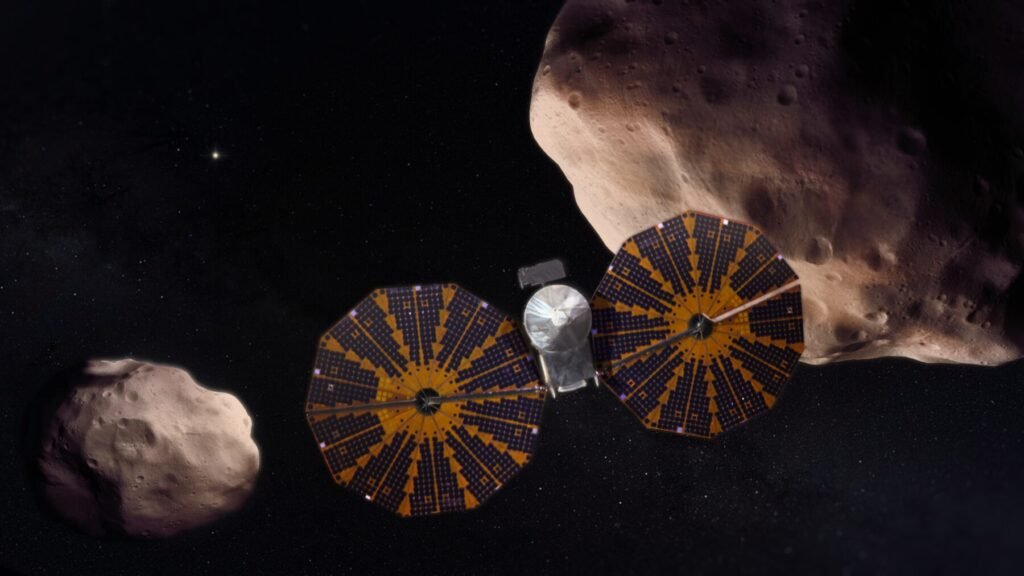
Lucy enters the Jupiter Trojan region: NASA says its spacecraft is the first to enter the part of space occupied by the Jupiter Trojan asteroids, five years after launch. This article summarizes NASA’s own mission blog and explains where Lucy is, how far it has traveled and which asteroids it will visit between 2027 and 2033. We add only labeled arithmetic and general definitions.
What did NASA announce?
NASA reports that Lucy, which launched on October 16, 2021, has reached the Trojan asteroid region and is approaching Jupiter’s L4 point. According to the agency, the spacecraft has traveled more than 2.2 billion miles and is the first to enter this region. Engineers track its position using radio signals and images of the surrounding stars. NASA also says Lucy now operates more than five times farther from the Sun than Earth does.
Where are the Trojans?
The Trojans are asteroids that sit near two points along Jupiter’s orbit. One cluster, called L4, is ahead of the planet. The other, called L5, trails behind it. NASA says both clusters are about 484 million miles from Jupiter, roughly the same distance as Jupiter is from the Sun. That means the two groups form a rough triangle with the Sun and the planet. The triangle description is a general geometric point and is not a quotation from NASA.
Why will it take years to reach the first target?
Entering the region is not the same as arriving at an asteroid. NASA says Trojans are separated by more than 6 million miles on average. Until Lucy closes in, each one looks like a single point of light. The first planned encounter, with the asteroid Eurybates, is on August 11, 2027, so the spacecraft still has a long approach ahead of it.
Which asteroids will Lucy visit?
NASA’s blog lists these targets and dates:
- Eurybates: August 11, 2027, the first encounter
- Polymele: September 2027
- Leucus: April 2028
- Orus: November 2028
- Earth gravity assist: 2030, the third and final one
- Patroclus and Menoetius, a binary pair: March 2033
The 2030 Earth gravity assist sends Lucy toward the trailing Trojan group, where it will study the Patroclus and Menoetius pair. The first four targets are in the leading group near L4. The pair is in the trailing group near L5.
How to read the numbers
By our own arithmetic, the gap between launch in October 2021 and the first encounter in August 2027 is a little under six years. The span from that first encounter to the Patroclus and Menoetius flyby in March 2033 is about five and a half years. Counting the two members of the binary pair separately, the article’s list names six Trojan asteroids. These calculations are ours and are not figures NASA states. The dates are plans, and mission teams can adjust schedules.
Why do Trojan asteroids matter?
The blog excerpt we used does not explain the science goals in detail, so we describe them only in general terms. Scientists study asteroids because they are leftovers from the early solar system, and objects that have stayed in one place for a long time may preserve clues about how the planets formed. That is a general explanation and is not drawn from NASA’s post. For the specific science objectives and instruments, readers should consult NASA’s Lucy mission pages.
How does Lucy compare with other missions?
Lucy is one of several long-duration missions that rely on patient cruising and carefully timed flybys. Our article on the Psyche mission covers a spacecraft heading to a metal asteroid, and our report on ESA’s Hera mission describes a probe preparing to study a binary asteroid system. Our guide to Europa Clipper covers another NASA spacecraft that uses gravity assists to reach a distant target. The common thread is that deep-space travel is slow, and the dates matter more than the headlines.
Telescopes also help with this kind of work, because they find and characterize small bodies from far away. Our article on the James Webb Space Telescope explains how that observatory works, though Lucy itself will gather data up close.
Related reading: Dragonfly Completes Its First Simulated Flight Ahead of a Titan Launch.
Glossary
- Trojan asteroid: an asteroid that shares a planet’s orbit around the Sun, in the groups ahead of or behind it
- L4 and L5: two stable regions in a planet’s orbit, one ahead and one behind, where small bodies can stay for long periods
- Gravity assist: a maneuver that uses a planet’s gravity to change a spacecraft’s speed or direction
- Binary asteroid: two asteroids that orbit each other
- Flyby: a close pass of a target without entering orbit or landing
These definitions are general explanations and are not quoted from NASA.
What is not covered here?
NASA’s blog post does not name Lucy’s instruments, and it does not describe what the spacecraft will measure at each target. It also does not give the sizes of the asteroids. We have not added those details from memory. Readers who need them should check NASA’s mission pages directly.
Key facts at a glance
- Launch: October 16, 2021
- Distance traveled: more than 2.2 billion miles
- Status: first spacecraft to enter the Jupiter Trojan region
- First encounter: Eurybates, August 11, 2027
- Final planned encounter: Patroclus and Menoetius, March 2033
Frequently asked questions
Has Lucy reached an asteroid yet?
Not yet. NASA says it has entered the Trojan region, and the first planned encounter is on August 11, 2027.
Why are the asteroids so far apart?
NASA says they are separated by more than 6 million miles on average, so the region is huge and sparse.
How far from the Sun is Lucy?
NASA says it is more than five times farther from the Sun than Earth is.
More in Science