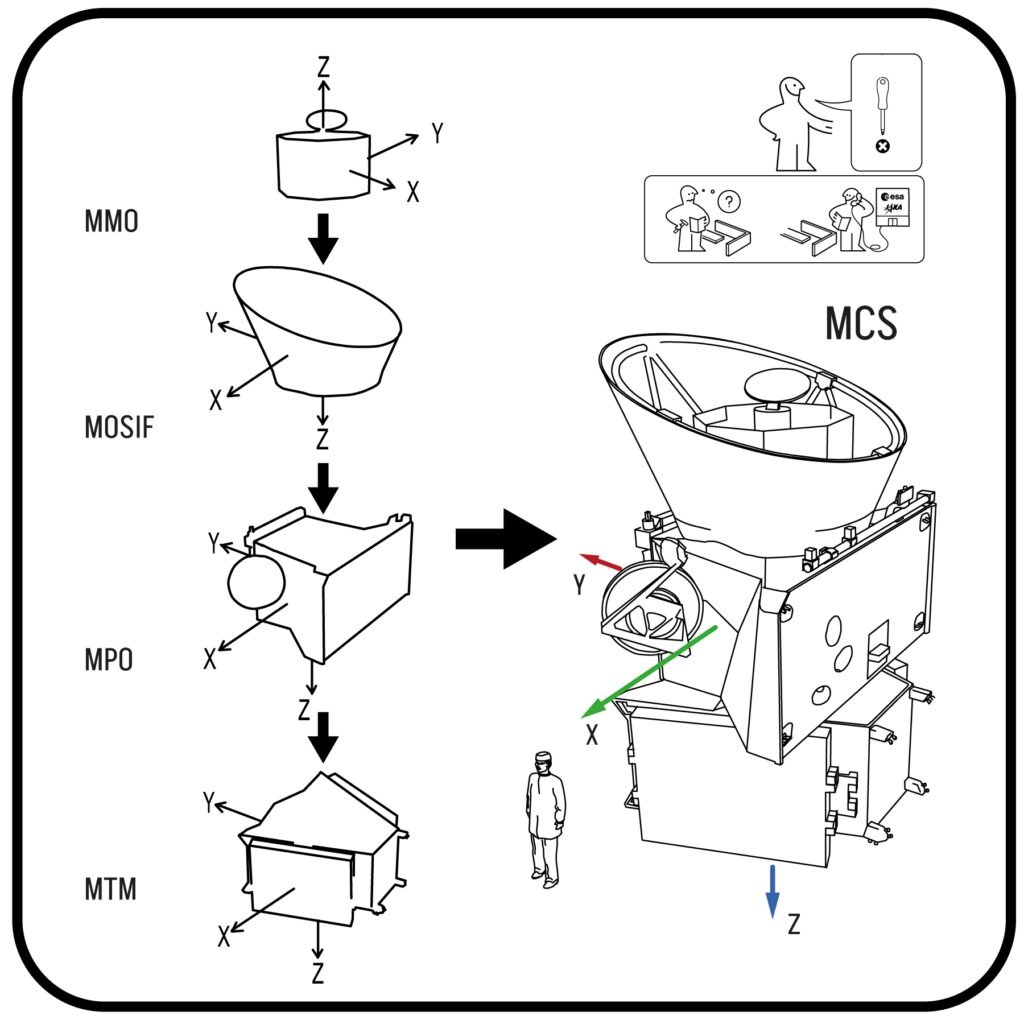
The European Space Agency (ESA) and Japan’s space agency JAXA expect that BepiColombo reaches Mercury on November 21, 2026, when it enters orbit around the planet, after eight years in the inner solar system. ESA’s mission page also lists the date the two orbiters separate and when the science phase begins. This article summarizes what ESA reports and what each part of the spacecraft does.
When does BepiColombo reach Mercury?
ESA says the composite spacecraft will enter Mercury orbit on November 21, 2026. The page gives no time of day for the insertion. The two orbiters, ESA’s Mercury Planetary Orbiter (MPO) and JAXA’s Mercury Magnetospheric Orbiter (Mio), will separate from each other on December 9 and 10, 2026. The science phase is set to begin in April 2027. By our own arithmetic, that leaves about four and a half months between orbit insertion and the start of science operations.
What are the parts of the spacecraft?
ESA’s page describes three modules:
- Mercury Transfer Module (MTM): separated from the stack on September 3, 2026
- Mercury Planetary Orbiter (MPO): ESA’s orbiter, which powers the stack until Mio separates
- Mercury Magnetospheric Orbiter (Mio): JAXA’s orbiter, which stays attached to MPO until December 9 to 10
ESA leads the mission in close collaboration with JAXA. The transfer module is the part that carried the orbiters through space, and a general description of its role is not given on the ESA page we used.
What happened in September 2026?
ESA reports that signal acquisition at 14:52 BST (15:52 CEST) on September 3 confirmed the transfer module had separated, after a preliminary Doppler signal at 13:41 BST. On September 24, MPO tested its axial thrusters for the first time in the new configuration. The burn lasted 8 minutes and 42 seconds and gave a push of 11.4 meters per second, the first planned trajectory correction since the separation. By our own arithmetic, 8 minutes 42 seconds is 522 seconds, and 11.4 meters per second is about 41 kilometers per hour. A Doppler signal is a shift in radio frequency caused by motion, a general definition that ESA does not give on the page.
Which instruments were tested?
ESA says three MPO instruments were switched on and tested for first light in September 2026: the BELA laser altimeter, the MERTIS thermal spectrometer and the SIMBIO-SYS science camera. A laser altimeter measures height by timing laser pulses, a thermal spectrometer measures heat radiation from a surface, and a science camera takes images. Those descriptions are general. ESA does not list science goals on the page we used, and we do not state any here.
What comes next?
ESA says several more small trajectory correction slots are planned before the main orbit insertion sequence in November. The page does not describe the orbit parameters. Readers should treat all dates as plans, since deep space schedules can shift, and check ESA’s mission page for updates. Our article on Parker Solar Probe’s record pass covers another spacecraft operating close to the Sun, and our article on the Psyche mission covers another mission that used gravity assists.
Why two orbiters?
ESA’s page names the two orbiters but does not explain their separate roles. The names offer a clue: one is a planetary orbiter and the other a magnetospheric orbiter. In general, a mission built this way studies both the planet itself and the magnetic environment around it, with each spacecraft carrying instruments for its own task. That is our general reading of the names and is not a statement from ESA. The agency’s only specific statement here is that ESA leads the mission in close collaboration with JAXA and that the two stay together until the December separation.
How to read the dates
Four dates matter. September 3 is the transfer module separation, which has happened. September 24 is the first thruster burn after separation, which has also happened. November 21 is orbit insertion, which has not. December 9 to 10 is the separation of the two orbiters, followed by April 2027 for science operations. The first two are reports of events, and the last three are plans. That distinction helps readers avoid treating planned dates as confirmed outcomes.
Why does reaching Mercury take so long?
ESA’s page says only that the spacecraft has spent eight years traveling through the inner solar system. Reaching Mercury requires slowing down, because a spacecraft falling toward the Sun gains speed. This is a general physical explanation, and ESA does not give it on this page. The same logic explains why missions to the inner planets often use planetary flybys. Our article on the Voyager 1 light-day milestone covers the opposite case, a spacecraft far from the Sun.
Glossary
- Orbit insertion: the maneuver that places a spacecraft into orbit around a body
- Trajectory correction: a small burn to adjust a spacecraft’s path
- Magnetosphere: the region around a planet shaped by its magnetic field
- Spectrometer: an instrument that splits light or radiation to study composition
- Doppler shift: a change in frequency caused by relative motion
These definitions are general explanations and are not quoted from ESA.
What is not covered here?
The ESA page does not give the launch date, the number of flybys, the orbit parameters or the science goals. We have not supplied them from memory. For those details, readers should consult ESA and JAXA mission pages.
Key facts at a glance
- Orbit insertion planned: November 21, 2026
- Orbiters separate: December 9 to 10, 2026
- Science phase begins: April 2027
- Transfer module separated: September 3, 2026
- Partners: ESA and JAXA
Frequently asked questions
When does BepiColombo arrive at Mercury?
ESA plans orbit insertion on November 21, 2026.
What are MPO and Mio?
MPO is ESA’s orbiter and Mio is JAXA’s orbiter. They fly together until December 9 to 10.
When does science start?
April 2027, per ESA.
More in Science
- ESA's Hera Mission Heads for Didymos: A Planetary Defense Follow-Up in November 2026
- Lucy Enters the Jupiter Trojan Region: What NASA Reports Five Years After Launch
- NEO Surveyor Sunshade: How NASA Plans to Find Hard-to-Spot Asteroids
- Artemis III in 2027: NASA Plans a 14-Day Earth-Orbit Test of Moon Landers