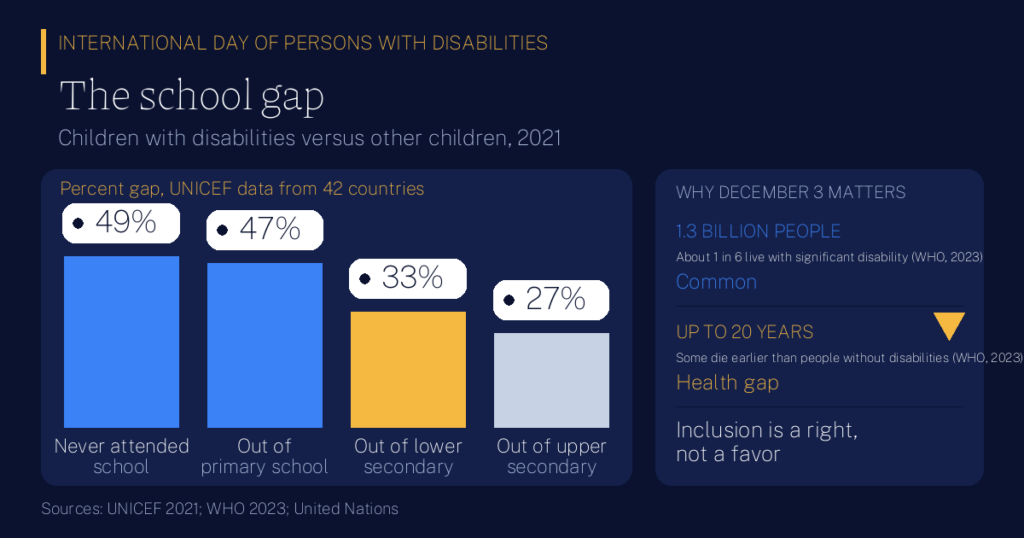
Disability is not rare, distant or someone else’s story. The World Health Organization (WHO) estimates that 1.3 billion people, about 1 in 6 of us, live with significant disability. Anyone who lives long enough is likely to join them, through illness, injury or age. Yet in many places stairs without ramps, websites without text alternatives and classrooms without support still decide who gets to take part. The International Day of Persons with Disabilities, observed every year on December 3, asks the world to look at those barriers and to treat their removal as a matter of rights, not charity. It sits close to World Children’s Day, because so many of the gaps begin in childhood.
How a day of awareness became a rights movement
The United Nations General Assembly proclaimed the observance in 1992 through resolution 47/3, at first calling it the International Day of Disabled Persons. Its aim is to promote the rights and well-being of persons with disabilities in every part of society and development, and to raise awareness of their situation in political, social, economic and cultural life.
The day gained a firmer legal footing with the Convention on the Rights of Persons with Disabilities, adopted in 2006 and in force since May 3, 2008. The UN’s observance page reports that 193 countries have ratified it. The Convention changed the conversation. Instead of treating disability as a medical problem to be fixed or a burden to be pitied, it asks societies to remove barriers so that people can exercise the same rights as everyone else.
What disability means
Disability is not only a feature of a body. The Convention recognizes that it results from the interaction between people with impairments and the attitudinal and environmental barriers around them. A person who uses a wheelchair is disabled by the staircase, not by the chair. Disability includes physical, sensory, intellectual and psychosocial conditions, and many are invisible. That is why inclusion is framed as a design question for everyone: buildings, transport, classrooms, forms and workplaces can be built to welcome people or to shut them out.
The numbers behind the day
WHO’s fact sheet of March 2023 estimates that 1.3 billion people experience significant disability, which is 16 percent of the world’s population. The UN observance page adds that about 80 percent of persons with disabilities live in developing countries. UNICEF’s 2021 analysis put the number of children with disabilities at almost 240 million, or 1 in 10 children.
- 1.3 billionpeople with significant disability, WHO 2023
- 16%of the world’s population, or 1 in 6
- 240 millionchildren with disabilities, UNICEF 2021
- 80%live in developing countries, per the UN
Health: a gap that starts before the clinic
WHO reports that some persons with disabilities die up to 20 years earlier than those without disabilities. They face twice the risk of conditions such as depression, asthma, diabetes, stroke, obesity or poor oral health, and they meet barriers in every part of the health system, from inaccessible buildings to the attitudes of health workers. Getting there is its own hurdle: WHO says inaccessible and unaffordable transportation is 15 times more difficult for persons with disabilities. The UN observance page adds that 50 percent of persons with disabilities cannot afford health care. Women with disabilities are 2 to 4 times more likely to experience intimate partner violence, according to WHO. Anyone facing violence can contact local emergency services or a national helpline.
Example 1: the missed checkup. Imagine a clinic with no ramp, no sign language interpreter and no accessible scale. Of 100 patients with disabilities who need a yearly checkup, suppose only 60 manage one. The 40 who miss it return later with problems that were easier to treat early. The numbers are round and illustrative, but they show how an access barrier turns into a health gap.
Children, school and the early gap
UNICEF’s 2021 report drew on internationally comparable data from 42 countries. Compared with other children, children with disabilities were 49 percent more likely to have never attended school, 47 percent more likely to be out of primary school, 33 percent more likely to be out of lower secondary school and 27 percent more likely to be out of upper secondary school. They were also 42 percent less likely to have foundational reading and numeracy skills. The UN observance page adds that children with disabilities are almost four times more likely to experience violence than other children.
Example 2: the classroom ladder. Picture a district where 100 children without disabilities finish primary school. If children with disabilities were 50 percent more likely to be out of school, then for every 100 children in school without disabilities, only about 67 of an equal group with disabilities would be there. The figures are illustrative and simplified, but they show how a gap that looks modest in a percentage becomes a large number of empty desks.
Work, cost and the case for inclusion
Exclusion is expensive and inclusion pays. WHO notes that there could be almost a US$10 return for every US$1 spent on disability inclusive prevention and care of noncommunicable diseases. Behind the system stand caregivers, who are mostly women and girls, and whose unpaid work rises when services are missing. Many of the fixes are not exotic. Ramps, captions, plain-language forms, flexible schedules and accessible websites help persons with disabilities first and then almost everyone else, from parents with strollers to older workers.
Example 3: the ramp and the return. Suppose a town spends $100,000 to make its clinics and bus stops accessible. At WHO’s headline ratio of almost $10 back for each $1, which applies to inclusive noncommunicable disease care and not to every project, the illustrative return would approach $1 million in avoided illness and restored work. The numbers are made up and rounded, but the logic is the one health economists use.
How the day is marked, and what progress needs
Each year the UN sets a theme and holds a commemorative event on December 3. The 2025 theme was fostering disability inclusive societies for advancing social progress. Governments, schools, employers and civil society groups mark the day with events, accessibility audits and public campaigns, and the strongest observances ask for something concrete: accessible buildings, inclusive classrooms, health services within reach and a seat at the table when decisions are made. The slogan that disability groups have long used still fits: nothing about us without us.
Key Takeaways
- Disability is common. WHO estimates 1.3 billion people, 16 percent of the world, live with significant disability.
- Barriers disable, not bodies. The Convention frames disability as the interaction between impairments and the world around them.
- The day has legal roots. Resolution 47/3 created it in 1992, and the Convention took effect on May 3, 2008.
- Health gaps are large. Some persons with disabilities die up to 20 years earlier and face twice the risk of several common conditions.
- The gap starts in childhood. Children with disabilities are 49 percent more likely to have never attended school.
- Inclusion pays. WHO cites almost $10 back per $1 for inclusive noncommunicable disease care.
- Act on one barrier. Ask how a building, website or meeting you use could welcome more people, and say so to those who run it.
How solid is this? Estimates of how many people live with disability depend on how it is defined and measured, so sources differ: WHO reports 16 percent, while UN pages cite figures near 15 percent. The UN observance pages used here are undated, and the UNICEF data cover 42 countries and 2021. The three worked examples use round, made-up numbers to show an idea. See also the International Days hub and the International Days Calendar.
More in Society
- United Nations, International Day of Persons with Disabilities, observance page
- United Nations, International Day of Persons with Disabilities, background
- World Health Organization, Disability fact sheet (March 2023)
- UNICEF, Nearly 240 million children with disabilities (November 2021)
- OHCHR, Convention on the Rights of Persons with Disabilities
- UN Treaty Collection, Convention on the Rights of Persons with Disabilities