Every time a plane lands, people who will never meet have already cooperated. Pilots, controllers, regulators and engineers in different countries follow shared rules so that an aircraft built in one nation can safely cross the skies of many others. International Civil Aviation Day, observed every year on December 7, honors that quiet cooperation. It also asks a harder question: how can air travel keep growing while becoming safer, cleaner and open to more people? The answer starts with a treaty signed in the middle of a world war.
From a wartime conference to a UN day
In 1944, with the Second World War still under way, the United States invited 55 States to an International Civil Aviation Conference in Chicago. Of those, 54 attended, and by the conclusion of the conference on December 7, 1944, 52 of them had signed the Convention on International Civil Aviation, known as the Chicago Convention. According to the United Nations, delegates gathered in the Grand Ballroom of the Stevens Hotel to conclude and sign it. The treaty laid the groundwork for ICAO, which was first run by an interim council and officially became ICAO on April 4, 1947, once enough States had ratified the Convention. Its first Assembly met that May.
The day itself came decades later. ICAO established International Civil Aviation Day in 1994 as part of its 50th anniversary activities, and in 1996 the United Nations General Assembly officially recognized December 7 as the day, in resolution A/RES/51/33. The date echoes the close of the Chicago conference. Today ICAO counts 193 Member States.
What civil aviation means
Civil aviation covers all flying that is not military: scheduled airlines, cargo carriers, charter flights and business aviation, along with the airports and air navigation services that support them. Because aircraft cross borders within hours, no single country can regulate the sector alone. ICAO’s standards and recommended practices are agreed by consensus among its Member States, and its December 2025 release notes that 32 resolutions were adopted unanimously at the 42nd Session of the ICAO Assembly that year. In practice, this shared rulebook is what lets a flight from one country land in another under procedures both sides recognize. It is the product the day celebrates.
The numbers behind the day
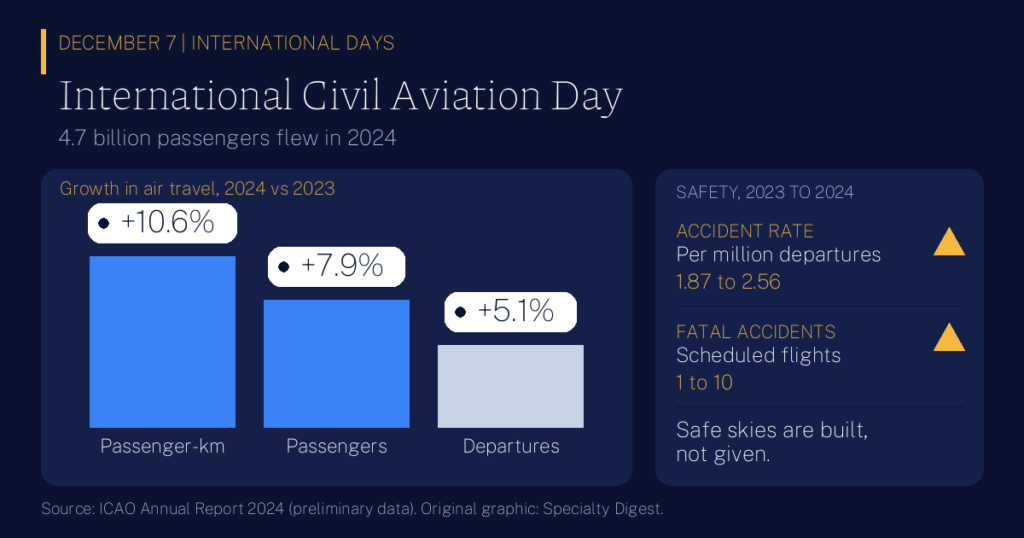
Air travel now operates at a scale that is easy to underestimate. ICAO’s preliminary figures for 2024 show that scheduled services carried 4.7 billion passengers, 7.9 percent more than in 2023. Airlines operated 37.4 million scheduled departures, up 5.1 percent, and passenger traffic reached 9,098 billion revenue passenger-kilometers, up 10.6 percent. A revenue passenger-kilometer is one paying passenger flown one kilometer, so the measure counts both how many people fly and how far. Traffic measured this way grew faster than departures, which points to longer trips, fuller aircraft, or both.
- 4.7 billionpassengers on scheduled services, 2024
- 37.4 millionscheduled departures, 2024
- 193ICAO Member States
- 52States signed the Chicago Convention by December 7, 1944
Example 1: a day of flying. Spread evenly over a year, 37.4 million departures is roughly 100,000 flights every day, and 4.7 billion passengers is nearly 13 million people a day. These are rounded, illustrative averages, not ICAO daily counts, but they show how much quiet coordination sits behind an ordinary morning at any large airport.
Safety, the reason the system exists
Safety was the heart of the 1944 treaty and remains the test of whether the system works. ICAO’s preliminary data record 95 accidents in scheduled commercial air transport in 2024, up from 66 reported by Member States in 2023. The global accident rate was 2.56 accidents per million scheduled departures, compared with 1.87 in 2023. Fatal accidents rose from one in 2023 to 10 in 2024, and fatalities in scheduled operations totaled 296. These figures cover airplanes above 5,700 kilograms maximum certificated takeoff mass.
Even so, a rate of 2.56 per million departures works out to about one accident for every 390,000 departures. The 2024 figures are a reminder that a strong record is not guaranteed. It is maintained by investigation, data sharing and regular updates to the rules, and each year’s results are a prompt to study what happened and what can change.
Example 2: reading a rate. Suppose a made-up airline network flies exactly 1 million departures in a year. At the 2024 global rate of 2.56, that would mean about 2.6 accidents of any kind. At the 2023 rate of 1.87, about 1.9. The network is invented and the numbers are rounded, but the arithmetic shows why regulators pay close attention to small shifts in a rate.
Who is served, and who is left out
Flying is not evenly shared across the world. For many islands, mountain regions and remote communities, an air link is often the practical way to move supplies, medical patients and trade, which is one reason access matters as much as growth. ICAO’s stated vision, repeated in its 2025 message for the day, is “air transport for everyone by 2050, with zero fatalities and net-zero carbon emissions.” That is a target, not a measured result. Meeting it means building and sustaining the airports, training and oversight that safe flying depends on in every region, not only in the busiest ones.
How the day is marked, and what progress needs
ICAO uses the day to issue a message and a theme. The 2025 theme was “Safe Skies and a Sustainable Future for All.” A newer theme was not confirmed in the sources reviewed, so check ICAO’s page for the day for the current one. The sustainability half of that theme connects aviation to wider efforts on transport and climate, which our article on World Sustainable Transport Day explores from another angle.
Progress rests on three things: steady attention to safety data, the cooperation the Chicago delegates began, and cleaner technology to meet the net-zero goal. Growth adds to the task, because every added flight needs the same standards, inspection and training as the ones before it.
Example 3: growth meets oversight. Imagine a region whose air traffic grows 8 percent in a year, close to the 7.9 percent global rise in passengers. A route that carried 1 million passengers would carry about 1.08 million. The figures are round and illustrative, but they show that safety systems must grow alongside traffic just to stand still.
Key Takeaways
- A treaty turned flying into a shared system. On December 7, 1944, 52 States had signed the Chicago Convention.
- The day is young. ICAO created it in 1994, and the UN General Assembly recognized it in 1996 in resolution A/RES/51/33.
- The scale is enormous. Scheduled services carried 4.7 billion passengers on 37.4 million departures in 2024, by ICAO’s preliminary count.
- Safety is maintained, not given. The accident rate rose from 1.87 to 2.56 per million departures between 2023 and 2024.
- Rules work because they are shared. ICAO’s 193 Member States agree its standards and practices by consensus.
- The goal is for everyone. ICAO’s vision for 2050 is air transport for all, with zero fatalities and net-zero emissions, and it remains a target.
How solid is this? The 2024 traffic and safety figures are preliminary ICAO data and may be revised. Safety counts cover airplanes above 5,700 kilograms in scheduled commercial operations, and rates are per million scheduled departures. The three worked examples use round, made-up numbers to show an idea. See also the International Days hub and the International Days Calendar.
More in Society
- United Nations. International Civil Aviation Day: background.
- ICAO. International Civil Aviation Day: ICAO is advocating for safe and sustainable air transport for all (5 December 2025).
- ICAO. The History of ICAO and the Chicago Convention.
- ICAO. Annual Report 2024: The World of Air Transport in 2024.
- ICAO. Convention on International Civil Aviation, Doc 7300.