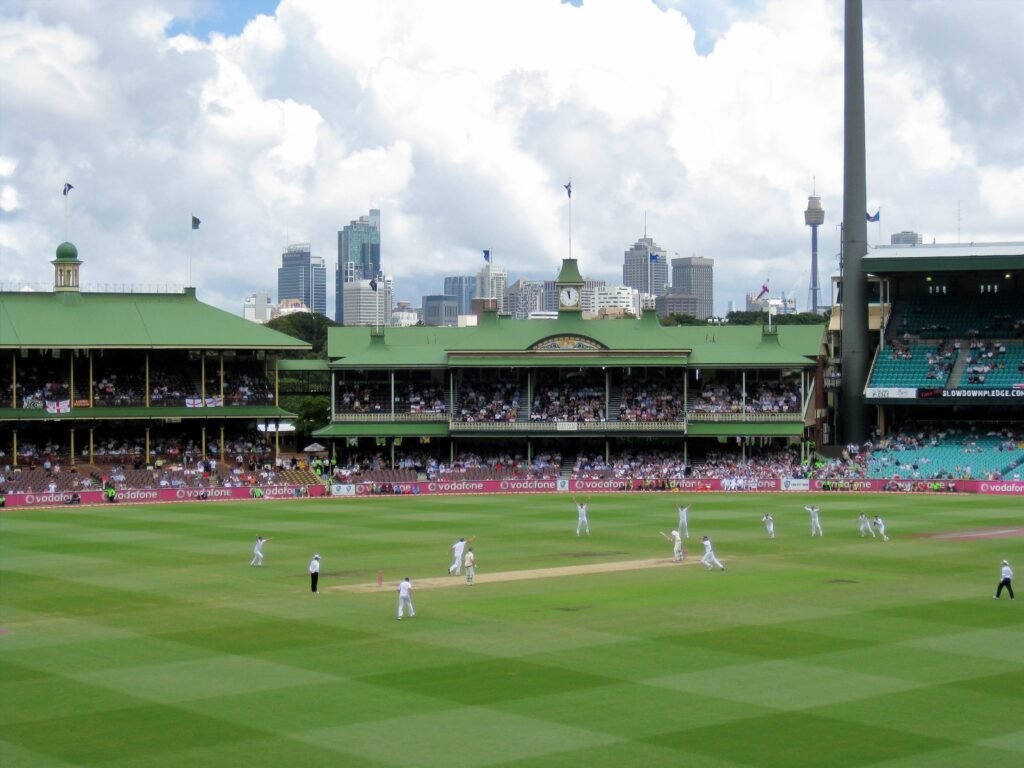
Cricket is a bat-and-ball team sport in which two teams of 11 players take turns to bat and field. The batting side scores runs by hitting the ball and running between two sets of wickets, and the bowling side tries to dismiss the batters. It is played on a grass oval with a 22-yard pitch at the center, and its Laws are maintained by Marylebone Cricket Club (MCC).
History of cricket
The first reference to cricket as an adult sport dates from 1611, the same year a dictionary described it as a boys’ game, according to the International Cricket Council (ICC). By the middle of the 17th century village cricket had developed in England. The first known match played under county names took place in 1709, and the first known women’s match was played in Surrey in 1745.
Early rules were agreed by the players before each match. The first generally accepted code of Laws was written in 1744. A revision in 1774 added the leg before wicket (lbw) rule, a third stump and a maximum bat width.
The Hambledon Club was the focus of the game for about thirty years, until MCC was formed and Lord’s opened in 1787. MCC issued a code of laws in 1788, and it remains the custodian of the Laws of Cricket today.
Cricket reached North America in the 17th century, and colonists took it to the West Indies. Mariners of the British East India Company brought it to India. It arrived in Australia almost as soon as colonization began in 1788, and it reached New Zealand and South Africa in the early 19th century.
The Imperial Cricket Conference was founded in 1909, when England, Australia and South Africa were its only members. The West Indies (1928), New Zealand (1930), India (1932) and Pakistan (1952) became Test-playing nations over the following decades. Sri Lanka (1982), Zimbabwe (1992) and Bangladesh (2000) joined later.
Rules and how cricket is played
Each team has 11 players, and one side bats while the other fields. A bowler delivers the ball from one end of the pitch toward a batter at the other, using a straight arm. An over consists of six balls.
Batters score runs by running between the wickets. A hit that reaches the boundary scores 4, and a hit that clears it without bouncing scores 6. A batter can be dismissed by being bowled, caught, given out leg before wicket, or run out. An innings ends when a team loses 10 wickets.
Cricket is played in three main formats. Test matches are the original international format, with two innings per team. One-day internationals, first played in 1971, are limited-overs games of 50 overs per side. Twenty20, created in 2003 by the England and Wales Cricket Board, gives each side 20 overs, and the team batting second must beat the first team’s score within those 20 overs.
Olympics.com calls Twenty20 the most popular format today. The three formats reward different skills, from the patience needed over several days in a Test to the rapid scoring of Twenty20.
Equipment and venues
The core equipment is a bat, a ball and the wickets at each end of the pitch. The pitch is 22 yards long and sits at the center of a grassy oval. At international level the ICC also oversees the Decision Review System, which handles reviews of umpiring decisions. The Laws have regulated the bat since 1774, when a maximum width was introduced.
Several grounds carry particular history. Lord’s, which opened in 1787, is the home of MCC and keeps the Ashes urn. The Melbourne Cricket Ground hosted the first Test match in 1877 and the first one-day international in 1971.
For the Los Angeles 2028 Olympics, Twenty20 matches are planned for the Fairgrounds Cricket Stadium in Pomona, California.
Governing bodies and major competitions
The ICC describes itself as the global governing body for cricket. It stages ICC events, appoints match officials, and oversees the Code of Conduct, the playing conditions and the Decision Review System. Its website lists 111 members. MCC remains responsible for the Laws themselves.
The events listed on the ICC site include the Cricket World Cup, the Men’s and Women’s T20 World Cups, the Women’s Cricket World Cup, the Champions Trophy and the World Test Championship. The first men’s Cricket World Cup was held in England in 1975 with all Test-playing nations taking part, and the West Indies won the final at Lord’s.
Notable moments in cricket history
The first Test match was played in Melbourne in 1877 between Australia and England, and Australia won. When Australia won at The Oval in London in 1882, the Sporting Times printed a mock obituary of English cricket, which started the contest for the Ashes.
The first one-day international was played in 1971 as a time-filler after a Test was abandoned because of rain.
Cricket appeared at the 1900 Paris Olympics, where a two-day, two-innings match saw Great Britain’s Devon and Somerset Wanderers beat the French Athletic Club Union. The IOC Executive Board approved the sport’s return for Los Angeles 2028 on April 9, 2025.
Cricket around the world
Cricket spread through the British colonial network, and the Test-playing nations now span several continents. The ICC lists 111 members across Africa, the Americas, Asia, East Asia-Pacific and Europe.
The ICC’s history notes that associate and affiliate members expanded their domestic competitions and later became involved in international cricket, which widened the game beyond the Test-playing nations. The first men’s Cricket World Cup in 1975 was limited to the Test-playing nations, whereas the ICC’s current event list includes a World Test Championship, a Champions Trophy, and both men’s and women’s World Cups and T20 World Cups.
The LA28 tournaments are planned as Twenty20 events, with six men’s teams and six women’s teams. Each gender has 90 athlete quotas, which allows squads of 15 players.
More in Sports Coaching and Performance
Key facts
- Array
Related concepts
Quick checkWhich body writes the Laws of Cricket?Show answer
Marylebone Cricket Club (MCC) issued a code of laws in 1788 and remains the custodian of the Laws of Cricket, while the International Cricket Council governs the international game.
Sources
- Array
Editorially reviewed by Specialty Digest Editorial TeamLast reviewed November 4, 2026Researched and drafted with AI assistanceReport an issue