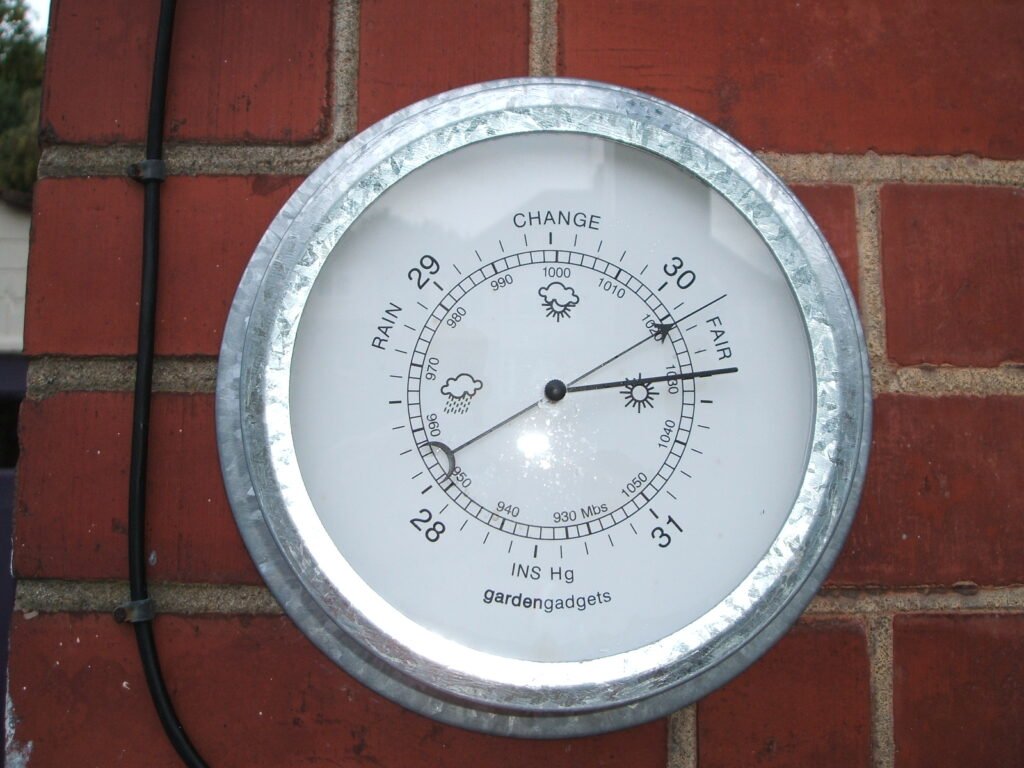
A barometer is an instrument that measures atmospheric pressure, the force of the air pressing on a surface. The first working version, a column of mercury held up in a glass tube, was built in Italy in the 1640s by Evangelista Torricelli. Barometers are now used mainly in weather forecasting and for measuring altitude.
History of the barometer
Torricelli was an Italian mathematician and physicist who studied under Benedetto Castelli and later served as Galileo’s secretary and assistant. His experiment is dated to about 1643, and he described it in a letter to Michelangelo Ricci dated June 11, 1644. He sealed one end of a glass tube roughly two cubits long, filled it with mercury and inverted it with the open end in a bowl of mercury. The column dropped to about 30 inches, or 76 centimeters, and stayed there, with an empty space above it.
Torricelli’s explanation was that the weight of the air held the mercury up. About 1647 the philosopher René Descartes added a graduated scale to the tube, which made readings easier to compare. In the late 1640s Blaise Pascal arranged for his brother-in-law Florin Périer to carry a barometer up the Puy de Dôme in France, where the mercury fell from about 76 centimeters to about 70 centimeters over a climb of roughly a mile. One reference dates this test to 1646 and another to 1648.
Later inventors added new forms. Robert Hooke devised the wheel barometer in 1663, and Jean-André de Luc designed a sturdy portable siphon barometer around 1750. Alexander Cumming built a continuously recording barometer, or barograph, for King George III in 1765. In 1843 the French physicist Lucien Vidie invented the aneroid barometer, which avoids liquid altogether.
Inventor and origins of the barometer
Torricelli is credited with the first accepted mercury barometer. The name of the instrument has a less certain history. One reference says the chemist Robert Boyle first used the word barometer in the early 1660s, while another credits the French priest and scientist Edmé Mariotte, in a book of 1676. The sources disagree, so neither claim can be stated as settled.
Priority disputes also followed the portable designs. Around 1695 John Patrick and Daniel Quare quarreled over a patent for a portable barometer. The history of the instrument is therefore a chain of improvements, with Torricelli at the start and many makers adding features after him.
How a barometer works
In a mercury barometer, the pressure of the air on the surface of the bowl supports the column of liquid in the tube, and the vacuum at the top exerts essentially no pressure. The height of the column therefore tracks the weight of the air above. Mercury suits the job because it is very dense, which keeps the column to a practical height, and because it has low vapor pressure. A water barometer would need a tube about 34 feet tall.
Mercury also expands with heat, so careful instruments carry a thermometer and a vernier scale to correct readings. Designs such as the Fortin and the English Kew barometer adjust for changes in the level of the mercury in the reservoir. Mercury is toxic, and a long glass tube of it is fragile, which are two reasons that liquid-free designs became attractive.
An aneroid barometer has no liquid. It uses a flexible sealed chamber containing a partial vacuum, and changes in air pressure move a pointer through a set of linkages. It is less bulky and less fragile than a mercury barometer, which was the goal of its design.
Types of barometers
The main types are the mercury barometer, the aneroid barometer and the barograph, which is an aneroid instrument that replaces the pointer with a pen that records pressure continuously on graph paper. The wheel barometer attributed to Hooke moves a dial hand through a mechanical linkage, and the siphon barometer designed by de Luc was meant to be portable and sturdy. Each type answers the same question of how much air presses down at a given place.
Standard sea-level pressure is 1,013.25 millibars. The same pressure is expressed as 760 millimeters of mercury, 29.92 inches of mercury or 14.7 pounds per square inch, and it is about 1.01 times 10 to the fifth power pascals. Pressure falls with height and reaches half the sea-level value at about 3.1 miles, or 5 kilometers, above the surface.
Mercury and aneroid barometers compared
A mercury barometer is the reference instrument. Its reading follows directly from the weight of the air, but it must be corrected for temperature, kept upright and handled with care because the liquid is toxic. A tall glass tube also makes it awkward to move from place to place.
An aneroid barometer trades some of that directness for convenience. It is smaller and sturdier, and its pointer can be replaced by a pen to make a barograph, which keeps a continuous record of pressure. Cumming’s barograph of 1765 was an early example of recording the pressure over time instead of reading it once.
Impact of the barometer
The first barometers showed that a vacuum could exist above a column of liquid, and early instruments were used to test laws of physics and to measure vacuums. The Puy de Dôme climb showed that pressure drops as altitude rises, which is the principle behind every pressure altimeter.
Uses of barometers today
In meteorology, differences in pressure drive winds, and barometer readings from several observation points help forecasters track air masses. Readings are quoted in millibars, inches of mercury or millimeters of mercury, depending on the country and the instrument.
Aneroid barometers measure altitude because pressure changes predictably with height, and the same principle underlies altimeters. Mountaineers, pilots and surveyors all rely on that link between pressure and height, and flights in commercial aviation depend on pressure instruments of this kind.
More in Climate & Weather
Key facts
- Array
Related concepts
Quick checkWho invented the barometer?Show answer
Evangelista Torricelli, an Italian physicist and assistant to Galileo, built the first accepted mercury barometer around 1643. Later makers added the wheel, siphon and aneroid forms.
Sources
- Array
Editorially reviewed by Specialty Digest Editorial TeamLast reviewed November 4, 2026Researched and drafted with AI assistanceReport an issue