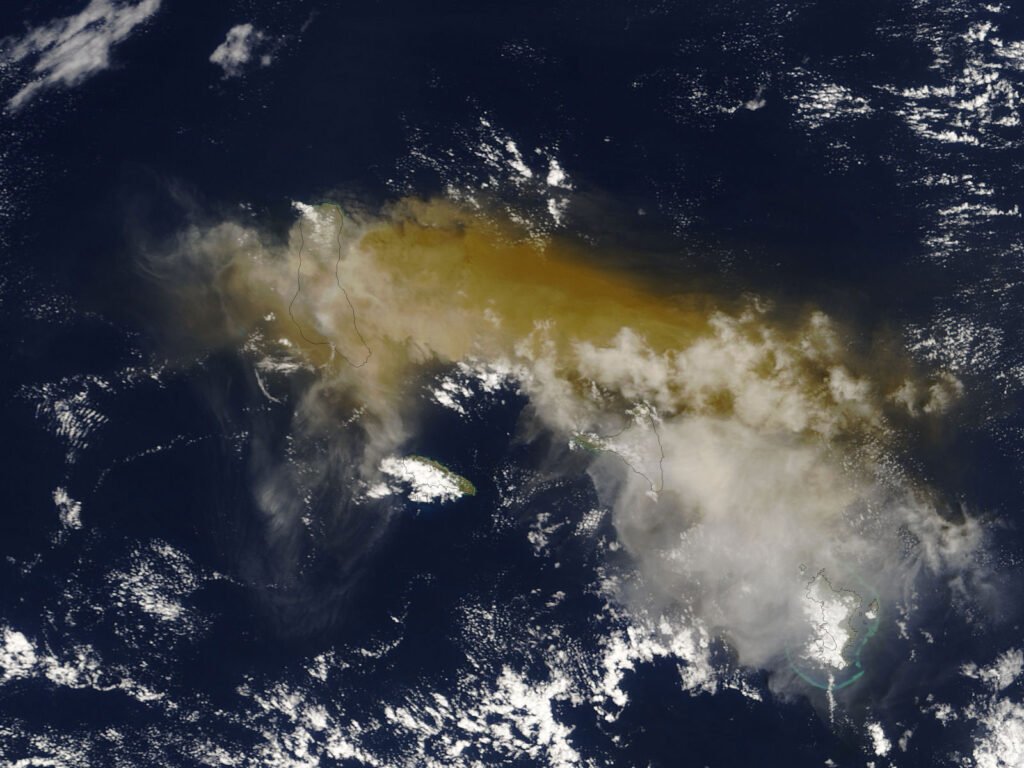
Comoros is a small volcanic island nation in the Indian Ocean, positioned in the Mozambique Channel between the northern tip of Madagascar and the East African coast. Officially the Union of Comoros, it consists of three main islands and is home to Mount Karthala, one of the most active volcanoes in the world, and roughly 900,000 people shaped by centuries of African, Arab, Persian, and Malagasy influence.
Key Takeaways
- Location: Comoros sits in the Indian Ocean between Madagascar and East Africa, and consists of three main volcanic islands plus a disputed fourth, Mayotte, administered by France.
- Landmark: Mount Karthala on Grande Comore is an active shield volcano and the country’s most recognizable natural feature.
- Independence: Comoros declared independence from France on July 6, 1975, after a referendum in which Mayotte alone voted to remain French.
- Government: The country is a federal republic with a president, vice presidents representing the islands, and a unicameral legislature.
- Economy: Agriculture, especially cloves, vanilla, and ylang-ylang, dominates exports and employment; remittances and domestic consumption also drive growth.
- Global recognition: The Comoros Islands were, for decades, the only known habitat of the coelacanth, a fish once believed extinct for 65 million years.
Where Is Comoros?
Comoros, officially the Union of Comoros, is an archipelago nation in the western Indian Ocean, located in the Mozambique Channel between the northern coast of Madagascar and mainland East Africa. The country comprises three main volcanic islands, Grande Comore (Ngazidja), Mohéli (Mwali), and Anjouan (Nzwani), along with several smaller islets. The capital and largest city, Moroni, sits on the western coast of Grande Comore. Comoros has a population of roughly 900,000, making it one of the smallest countries in Africa by population. A fourth island in the same geological archipelago, Mayotte, is administered by France as an overseas department; Comoros continues to claim Mayotte as part of its national territory, a dispute rooted in the different paths the islands took at independence.
Geography
All of the Comoro Islands are volcanic in origin, rising steeply from the floor of the Indian Ocean and ringed in places by coral reefs. The terrain ranges from Grande Comore’s relatively young, still-active volcanic ground to the more eroded, mountainous interiors of Mohéli and Anjouan, both shaped by older, extinct volcanic systems. The climate is tropical, with a hot, humid season from roughly November to April and a cooler, drier season for the remainder of the year.
Mount Karthala
Grande Comore is dominated by Mount Karthala, an active shield volcano and the country’s most recognizable landmark. Karthala’s summit rises to about 2,350 meters (7,710 feet) and is capped by overlapping calderas measuring roughly three to four kilometers across, formed by repeated collapses at the summit. It is among the most active volcanoes in the world: Karthala has erupted more than 20 times since the 19th century, including a major 2005 eruption that displaced roughly 10,000 residents, and its most recent recorded eruption, in January 2007, produced a lava lake in the summit crater.
A Brief History
The islands were settled over many centuries by successive waves of migrants and traders from the African mainland, the Arabian Peninsula, Persia, and Madagascar, producing a society shaped by Indian Ocean trade networks long before European contact. France began colonizing the archipelago in the 19th century, taking possession of Mayotte in 1843 and placing the other three islands under French protection by 1886; the territory was later administered jointly with Madagascar before becoming a separate French overseas territory in 1947.
Comoros declared independence from France on July 6, 1975, following a 1974 referendum in which majorities on three islands voted for separation; voters on Mayotte chose to remain under French administration, and Mayotte has never joined the independent Comorian state, a divergence later reaffirmed in a 2009 French referendum that Comoros and the African Union have not recognized. The decades after independence brought significant political instability, including a series of coups and attempted coups between the late 1970s and the 2010s. A new constitution adopted in 2001 restructured the country as a union of semi-autonomous islands with a rotating federal presidency, a rotation that a 2018 constitutional referendum later ended.
Government and Economy
Comoros is a federal republic. Executive power is held by a president, who serves as head of state and government and is assisted by vice presidents representing the islands, while a unicameral legislature, the Assembly of the Union, combines directly elected members with representatives chosen by the islands’ local governments.
The economy is small and heavily agricultural. Agriculture accounts for roughly 36 percent of GDP and about 38 percent of employment, the largest share of any sector of the economy. Three export crops, cloves, vanilla, and ylang-ylang, together generate around 90 percent of Comoros’s export income, though total export earnings remain modest by international standards. Remittances from Comorians living abroad and domestic consumption are also major drivers of economic activity; the World Bank estimated economic growth of about 3.2 percent in 2026, with poverty, measured against an international line of $4.20 a day, projected to affect roughly one in six residents.
Culture and People
The population of Comoros reflects centuries of mixing among Bantu African, Arab, Persian, and Malagasy communities, and the great majority of Comorians are Sunni Muslim, with Islam shaping much of daily and civic life. Comorian, known locally as Shikomori, a Bantu language closely related to Swahili and influenced by Arabic vocabulary, is spoken alongside Arabic and French, the country’s other official languages. The old quarters of Moroni, including a mosque dating to the 15th century, reflect the islands’ long-standing ties to Swahili Coast and Arab trading culture around the Indian Ocean.
What Comoros Is Best Known For
Internationally, Comoros is best known for two very different things. The first is Mount Karthala’s volcanic activity, which has repeatedly displaced island residents and reshaped Grande Comore’s terrain. The second is the coelacanth, a large fish once thought to have gone extinct along with the dinosaurs roughly 65 million years ago. After a live coelacanth was caught off South Africa in 1938, the population later identified in the waters around the Comoros Islands became, for decades, the only confirmed living population of this “living fossil” fish, until a distinct Indonesian population was identified in the late 1990s. Comoros is also a globally significant source of ylang-ylang essential oil and vanilla, both valued as ingredients in the international perfume and flavor industries.
Why Comoros Matters
Comoros illustrates challenges common to many small island developing states: geographic isolation, a narrow economic base concentrated in a handful of export crops, exposure to volcanic and climate hazards, and heavy reliance on remittances from citizens living abroad. Its position astride historic Indian Ocean trade routes, and the unresolved status of Mayotte, also give it continuing relevance to regional politics in East Africa and the wider Indian Ocean.
Sources
- World Bank, Comoros Overview
- UNFPA, World Population Dashboard: Comoros
- Encyclopaedia Britannica, “Comoros”
- Encyclopaedia Britannica, “Comoros: Government and Society”
- Encyclopaedia Britannica, “Comoros: History”
- NASA Earth Observatory, “Karthala Volcano, Comoros”
- Smithsonian Institution Global Volcanism Program, “Karthala”
- World Bank, “The Union of the Comoros: Jumpstarting Agricultural Transformation”
- Smithsonian Ocean, “Coelacanth”
Key facts
- Comoros consists of three main islands, Grande Comore, Moheli, and Anjouan, plus the disputed island of Mayotte, administered by France23
- Mount Karthala on Grande Comore is an active shield volcano that has erupted more than 20 times since the 19th century, most recently in 200767
- Comoros declared independence from France on July 6, 19755
- Agriculture accounts for roughly 36 percent of GDP, and cloves, vanilla, and ylang-ylang together supply about 90 percent of export income8
- The Comoros Islands were, for decades, the only known habitat of the coelacanth, a fish once thought extinct for 65 million years9
Quick checkWhat is Comoros's most recognizable natural landmark?Show answer
Mount Karthala, an active shield volcano on the island of Grande Comore, one of the most active volcanoes in the world.
Sources
- World Bank, Comoros Overview - https://www.worldbank.org/en/country/comoros/overview
- UNFPA, World Population Dashboard: Comoros - https://www.unfpa.org/data/world-population/KM
- Encyclopaedia Britannica, Comoros - https://www.britannica.com/place/Comoros
- Encyclopaedia Britannica, Comoros: Government and Society - https://www.britannica.com/place/Comoros/Government-and-society
- Encyclopaedia Britannica, Comoros: History - https://www.britannica.com/place/Comoros/History
- NASA Earth Observatory, Karthala Volcano, Comoros - https://science.nasa.gov/earth/earth-observatory/karthala-volcano-comoros-5442/
- Smithsonian Institution Global Volcanism Program, Karthala - https://volcano.si.edu/volcano.cfm?vn=233010
- World Bank, The Union of the Comoros: Jumpstarting Agricultural Transformation - https://documents1.worldbank.org/curated/en/388741568097428668/pdf/The-Union-of-the-Comoros-Jumpstarting-Agricultural-Transformation.pdf
- Smithsonian Ocean, Coelacanth - https://ocean.si.edu/ocean-life/fish/coelacanth
Editorially reviewed by Specialty Digest Editorial TeamLast reviewed September 22, 2026Researched and drafted with AI assistanceReport an issue