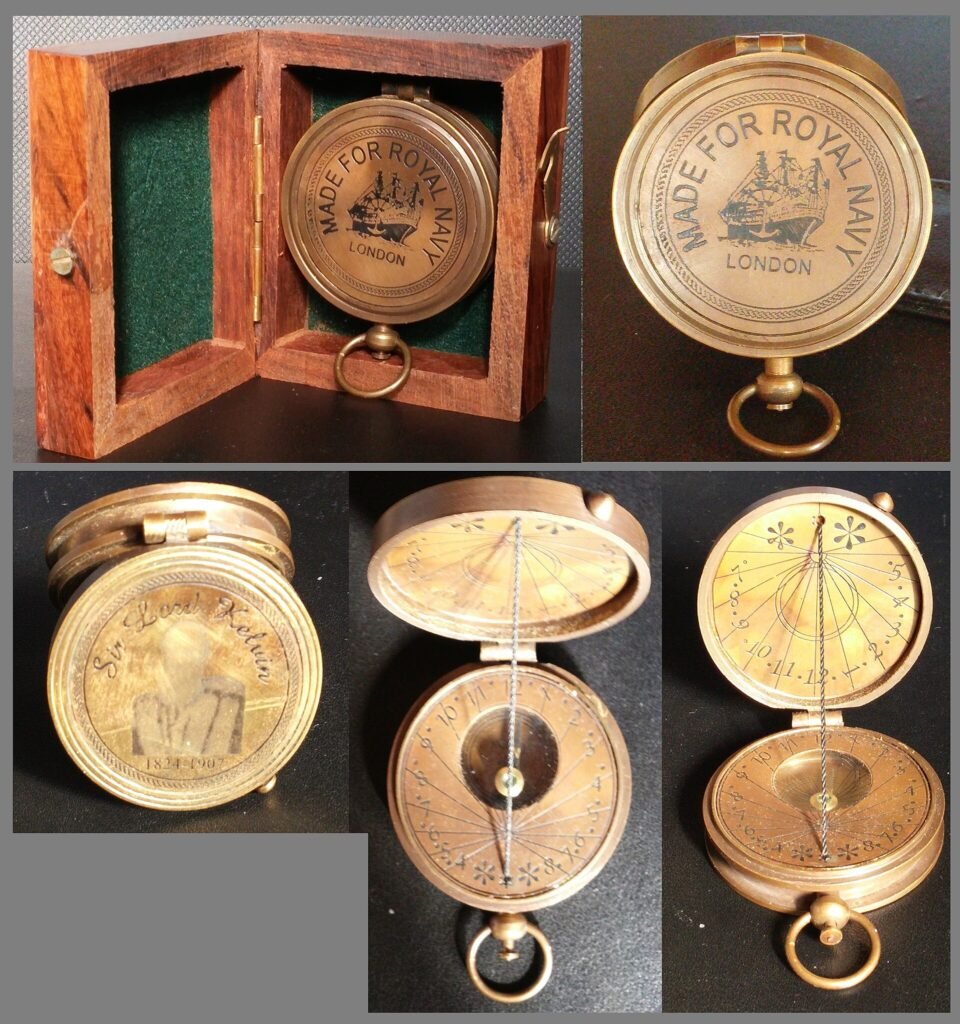
A compass is a navigational instrument with a freely turning magnetized needle or card that lines up with Earth’s magnetic field and so shows direction. Magnetic compasses were first described in China, were being used at sea by the 12th century, and became standard equipment for navigation around the world.
History of the compass
Lodestone, a naturally magnetized mineral, was known in ancient China, where early lodestone devices were used mainly for divination rather than travel. The step to a magnetized needle came later.
In his Dream Pool Essays, written in the 1080s, the Song dynasty scholar Shen Kuo gave the earliest description of the principle of the compass. He magnetized a needle by rubbing its tip with lodestone and hung it from a single strand of silk fixed to its center with a little wax. He noted that a needle prepared this way sometimes points south and sometimes north.
Chinese writers of the early 12th century mention compasses used at sea, and around 1190 the English scholar Alexander Neckam described a magnetized needle used by sailors. Persian and Arabic works of the 13th century describe compasses too.
Over the following centuries the needle was mounted on a card marked with directions and set in gimbals, which keep the instrument level on a pitching deck. The Royal Museums Greenwich holds a dry compass of 1844 with a mica card covered in paper, four light bar needles fixed beneath it, and an inverted pivot carried in a double gimbal.
Who invented the compass?
The compass has no single inventor. The earliest evidence comes from China, but the first devices were lodestone pointers rather than needle compasses, and the Song texts record a technique that was already known to some people rather than a moment of invention.
Historians still debate how the compass reached the Islamic world and Europe, and whether it passed from one region to another or was developed in more than one place. Written evidence for the early centuries is sparse, so dates are often stated as approximate, and claims of a firm first user at sea should be treated with caution.
How a compass works
A compass relies on Earth’s magnetic field. According to the National Oceanic and Atmospheric Administration (NOAA), most of the planet’s magnetism comes from the movement of electrically charged molten metals in its outer core.
A magnetized needle that can turn freely lines up with the local direction of this field, and its marked end points toward the north magnetic pole. That pole is not at the geographic North Pole, and the angle between the two directions is called magnetic declination.
The field also changes. NOAA reports that the north magnetic pole has been drifting toward Siberia for several decades, so the World Magnetic Model that navigators and devices use must be updated regularly. The current version, WMM2025, was released in late 2024. A compass can also be misled by nearby iron, magnets and electric currents.
Using a compass
To take a reading, hold the compass level and away from steel objects, then wait for the needle to settle. The marked end points toward magnetic north, and the bearing to a landmark is read from the scale.
To convert a magnetic bearing into a true bearing, the user adds or subtracts the local declination, which is printed on many maps and can be looked up from the World Magnetic Model. Near the magnetic poles the field lines point steeply downward, so an ordinary compass becomes slow and unreliable there.
Phones and vehicles use small electronic magnetic sensors in place of a swinging needle, and they need occasional recalibration because nearby metal changes what the sensor reads.
Types of compasses
A dry compass has a needle or card that turns in air. A liquid compass seals the card in fluid, which damps its swinging and makes it steadier on boats and in handheld baseplate models used for hiking and orienteering.
A gyrocompass works differently. It uses a spinning gyroscope that settles on the direction of Earth’s rotation axis, so it finds true north without relying on magnetism. Ships and aircraft use gyrocompasses alongside magnetic ones, and phones use electronic magnetic sensors to give a digital heading.
Impact of the compass
Before the compass, sailors steered by landmarks, the sun and stars, and the direction of winds and swells, all of which fail in cloud or fog. The compass let sailors hold a course when clouds hid the sun and stars and no coast was in sight. That helped make long sea routes more dependable and supported the growth of trade and exploration in the era of the Renaissance.
It also shaped mapping. Navigators plotted courses as compass bearings, and the Mercator projection was designed so that a line of constant compass bearing appears as a straight line on the chart.
Compass vs. GPS
A compass gives direction only, and it needs no battery or signal. The Global Positioning System gives position and speed from satellite signals, but those signals can be blocked or jammed, and a phone needs power.
For that reason many mariners, pilots and hikers carry a magnetic compass as a backup even when they rely on satellite navigation. The two tools complement each other more than they compete.
FAQs about the compass
Does a compass point to true north? No. It points to magnetic north, and the difference depends on where you are and changes over time.
Why does a compass fail near metal? Iron objects and electric currents create their own magnetic fields, which pull the needle away from Earth’s field.
Who first used the compass at sea? Chinese and European writers describe sea use in the 12th century, and the relative order is hard to prove from the surviving texts.
More in Earth Sciences
Key facts
- Shen Kuo's Dream Pool Essays gave the earliest description of the compass principle: a magnetized needle hung from silk.1
- Shen Kuo noted that the needle sometimes points south and sometimes north.1
- A dry compass of 1844 in the Royal Museums Greenwich has a mica card and a double gimbal.2
- Most of Earth's magnetism comes from moving molten metals in the outer core.3
- The north magnetic pole has been drifting toward Siberia for decades, and the World Magnetic Model is updated to track it.3
Related concepts
In the news
Quick checkWho invented the compass?Show answer
No single person did. Chinese sources describe lodestone pointers and then a magnetized needle by the late 11th century, and historians still debate how the compass spread to the Islamic world and Europe.
Sources
- Jeremy Norman's History of Information, In Dream Pool Essays Shen Kuo Provides the Earliest Description of the Compass, https://historyofinformation.com/detail.php?id=222
- Royal Museums Greenwich, Dry compass (object ACO0935), https://www.rmg.co.uk/collections/objects/rmgc-object-8010
- NOAA National Centers for Environmental Information, 2025 WMM Annual Report is Released, https://www.ncei.noaa.gov/node/8576
Editorially reviewed by Specialty Digest Editorial TeamLast reviewed November 4, 2026Researched and drafted with AI assistanceReport an issue