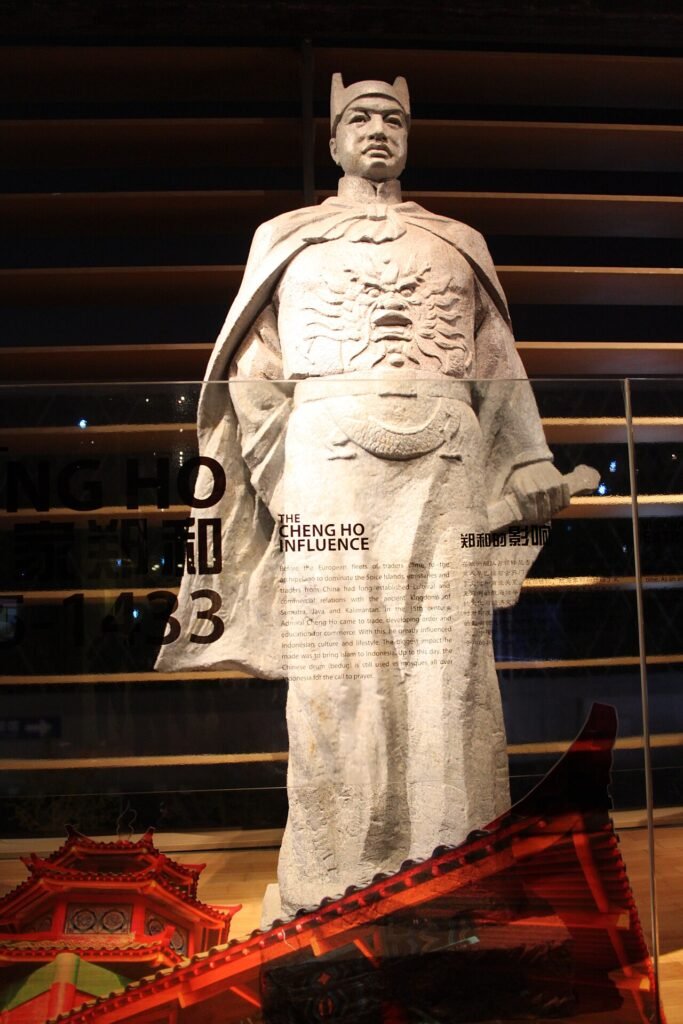
Zheng He (about 1371 to 1433) was a Chinese admiral and diplomat who commanded seven large naval expeditions across the Indian Ocean for the Ming dynasty between 1405 and 1433. Born into a Muslim family in Yunnan, he rose from a captured boy to the most trusted officer of the Yongle Emperor.
Early life of Zheng He
Zheng He was born around 1371 as Ma He into a Muslim family in Yunnan, in southwestern China. His father had made the pilgrimage to Mecca, a detail that appears in several accounts of the family. Yunnan was then under Mongol control. When Ming armies conquered the province, the ten-year-old Ma He was captured.
As was common for captive boys destined to serve at court, he was castrated and sent to the household of the Prince of Yan, Zhu Di, who later became the Yongle Emperor. Ma He grew up among soldiers, rose through the ranks and became a close aide of the prince. He supported Zhu Di in the civil war of the early 1400s that ended with Zhu Di taking the throne. The new emperor gave him the surname Zheng, and he became a senior eunuch officer.
Career and the seven voyages
The Yongle Emperor ordered the construction of an ocean-going fleet in 1403 and chose Zheng He to command it. Between 1405 and 1433 the fleet made seven voyages. Sources date the first one to 1404 or 1405, and they differ on some later dates and on how many of the trips Zheng He led in person.
The first expedition had 317 ships, including some 60 large treasure ships, and an estimated 20,000 to 32,000 people. They included soldiers, diplomats, doctors, astronomers and translators. The first three voyages went through Southeast Asia to India and India‘s west coast, with stops that included Champa, Java, Malacca and Calicut. The fourth, around 1413, reached Hormuz on the Persian Gulf. Later voyages went to Aden and to the east coast of Africa, with stops at Mogadishu in Somalia and Malindi in Kenya. A side trip on the last expedition reached Jeddah, a short distance from Mecca.
A Muslim translator named Ma Huan joined the fourth voyage and became its main chronicler. Zheng He died during the seventh voyage, in 1433. One source says he died at Calicut and that his body was taken home, while another says he died on the return and was buried at sea. A tomb in Nanjing is associated with him. A few historians give 1435 as the year of his death.
Purpose and methods of the voyages
The Yongle Emperor wanted to revive the tribute system, in which foreign rulers acknowledged the Chinese emperor and received gifts and trading rights in return. Some scholars add that an early aim may have been to find the deposed Jianwen Emperor and prevent a rebellion. A few have argued that the voyages were colonial in intent, but this is not the widely held view.
At each port Zheng He presented the local ruler with messages of goodwill and large gifts, such as silk, porcelain, tea and gold and silver objects. He invited the ruler to visit China or to send an envoy. Many rulers did, and the fleet carried delegations to the Ming court and later took them home. The expeditions also brought back exotic goods and animals, including giraffes, zebras and lions from Africa. At court the giraffe was taken as a sign of good fortune, a living version of the mythical qilin.
The ships used technology that included watertight compartments, sternpost rudders, paper charts and the magnetic compass. Their size is disputed. Older accounts describe treasure ships over 400 feet long with nine masts, but some modern historians estimate lengths up to around 180 feet. The exact figures are uncertain because records are limited. The fleet was a major early example of long-distance maritime transport under state direction.
Controversies and debate
The voyages were not purely peaceful. The fleet carried soldiers and weapons, and several accounts describe fighting. On the return from the first voyage, Zheng He captured the pirate leader Chen Zuyi, who had disrupted shipping in the Strait of Malacca and was taken to Nanjing for punishment. During the third voyage, fighting broke out in Sri Lanka, and Zheng He captured the king and brought him to China, where the emperor later released him. In Sumatra, Zheng He took sides in a dispute over the throne. Historians read these events either as the policing of trade routes or as a show of force meant to bring states into China’s tribute system.
The economic results are also debated. The expeditions were costly, and the tribute they brought back was worth much less than the goods sent out, except in parts of Southeast Asia. Historians continue to discuss the real purpose of the voyages, the size of the ships and the routes taken.
Legacy of Zheng He
After the Yongle Emperor died, officials who favored frugality gained ground at court. Zheng He’s final voyage was approved by the Xuande Emperor, but that emperor ended the program. According to one account he also restricted the building and use of ocean-going ships. Later, in 1477, an official removed Zheng He’s records from the archives and described them as deceitful exaggerations. As a result, many details of the expeditions are lost.
Zheng He was nearly forgotten in China for a long time, but he was remembered in Chinese communities in Southeast Asia, where he is celebrated and, in places, revered as a god. In modern times he is widely seen as one of the greatest explorers in Chinese history. Statues of him stand in Malaysia, Indonesia and China. His voyages are often compared with those of Marco Polo and Ibn Battuta, though his fleets were official missions of the Ming state and far larger. They carried Chinese influence, goods and knowledge across the Indian Ocean decades before Europeans entered it by sea, and they also brought knowledge of foreign lands back to China. The tablets he left in Fujian in 1432 recorded that his fleet had sailed well over a hundred thousand li, a distance that translators have converted to about 27,000 nautical miles.
More in History
Key facts
- Zheng He was born about 1371 as Ma He in a Muslim family in Yunnan.1
- He commanded seven voyages for the Ming dynasty between 1405 and 1433.1
- The first fleet had 317 ships and an estimated 20,000 to 32,000 people.1
- The fleet reached India, the Persian Gulf and the east coast of Africa.2
- He died during the seventh voyage in 1433, and sources differ on where he was buried.1
Related concepts
Quick checkWhere did Zheng He sail?Show answer
His fleets sailed from China through Southeast Asia to India and Sri Lanka, then to Hormuz in the Persian Gulf, Aden, and East African ports such as Mogadishu and Malindi.
Sources
- World History Encyclopedia, The Seven Voyages of Zheng He, https://www.worldhistory.org/article/1334/the-seven-voyages-of-zheng-he/
- Columbia University Asia for Educators, The Ming Voyages, https://afe.easia.columbia.edu/special/china_1000ce_mingvoyages.htm
Editorially reviewed by Specialty Digest Editorial TeamLast reviewed November 4, 2026Researched and drafted with AI assistanceReport an issue