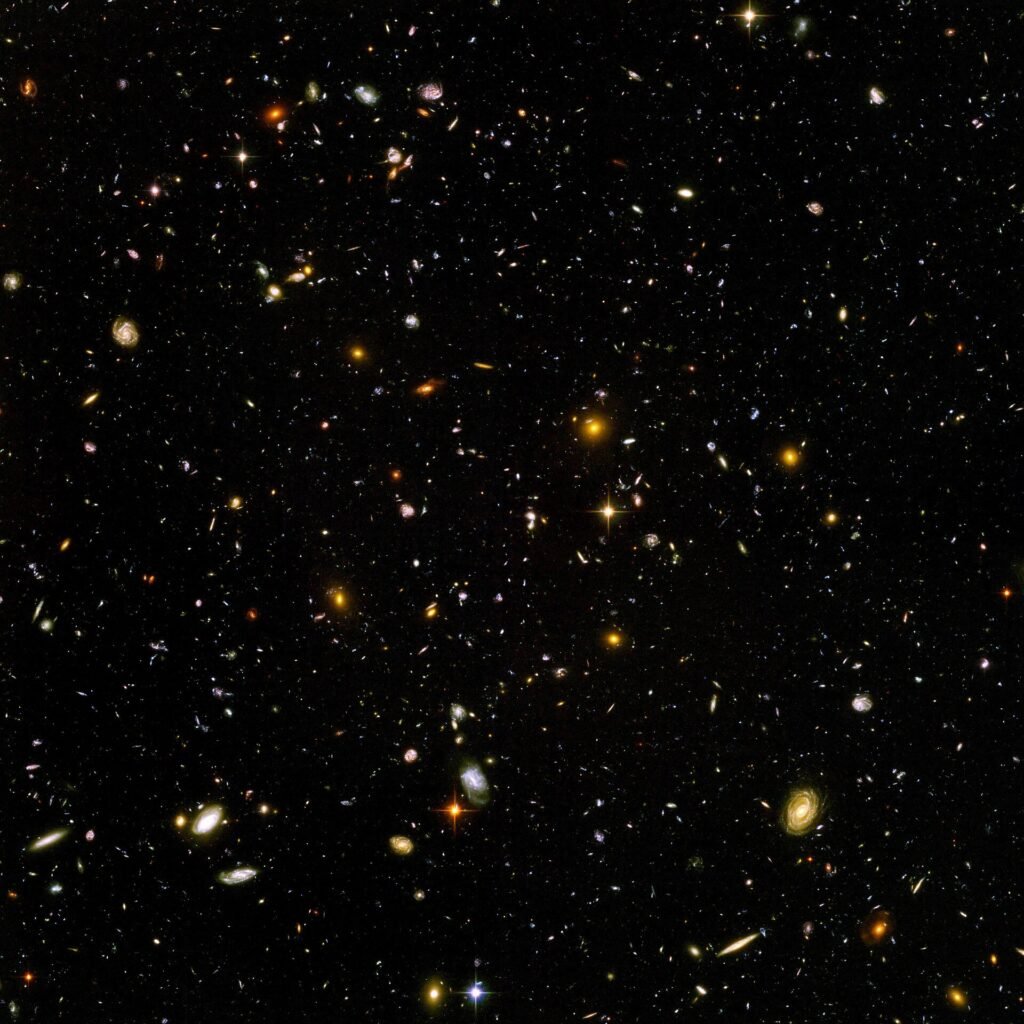
The discovery of the expansion of the universe was the finding, established in the late 1920s, that distant galaxies are receding from us, and the farther away they are, the faster they move. Georges Lemaître derived the effect in 1927, and Edwin Hubble published supporting measurements in 1929. In 2018 the International Astronomical Union recommended calling the relation the Hubble-Lemaître law.
Background to the discovery of the expansion of the universe
In the early twentieth century most scientists took for granted that the universe was static. According to the American Institute of Physics, the belief was powerful, and only the weight of accumulating observations could overturn it. The first of those observations, by Vesto Slipher, who studied the light of spiral nebulae, was reported in 1915.
Theory pointed the same way. In 1922 the Russian mathematician Alexander Friedmann published solutions to Einstein‘s equations that described a universe that was not static. Einstein accepted that the solutions were mathematically possible. He later told Lemaître that he had always felt uneasy about a term he had added to his equations to allow a static universe.
The discovery of the expansion of the universe
Lemaître, a Belgian astrophysicist and Catholic priest, published a model of an expanding universe in 1927. Astronomy magazine says he represented the idea mathematically and connected it to Einstein’s general theory of relativity. Because he published in the little-read Annals of the Brussels Scientific Society, the work attracted almost no attention at the time.
Edwin Hubble’s 1929 paper reached a wider audience. It presented a velocity-distance relation for 46 nebulae, 24 of which had individually estimated distances, and it concluded that the relation was roughly linear. The other 22 nebulae, whose distances could not be estimated individually, were combined into groups. Hubble stressed the observational side of his result. He mentioned theory only in the final paragraph, where he noted that the relation might reflect an effect predicted by Willem de Sitter.
How the expansion was confirmed
Hubble worked to establish the relation beyond doubt. With his colleague Milton Humason he collected improved observations of the redshift, the stretching of light toward longer wavelengths, in distant nebulae. Einstein soon said that these observations made it likely that the structure of the universe was not static. According to the American Institute of Physics, the observations showed redshifts that grew with distance, which ruled out Einstein’s own static model and a static model proposed by de Sitter that contained no matter.
Opinion shifted quickly. Einstein confirmed that Lemaître’s work fit general relativity, and in 1931 de Sitter publicly praised Lemaître’s brilliant discovery of the expanding universe. The same year, Lemaître proposed that the present universe is the ashes of an earlier bright and rapid event, which scientists now regard as a first version of the Big Bang theory.
The velocity-distance relation was not obviously a statement about the universe as a whole. Astronomers needed both the theory of a changing space and the data on receding nebulae before the picture was convincing, and neither alone persuaded many people. The two lines of work came together in the early 1930s.
Disputes over credit for the discovery
The American Institute of Physics describes the question of what counts as the discovery as an open historical and philosophical matter. Hubble established an empirical formula that persuaded most scientists, but Lemaître had published a theoretical expanding model two years earlier. In its account, the claim that the universe expands grew gradually in scientists’ minds rather than arriving in a single paper.
In 2018, members of the International Astronomical Union voted to recommend that the Hubble law be known as the Hubble-Lemaître law. The union said its aim was to honor the intellectual integrity and the very significant discovery of Lemaître. It was a recommendation, not an enforceable change, and astronomers remain free to use either name.
Scientific significance of the expansion of the universe
The expansion meant that galaxies are not moving through space away from a central point. The American Institute of Physics explains that no special location exists in the universe: every galaxy sits inside the expansion, so any two galaxies separate faster the farther apart they are. It also implied that the universe was once far denser, and that time itself might have had a beginning.
Later work built directly on this idea. The cosmic microwave background, the faint radiation that fills the sky, was interpreted as a relic of a hot dense early universe, as described in the discovery of the cosmic microwave background. The Nobel Prize in Physics 2011 went to Saul Perlmutter, Brian Schmidt and Adam Riess for discovering that the expansion is accelerating.
Later developments and legacy
The Nobel committee noted that the two research teams studied more than 50 distant supernovae, whose light was weaker than expected, and both groups reached the same conclusion. The universe is known to be expanding as a consequence of the Big Bang about 14 billion years ago, and if the acceleration continues, the committee wrote, it will end in ice.
Lemaître kept a long career in science. According to the American Institute of Physics, he served as president of the Pontifical Academy of Sciences from 1960 until his death in 1966, and his contribution is now widely celebrated even though it made no impression when first published.
The Hubble Space Telescope carries the name of the astronomer who gave the effect its first observational form. The law that bears two names is a reminder that scientific discoveries often have several contributors, and that an idea can be correct years before it is widely understood.
More in Astronomy & Space
Key facts
- Georges Lemaître published a model of an expanding universe in 1927 in the Annals of the Brussels Scientific Society.1
- Alexander Friedmann published non-static solutions to Einstein's equations in 1922.1
- Edwin Hubble's 1929 paper gave a velocity-distance relation for 46 nebulae, 24 of them with individually estimated distances.1
- Observations by Hubble and Humason led Einstein to say the universe was probably not static.1
- Members of the International Astronomical Union voted in 2018 to recommend the name Hubble-Lemaître law.2
- Perlmutter, Schmidt and Riess won the 2011 Nobel Prize in Physics for discovering the accelerating expansion.3
Related concepts
Quick checkWho discovered that the universe is expanding?Show answer
Georges Lemaître derived an expanding-universe model in 1927, and Edwin Hubble published supporting measurements in 1929. The IAU recommended the name Hubble-Lemaître law in 2018.
Sources
- American Institute of Physics, Discovery of the Universe: The Expanding Universe, https://history.aip.org/exhibits/cosmology/ideas/expanding.htm
- Astronomy magazine, IAU vote recommends changing the name of Hubble's law, https://www.astronomy.com/science/iau-vote-recommends-changing-the-name-of-hubbles-law/
- Nobel Foundation, The Nobel Prize in Physics 2011 press release, https://www.nobelprize.org/prizes/physics/2011/press-release/
Editorially reviewed by Specialty Digest Editorial TeamLast reviewed November 5, 2026Researched and drafted with AI assistanceReport an issue