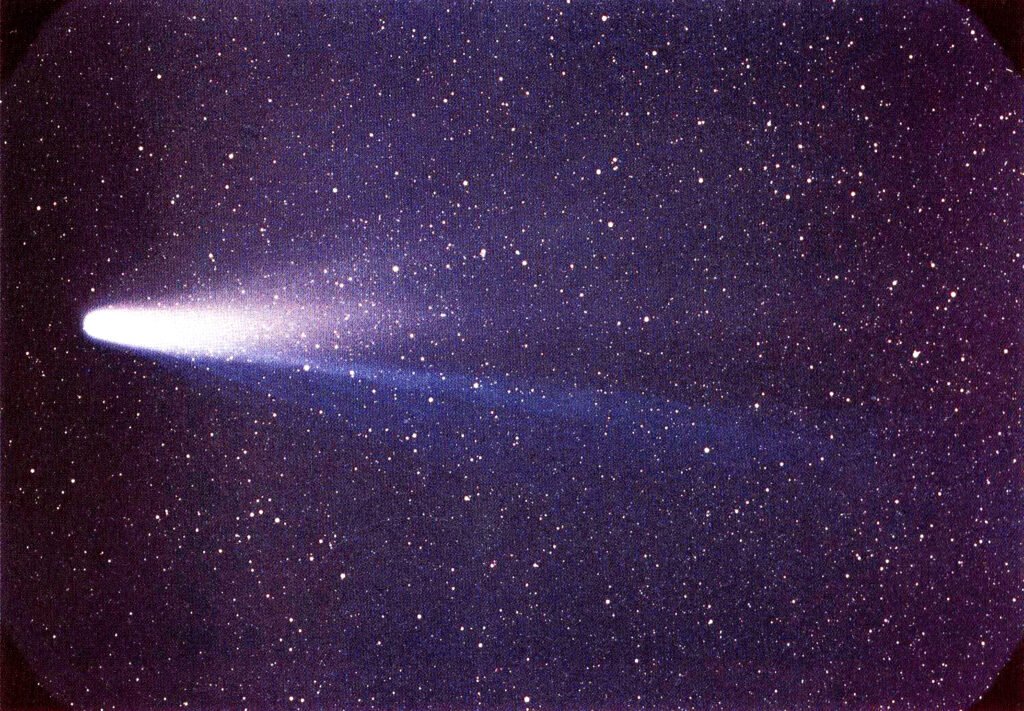
The discovery of Halley’s Comet was not the first sighting of the comet, which people had recorded for more than 2,000 years, but the realization that it is a single object returning on a regular schedule. The English astronomer Edmond Halley made that case in 1705 and predicted its return in 1758. When an amateur astronomer spotted it on Christmas Eve 1758, it became the first comet whose return was successfully predicted.
Background to the discovery of Halley’s Comet
Comets have been watched since ancient times, and for most of history people treated them as omens. The Gale encyclopedia entry on the comet notes that nearly every appearance has been linked to a major event: the death of Agrippa in 11 BC, Attila the Hun’s only defeat in AD 451 and the Norman conquest of England in 1066. NASA adds that the comet appears in the Bayeux embroidery, the famous medieval cloth that records the Battle of Hastings.
Until Halley’s time, according to NASA, astronomers believed that comets made only one pass through the solar system. A bright comet appeared, faded and was gone. Nobody had a way to show that two sightings decades apart belonged to the same body.
The comet itself had been seen many times. NASA says astronomers have linked its appearances to observations going back more than 2,000 years, and ESA notes that the Italian painter Giotto di Bondone saw it in 1301. In that sense Halley did not discover the comet. He discovered what kind of object it was.
The discovery of Halley’s Comet
Halley (1656 to 1742) had Isaac Newton‘s new theory of gravitation and planetary motion to work with. NASA says he used it in 1705 to compute the orbits of several comets. He noticed that the orbits of bright comets reported in 1531, 1607 and 1682 were remarkably similar and suggested that the three were one comet making repeated trips around the Sun.
The Gale entry places Halley’s calculations of two dozen comet orbits earlier, in 1695, so sources differ on exactly when the work was done and published. Both agree on the conclusion. Halley also noticed that the planets could disturb a comet’s path. Allowing for the pull of Jupiter, he narrowed the expected return to late 1758 or early 1759.
His prediction was a bold test of Newton’s ideas. If correct, it would show that comets obey the same laws of gravity as planets and follow closed orbits. If wrong, the idea of returning comets would have been weakened.
How the discovery was confirmed
Halley did not live to see the test. He died in 1742, and astronomers around the world watched the sky in 1758, each hoping to be the first to recover the comet. On Christmas Eve 1758, a German farmer and amateur astronomer, Johann Palitzsch, spotted it.
The comet therefore returned in line with the prediction, and the periodic comet was named in Halley’s honor after his death. Credit for the name belongs to the correct forecast, not to being the first person to see the object. NASA notes that this was the first such prediction ever made. The letter P in its official designation, 1P/Halley, marks it as a periodic comet, meaning one with an orbital period of less than 200 years.
Scientific significance of Halley’s Comet
The confirmed return changed the way people understood comets. They were no longer random visitors but members of the solar system that follow orbits and can be predicted. It was also a public demonstration that Newton’s physics could forecast events in the sky years in advance.
NASA reports that Halley’s average orbital period is about 76 Earth years. The period varies because the planets disturb its path: it was as short as 74.42 years between 1835 and 1910 and as long as 79.25 years between 451 and 530. The comet moves backward, or retrograde, compared with the planets, and at its farthest from the Sun it lies beyond the orbit of Neptune.
Halley’s nucleus is about 11 kilometers, or 6.8 miles, across. According to NASA, the comet’s closest approach to Earth occurred on 10 April 837, when it passed about 4.94 million kilometers away and reached an apparent magnitude of about minus 3.5, nearly as bright as Venus at its best.
NASA’s quick facts list the comet’s rotation period as 2.2 Earth days and its orbit as tilted 18 degrees to the plane of Earth’s orbit. One full circuit of the Sun covers about 12.2 billion kilometers, or 7.6 billion miles. Because Halley is a short-period comet, it comes back often enough that a prediction of its return could be tested within a human lifetime, which was the key to the success of 1758.
Later developments and legacy
The comet last appeared in Earth’s skies in 1986. A fleet of five spacecraft was sent to study it: two Soviet Vega probes, two Japanese probes, Suisei and Sakigake, and the European Space Agency‘s Giotto, according to ESA. NASA’s account also lists the international ISEE-3 spacecraft and NASA’s own Pioneer 7 and Pioneer 12 among the observers.
ESA says Giotto, which launched on 2 July 1985, returned the first close-up images of a comet nucleus. It showed the nucleus’s size and shape, found that its surface was very dark and saw bright jets of gas and dust springing from it. The spacecraft is named after the Italian painter Giotto di Bondone, who observed Halley’s Comet in 1301 and painted it as the star of Bethlehem.
Even in 1910, the Gale entry reports, some people panicked, believing the comet’s tail contained poisonous gas. By 1986 the comet was understood as a ball of ice and dust, and scientists studied it with instruments rather than fearing it. NASA expects it to return in 2061 on its regular 76-year circuit.
More in Astronomy & Space
Key facts
- NASA says Halley used Newton's theories in 1705 to compute comet orbits and linked the bright comets of 1531, 1607 and 1682.1
- He predicted the comet would return in 1758, the first such prediction for a comet.1
- Johann Palitzsch, a German farmer and amateur astronomer, spotted the comet on Christmas Eve 1758.2
- Edmond Halley lived from 1656 to 1742.1
- The comet's average period is about 76 years and it is next due in 2061.1
- A fleet of five spacecraft, including ESA's Giotto, studied the comet in 1986.13
- Sources differ on the year Halley computed two dozen comet orbits: NASA says 1705, a Gale reference says 1695.12
Related concepts
Quick checkWho discovered Halley's Comet?Show answer
No single person, because it had been seen for over 2,000 years. Edmond Halley showed in 1705 that comets seen in 1531, 1607 and 1682 were one object and predicted its 1758 return.
Sources
- NASA Science, 1P/Halley, https://science.nasa.gov/solar-system/comets/1p-halley/
- Encyclopedia.com (Gale), Halley's Comet, https://encyclopedia.com/science/encyclopedias-almanacs-transcripts-and-maps/halleys-comet
- European Space Agency, Giotto overview, https://www.esa.int/Science_Exploration/Space_Science/Giotto_overview
Editorially reviewed by Specialty Digest Editorial TeamLast reviewed November 5, 2026Researched and drafted with AI assistanceReport an issue