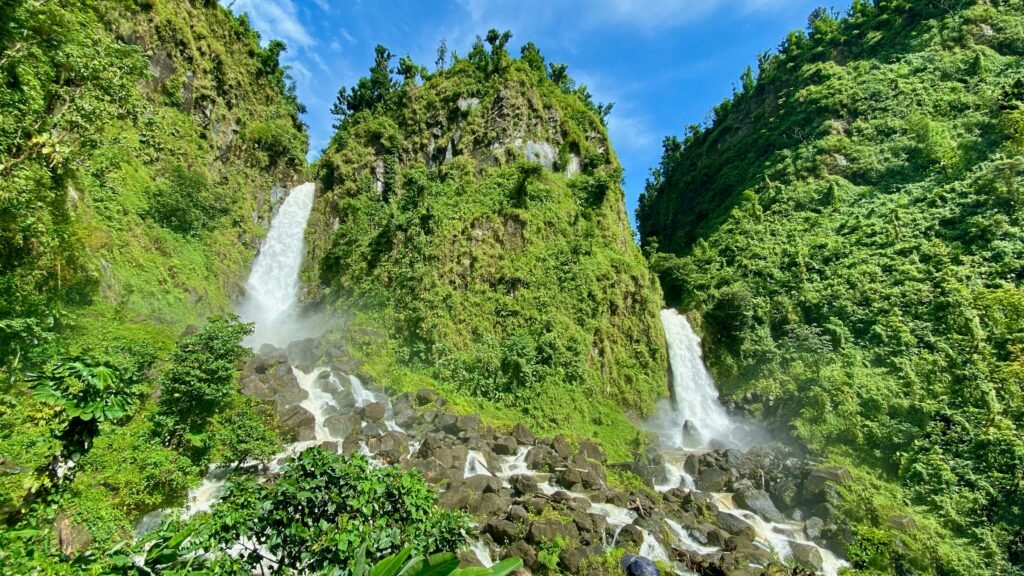
Dominica, officially the Commonwealth of Dominica, is a mountainous island nation in the Eastern Caribbean’s Lesser Antilles, situated between the French territories of Guadeloupe and Martinique. It is frequently confused with the much larger Dominican Republic, which shares the island of Hispaniola with Haiti more than 500 miles to the northwest, but the two countries are unrelated in geography, history, and language. Dominica, with a population of roughly 66,000 and its capital at Roseau, is known internationally as the “Nature Island of the Caribbean” for its volcanic peaks, rainforest cover, and unusually intact biodiversity for an island of its size.
Key Takeaways
- Dominica is a separate, much smaller country from the Dominican Republic, located in the Lesser Antilles rather than on Hispaniola.
- It gained independence from the United Kingdom on November 3, 1978, and is a parliamentary republic within the Commonwealth.
- Morne Trois Pitons National Park, a UNESCO World Heritage Site since 1997, contains Boiling Lake, the world’s second-largest hot spring.
- Hurricane Maria caused an estimated $1.8 billion in damage in 2017, close to three times the country’s annual GDP.
- The Kalinago Territory on the island’s east coast holds the last community of indigenous Kalinago (Carib) people in the Caribbean.
- Dominica is a member of both CARICOM and the Organisation of Eastern Caribbean States (OECS).
Geography
Dominica covers about 750 square kilometers, making it one of the larger islands in the Eastern Caribbean chain despite its small population. Its interior is dominated by volcanic terrain: nine potentially active volcanoes rise across the island, including Morne Diablotins, the highest peak at 1,447 meters, and Morne Trois Pitons at 1,386 meters. Steep, forested slopes cover roughly half the island, feeding an unusually dense network of rivers, said locally to number 365, one for each day of the year, along with numerous waterfalls including Trafalgar Falls and the Emerald Pool.
The island’s most distinctive geological feature is Boiling Lake, a flooded fumarole roughly 60 meters wide inside Morne Trois Pitons National Park, where water heated by volcanic gases reaches temperatures near 95 degrees Celsius. The lake sits within the Valley of Desolation, an active geothermal field of fumaroles and hot springs. This combination of volcanic terrain and forest cover, along with three freshwater crater lakes, led the park to be inscribed as a UNESCO World Heritage Site in 1997 for both its ongoing volcanic processes and its largely intact forest ecosystems.
Brief History
Dominica was settled by Indigenous peoples for over a thousand years before European contact, most recently by the Kalinago, who arrived from South America around 1000 CE. Christopher Columbus sighted the island on a Sunday in November 1493 and named it accordingly, but its rugged terrain and the Kalinago’s sustained resistance kept European colonizers at bay far longer than on neighboring islands; Dominica is often cited as the last Caribbean island the Europeans permanently colonized. France and Britain contested control through the eighteenth century, and the island passed formally to Britain under the 1763 Treaty of Paris, though French cultural influence persisted and shaped Dominica’s Antillean Creole language.
Dominica became part of the British Windward Islands administration and moved through stages of self-government in the twentieth century, joining the short-lived West Indies Federation before that arrangement dissolved in 1962. It achieved associated statehood with Britain in 1967 and full independence on November 3, 1978, becoming the Commonwealth of Dominica. Today, the Kalinago Territory, a 3,700-acre area on the island’s east coast established in 1903 and comprising eight villages, remains home to the descendants of the island’s original inhabitants, one of the few communities of pre-Columbian heritage still living on ancestral land in the Caribbean.
Government and Economy
Dominica is a parliamentary republic. A president serves as ceremonial head of state, while executive authority rests with a prime minister and cabinet accountable to a unicameral House of Assembly. The country is a member of the Caribbean Community (CARICOM) and the Organisation of Eastern Caribbean States (OECS), and it uses the Eastern Caribbean dollar, a currency shared across the OECS and pegged to the US dollar.
The economy is small and service-oriented, built around tourism, agriculture (notably bananas and other tropical crops), and a Citizenship-by-Investment program that has become a significant source of government revenue. Growth has been shaped heavily by exposure to hurricanes: Tropical Storm Erika in 2015 and Hurricane Maria in 2017 together caused an estimated $1.8 billion in damage, nearly three times Dominica’s gross domestic product. In response, the government launched a Climate Resilience and Recovery Plan aiming to make Dominica the world’s first climate-resilient nation, supported by financing from the World Bank and other international partners. Public debt has remained high as a share of GDP in the years since, though recent growth has been driven by infrastructure investment and a recovering tourism sector.
Culture and People
Dominica’s population reflects a blend of African, Kalinago, and European heritage, produced by the transatlantic slave trade, colonial settlement, and the survival of the island’s Indigenous community. English is the official language, while Dominican Creole French, known locally as Kwéyòl or Patwa, remains widely spoken and reflects the island’s period of French colonial contact. Music and festival traditions, including Carnival and the bouyon musical genre that originated in Dominica, are central to cultural life, alongside Kalinago crafts such as basket weaving and canoe building that continue in the Kalinago Territory.
What Dominica Is Known For
Dominica markets itself, with substantial justification, as the “Nature Island of the Caribbean.” Unlike many Caribbean destinations built around beaches, its reputation rests on rainforest coverage, volcanic geology, and biodiversity that is unusually intact for an island of its size. Morne Trois Pitons National Park and Boiling Lake anchor that identity, alongside endemic species such as the Sisserou parrot, Dominica’s national bird, found nowhere else in the world. This ecological profile has made the island a focus of conservation and ecotourism efforts, distinguishing it within a region more commonly associated with resort development.
Why Dominica Matters
Dominica matters as a case study in small-island vulnerability and resilience. Its exposure to intensifying hurricanes, demonstrated starkly by Hurricane Maria’s near-total destruction of the island’s infrastructure and agriculture in 2017, has made it a reference point in international discussions of climate adaptation financing for small island developing states. At the same time, its unusually preserved rainforest and volcanic ecosystems, protected through one of the Caribbean’s few UNESCO natural World Heritage Sites, and the continued presence of the Kalinago Territory give Dominica a disproportionate significance in conservation and Indigenous heritage terms relative to its small size and population.
Key facts
- Array
Quick checkIs Dominica the same country as the Dominican Republic?Show answer
No. Dominica is a small, separate island nation in the Lesser Antilles of the Eastern Caribbean, while the Dominican Republic is a much larger country that shares the island of Hispaniola with Haiti, more than 500 miles away.
Sources
- Array
Editorially reviewed by Specialty Digest Editorial TeamLast reviewed September 23, 2026Researched and drafted with AI assistanceReport an issue