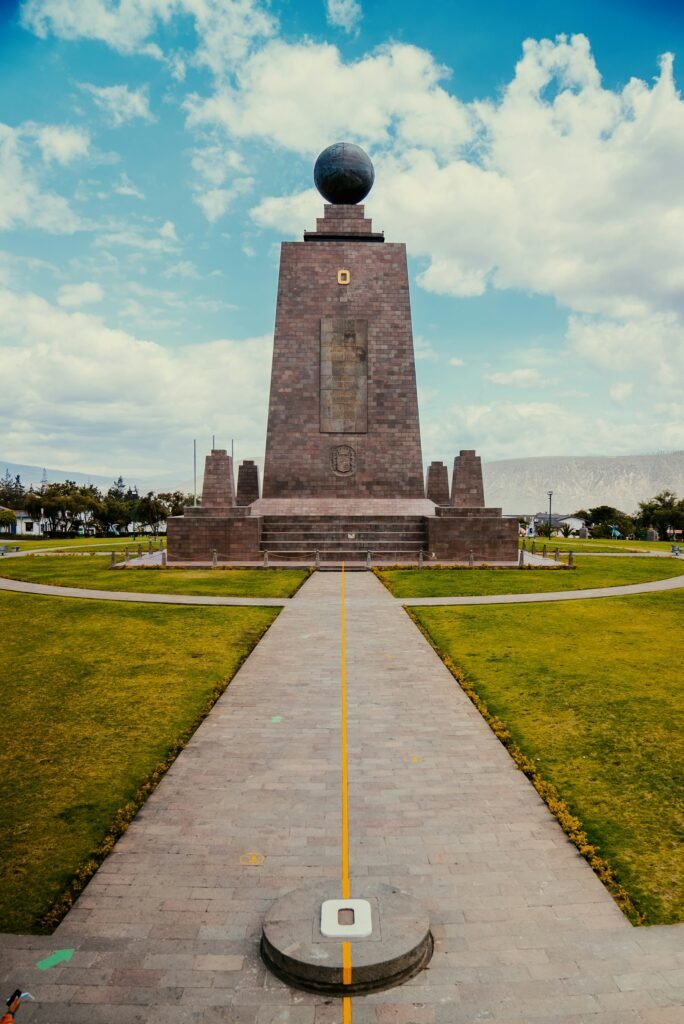
Ecuador is a South American country that straddles the equator on the Pacific coast, giving the nation its name (Spanish for “equator”). Its territory spans four distinct regions: a Pacific coastal lowland, the Andean highlands, the Amazon basin to the east, and the volcanic Galapagos Islands roughly 1,000 kilometers offshore, together covering about 256,850 square kilometers (99,170 square miles).
Where Ecuador Is and Why the Name Fits
Ecuador sits on South America’s northwestern edge, bordered by Colombia to the north, Peru to the south and east, and the Pacific Ocean to the west. The equatorial line passes just north of the capital, Quito, and the country takes its name directly from that line rather than from a person, dynasty, or older place name, a naming choice that is unusual among South American republics.
Quito itself sits at roughly 2,850 meters (9,350 feet) in the Andes, making it one of the highest capital cities in the world. The city’s colonial core, founded by Spanish settlers in 1534 on the site of an earlier Inca and Indigenous settlement, was one of the first two properties ever inscribed on the UNESCO World Heritage List, in 1978, cited for the best-preserved historic center in Latin America and for the influence of its Baroque school of art and architecture on the wider region.
Geography: Andes, Amazon, Coast, and the Galapagos
Mainland Ecuador is commonly divided into three regions. The Costa, along the Pacific, holds the country’s largest city, Guayaquil, and its main agricultural export lands. The Sierra runs down the spine of the Andes, where twin mountain ranges enclose a chain of high valleys and active volcanoes, including Cotopaxi and Chimborazo. East of the Andes lies the Oriente, Ecuador’s share of the Amazon basin, covered in tropical rainforest and drained by rivers that feed the Amazon system.
The fourth region, the Galapagos archipelago, lies isolated in the Pacific and is administered as its own province. UNESCO inscribed the islands as one of the first World Heritage Sites in 1978, describing them as a “living museum and showcase of evolution.” The World Heritage Centre notes the archipelago’s roughly 127 islands, islets, and rocks support extreme concentrations of endemism, including all 36 of its reptile species, found nowhere else on Earth.
A Brief History
The territory that is now Ecuador was home to distinct Indigenous societies for centuries before the Inca Empire absorbed the northern Andes in the second half of the 15th century. Spanish forces established control in 1534, founding Quito atop the ruins of an earlier settlement. Colonial Ecuador was governed first as part of the Viceroyalty of Peru and, from 1740, as part of the Viceroyalty of New Granada.
Ecuador gained independence from Spain in 1822 as part of the short-lived republic of Gran Colombia, the union that Simon Bolivar had assembled from much of northern South America. When Gran Colombia dissolved, Ecuador emerged as a fully sovereign state in 1830, adopting the equatorial line as its namesake.
Ecuador’s borders were not fully settled at independence, and a long-running territorial dispute with Peru over Amazonian land periodically flared into conflict, most seriously during a brief 1995 clash along the Cenepa River. The two countries signed a comprehensive peace agreement in October 1998, brokered with the United States, Brazil, Argentina, and Chile acting as guarantor nations, which demarcated the disputed border and closed a dispute that had persisted, on and off, since the nineteenth century.
Government and Economy
Ecuador is a unitary republic with an elected president and a single-chamber National Assembly. Daniel Noboa has served as president since 2023; his government entered 2026 having lost a November 2025 referendum on constitutional changes, following weeks of national protest led by Ecuador’s Indigenous confederation over the removal of diesel fuel subsidies, a reminder of how central both Indigenous political organizing and energy subsidies remain to Ecuadorian governance.
The economy has used the United States dollar as its official currency since 2000, adopted after a severe banking and currency crisis, and remains one of relatively few dollarized economies in the world. According to World Bank data, Ecuador’s population reached about 18.3 million in 2025, with gross domestic product of roughly 130 billion dollars and GDP per capita near 7,125 dollars. Petroleum, bananas, shrimp, and other agricultural exports anchor the economy, alongside remittances, which the World Bank estimates at nearly 6 percent of GDP.
People and Culture
Most Ecuadorians identify as mestizo, of mixed Indigenous and European descent, though the country’s census data on ethnicity has historically been limited, and Encyclopaedia Britannica notes that ethnic identity in Ecuador is often a matter of self-identification rather than fixed categories. Indigenous communities, including Quichua-speaking highland groups, remain politically organized and numerically significant, and Afro-Ecuadorian communities are concentrated along the northern coast in Esmeraldas province and in the Chota River valley. Spanish is the official language nationwide, while Quichua and Shuar hold official status for intercultural use in the regions where they are spoken.
What Ecuador Is Known For: The Galapagos and the Theory of Evolution
Ecuador’s global reputation rests most heavily on the Galapagos Islands. Charles Darwin visited the archipelago in 1835 aboard HMS Beagle, and his observations of the islands’ finches, mockingbirds, and giant tortoises, each subtly different from island to island, became central evidence in the theory of evolution by natural selection that he published more than two decades later.
The islands remain a live laboratory for that science. The Charles Darwin Foundation, which operates the Charles Darwin Research Station in the Galapagos, reports that all twelve surviving species of Galapagos giant tortoise are of conservation concern, after roughly two centuries of overhunting by sailors and whalers drove several related species to extinction and reduced others to critically small populations. Current recovery work, coordinated with the Galapagos National Park Directorate, includes controlling invasive species such as goats and pigs, monitoring tortoise health before relocating animals between islands, and tracking movement patterns to understand how the reptiles use the islands’ varied habitats.
Why Ecuador Matters
Ecuador packs an unusual range of biomes, an Amazon frontier, high Andean peaks, a Pacific coast, and an isolated oceanic archipelago, into a country roughly the size of the United Kingdom. That geographic compression, combined with the Galapagos Islands’ outsized role in the history of biology, gives Ecuador a scientific and cultural significance well beyond its population or economic size. Its 1998 settlement with Peru also stands as one of Latin America’s more durable examples of a long territorial dispute resolved through negotiated, internationally guaranteed diplomacy rather than continued conflict.
Key Takeaways
- Ecuador takes its name from the equatorial line that crosses it just north of Quito, its Andean capital.
- The country comprises four regions: the Pacific coast, the Andean highlands, the Amazon basin, and the Galapagos Islands.
- Quito’s historic center and the Galapagos Islands were both inscribed on UNESCO’s first World Heritage List in 1978.
- Charles Darwin’s 1835 visit to the Galapagos supplied key evidence for his theory of evolution by natural selection.
- Ecuador has used the U.S. dollar as its official currency since 2000.
- A 1998 peace treaty, guaranteed by the United States, Brazil, Argentina, and Chile, resolved Ecuador’s long-running border dispute with Peru.
- All twelve living species of Galapagos giant tortoise are currently classified as of conservation concern.
Sources
- The World Bank | Ecuador Overview and Data | Undated | https://www.worldbank.org/en/country/ecuador/overview | 2026-09-23
- The World Bank | World Bank Open Data, Ecuador | Undated | https://data.worldbank.org/country/ecuador | 2026-09-23
- UNESCO World Heritage Centre | Galapagos Islands | Undated | https://whc.unesco.org/en/list/1 | 2026-09-23
- UNESCO World Heritage Centre | City of Quito | Undated | https://whc.unesco.org/en/list/2/ | 2026-09-23
- Charles Darwin Foundation | Giant Tortoise Conservation | Undated | https://www.darwinfoundation.org/en/our-work/land/giant-tortoise-conservation/ | 2026-09-23
- Encyclopaedia Britannica | Ecuador (Summary) | Undated | https://www.britannica.com/summary/Ecuador | 2026-09-23
- Encyclopaedia Britannica | Ecuador: People | Undated | https://www.britannica.com/place/Ecuador/People | 2026-09-23
- Americas Society/Council of the Americas (AS/COA) | Ecuador: A 2026 Snapshot | 2026 | https://www.as-coa.org/articles/ecuador-2026-snapshot | 2026-09-23
- Encyclopedia.com | Ecuador-Peru Boundary Disputes | Undated | https://www.encyclopedia.com/humanities/encyclopedias-almanacs-transcripts-and-maps/ecuador-peru-boundary-disputes | 2026-09-23
Key facts
- Ecuador's population reached about 18.3 million in 2025 and its GDP per capita stood near 7,125 dollars, according to World Bank data12
- The Galapagos Islands and the historic center of Quito were both among the first sites ever inscribed on UNESCO's World Heritage List, in 197834
- All twelve living species of Galapagos giant tortoise are currently classified as of conservation concern, following two centuries of overhunting, according to the Charles Darwin Foundation5
- Ecuador has used the U.S. dollar as its official currency since 2000, adopted after a severe banking and currency crisis12
- A 1998 peace treaty guaranteed by the United States, Brazil, Argentina, and Chile resolved Ecuador's long-running border dispute with Peru, which had flared into armed conflict as recently as 19958
Quick checkWhy are the Galapagos Islands, part of Ecuador, considered scientifically significant?Show answer
Charles Darwin visited the Galapagos in 1835, and his observations there of finches, mockingbirds, and giant tortoises that varied from island to island supplied key evidence for his theory of evolution by natural selection; the islands remain an active site for evolutionary and conservation research today.
Sources
- The World Bank. Ecuador Overview and Data. Undated (accessed 2026-09-23)
- The World Bank. World Bank Open Data, Ecuador. Undated (accessed 2026-09-23)
- UNESCO World Heritage Centre. Galapagos Islands. Undated (accessed 2026-09-23)
- UNESCO World Heritage Centre. City of Quito. Undated (accessed 2026-09-23)
- Charles Darwin Foundation. Giant Tortoise Conservation. Undated (accessed 2026-09-23)
- Encyclopaedia Britannica. Ecuador (Summary). Undated (accessed 2026-09-23)
- Encyclopaedia Britannica. Ecuador: People. Undated (accessed 2026-09-23)
- Americas Society/Council of the Americas (AS/COA). Ecuador: A 2026 Snapshot. 2026 (accessed 2026-09-23)
- Encyclopedia.com. Ecuador-Peru Boundary Disputes. Undated (accessed 2026-09-23)
Editorially reviewed by Specialty Digest Editorial TeamLast reviewed September 23, 2026Researched and drafted with AI assistanceReport an issue