What Is the Dominican Republic?
The Dominican Republic is a sovereign nation in the Caribbean that occupies the eastern two-thirds of the island of Hispaniola, which it shares with Haiti to the west. It is not the same country as Dominica, a much smaller island nation roughly 400 miles to the southeast in the Lesser Antilles; the two share a Latin root in their names but have separate governments, histories, and populations. With about 11.5 million people as of 2025, the Dominican Republic is the second-largest country in the Caribbean by both area and population, after Cuba, and its capital, Santo Domingo, is home to the oldest continuously inhabited European settlement in the Americas.
Geography and Location
Hispaniola sits between Cuba and Puerto Rico in the Greater Antilles, and the Dominican Republic covers the larger, eastern share of it, bordered on the west by Haiti along a line shaped by colonial-era treaties and later boundary agreements. The country’s terrain is unusually varied for its size: the Cordillera Central mountain range runs through the interior and culminates in Pico Duarte, which at roughly 3,175 meters (10,417 feet) is the highest point in the Caribbean, while Lake Enriquillo, a saline lake in the southwest, sits below sea level and marks one of the lowest points in the region.[2] The Dominican Republic’s Atlantic and Caribbean coastlines, along with its mountain valleys and the fertile Cibao lowlands in the north, give it a wider range of ecosystems than most of its island neighbors.
A Brief History
The Taino people inhabited Hispaniola when Christopher Columbus arrived in 1492. Six years later, in 1498, Bartholomew Columbus founded Santo Domingo, which UNESCO recognizes as the site of the first permanent European settlement in the Americas and the base from which Spanish expeditions, including those of Juan Ponce de Leon and Hernan Cortes, set out to explore and conquer other parts of the continent.[3] Governor Nicolas de Ovando laid out the city’s grid street plan in 1502, a design later copied across Spanish colonial towns throughout the hemisphere, and the settlement went on to host the Americas’ first cathedral, first university, and first hospital.[3]
Spanish control of the colony weakened over the seventeenth and eighteenth centuries as France established a rival colony, Saint-Domingue, in the western third of the island; that colony became Haiti after a slave revolt led to independence in 1804. The eastern Spanish-speaking colony changed hands several times, including a period of Haitian rule from 1822 to 1844, before Dominican independence leaders declared the Dominican Republic a separate republic in February 1844. The border between the two nations, and the relationship between them, has been shaped since by episodes of conflict, including the 1937 killing of thousands of Haitians and Haitian-descended Dominicans on the orders of dictator Rafael Trujillo, an event widely documented in the historical record as the Parsley Massacre.[4] The twentieth century was also marked by the long dictatorship of Trujillo (1930-1961) and a U.S. military occupation from 1916 to 1924, followed by another U.S. intervention in 1965. Democratic government has been in place since 1966, with regular elections and peaceful transfers of power becoming the norm from the 1990s onward.
Government and Economy
The Dominican Republic is a unitary presidential republic with an elected president, a bicameral congress, and a multiparty political system. Its economy has been one of the fastest-growing in Latin America and the Caribbean over the past two decades, driven by tourism, remittances, manufacturing in free-trade zones, mining, and agriculture. The World Bank reports that this growth lifted nearly 3 million people out of poverty and that the country now aims for high-income status by 2036, with growth moderating to about 2.1 percent in 2025 after a stronger 5 percent expansion in the first half of 2024 on the back of robust exports and credit growth, according to the International Monetary Fund.[1][5] As of 2025, the Dominican Republic’s gross domestic product stood at about $127.4 billion, with GDP per capita of roughly $11,059, and the World Bank’s active portfolio in the country totaled $1.8 billion across projects in energy, health, water, and social protection.[6][1] The government has also pursued measures such as the country’s first sovereign green bond and a national digital health strategy as part of its development agenda.[1]
Culture and People
Dominican culture reflects the layered history of Taino, Spanish colonial, and African influences that converged on Hispaniola beginning in the late fifteenth century, a mixing UNESCO cites as part of the outstanding value of Santo Domingo’s colonial core.[3] Spanish is the official language, and the population is predominantly Roman Catholic, though evangelical and other faiths have grown in recent decades. The country is closely associated with merengue and bachata, both recognized musical forms that originated in the Dominican Republic and have since spread internationally, and with baseball, which is the most popular sport and a major source of talent for U.S. Major League Baseball. Family networks, strong regional identities tied to cities such as Santiago and Santo Domingo, and a large diaspora concentrated in the United States, particularly in New York, all shape contemporary Dominican life.
Dominican Republic-Haiti Relations
Because the Dominican Republic and Haiti share a single island, their histories are entangled in ways not typical of most neighboring states. The border has shifted with conquest, colonial treaties, and periods of unification and separation, and relations between the two governments have periodically been strained, most severely during the 1937 Parsley Massacre under Trujillo.[4] In recent years, tensions have centered on cross-border migration, the treatment of Haitian migrants and Dominicans of Haitian descent, and disputes such as the 2023 closure of the shared border over a Haitian irrigation canal project on the Massacre River.[4] These issues remain politically sensitive and are the subject of ongoing debate among Dominican and Haitian officials, international human rights bodies, and regional organizations; this article describes them factually rather than taking a position on contested policy questions.
What the Dominican Republic Is Known For
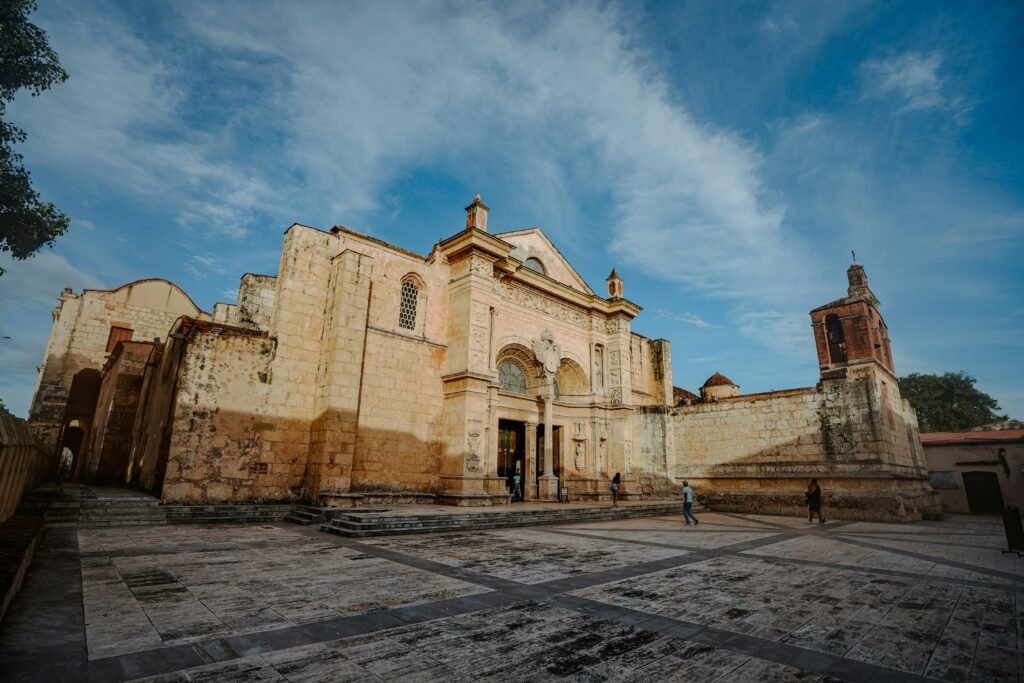
Internationally, the Dominican Republic is best known for the Colonial City of Santo Domingo, inscribed by UNESCO as a World Heritage Site in 1990 for its role as the first European city built in the Americas and for structures such as the Catedral Primada de America, the oldest cathedral in the hemisphere, and the Alcazar de Colon, the residence built for Columbus’s son Diego.[3] The country is also a major Caribbean tourism destination, a leading producer of cacao and sugar, and, through Major League Baseball, one of the most significant sources of professional baseball talent outside the United States.
Why It Matters
The Dominican Republic matters both as a historical hinge point and as a contemporary case study. Santo Domingo is where European colonization of the Americas began in practical, institutional terms, from its cathedral and university to its street grid, making the country a reference point for understanding how Spanish colonial administration took shape across the hemisphere.[3] Today, it is frequently cited by international financial institutions as an example of sustained, broad-based growth in a middle-income economy, while its relationship with Haiti continues to raise questions, discussed by scholars and international organizations, about migration, shared resources, and the long-term consequences of two very different national trajectories unfolding on one island.[1][4]
Key Takeaways
- The Dominican Republic occupies the eastern two-thirds of Hispaniola and is distinct from Dominica, a separate, much smaller island nation in the Lesser Antilles.
- Santo Domingo, the capital, is recognized by UNESCO as the site of the first permanent European settlement in the Americas, founded in 1498.
- The Colonial City of Santo Domingo became a UNESCO World Heritage Site in 1990, home to the hemisphere’s oldest cathedral and the Alcazar de Colon.
- With about 11.5 million people and GDP of roughly $127.4 billion in 2025, it has one of the fastest-growing economies in Latin America and the Caribbean.
- Pico Duarte, in the Cordillera Central, is the highest peak in the Caribbean at about 3,175 meters (10,417 feet).
- The Dominican Republic and Haiti share one island but have distinct languages, histories, and governments; their relationship has included historical conflict, including the 1937 Parsley Massacre, and ongoing migration-related tensions.
- The country is a leading source of Major League Baseball talent and the birthplace of merengue and bachata.
Sources
- World Bank, “Dominican Republic Overview,” Undated (accessed 2026), worldbank.org/en/country/dominicanrepublic/overview
- Britannica, “Duarte Peak,” Undated, britannica.com/place/Duarte-Peak
- UNESCO World Heritage Centre, “Colonial City of Santo Domingo,” 1990 (inscription), whc.unesco.org/en/list/526
- Harvard International Law Journal, “The Republic of Haiti and the Dominican Republic: A Relationship in Troubled Waters,” December 2023, journals.law.harvard.edu
- International Monetary Fund, “Dominican Republic: Staff Concluding Statement of the 2025 Article IV Mission,” September 15, 2025, imf.org
- World Bank, “Dominican Republic Data,” 2025, data.worldbank.org/country/dominican-republic
- Britannica, “Dominican Republic,” Undated, britannica.com/place/Dominican-Republic
Key facts
- Array
Quick checkIs the Dominican Republic the same country as Dominica?Show answer
No. The Dominican Republic is a separate, much larger nation sharing the island of Hispaniola with Haiti; Dominica is a small, distinct island nation in the Lesser Antilles.
Sources
- Array
Editorially reviewed by Specialty Digest Editorial TeamLast reviewed September 23, 2026Researched and drafted with AI assistanceReport an issue