Egypt sits in the northeastern corner of Africa, with the Sinai Peninsula extending into Asia, making it one of the few countries spanning two continents. It is bordered by the Mediterranean Sea to the north, the Red Sea to the east, Libya to the west, and Sudan to the south. Almost the entire population lives along the Nile River and its delta, since more than ninety percent of the country’s land is desert.
Where Is Egypt Located?
Egypt occupies the northeastern tip of Africa and the Sinai Peninsula in southwestern Asia, giving it coastlines on both the Mediterranean and Red Seas. Its location at the meeting point of Africa, Asia, and the Mediterranean world has made it a crossroads for trade, migration, and empires for thousands of years, a position formalized today by the Suez Canal, which connects the Mediterranean to the Red Sea and remains one of the world’s most important shipping routes.
Geography of Egypt
The Nile River, the longest river in Africa, runs the length of the country from south to north before fanning into a fertile delta at the Mediterranean coast. This narrow ribbon of farmland, rarely more than a few miles wide outside the delta, has supported dense human settlement since antiquity, while the Western and Eastern Deserts that flank it are largely uninhabited. The Aswan High Dam, completed in 1970, now regulates the Nile’s flow and stores water in Lake Nasser, one of the largest reservoirs in the world.
The Nile and the Desert
Because rainfall across most of Egypt is negligible, the Nile is not just a geographic feature but the basis of the country’s agriculture, drinking water, and history. Ancient Egyptians called their land Kemet, the “black land,” for the dark silt the river once deposited each flood season, in contrast to the surrounding “red land” of desert.
A Brief History of Egypt
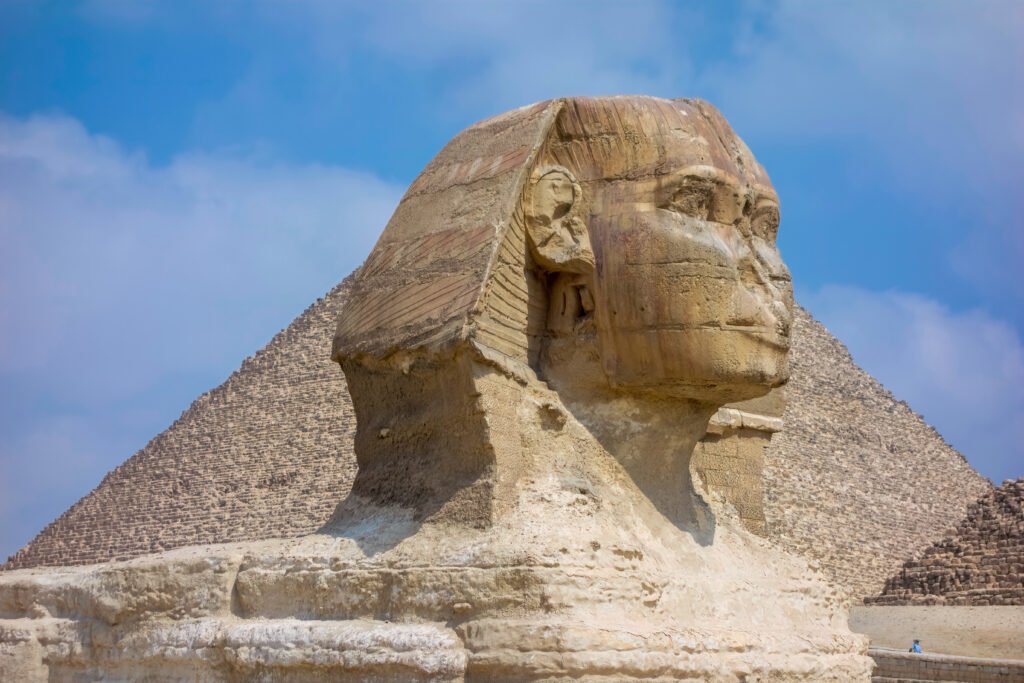
Egypt is home to one of the world’s oldest continuous civilizations, traditionally dated to the unification of Upper and Lower Egypt under a single ruler around 3100 BCE. The pharaonic period that followed lasted roughly three thousand years and produced the monumental architecture, writing system, and religious traditions that still define outside perceptions of ancient Egypt. The Great Pyramid of Giza and the Great Sphinx, both built during the Fourth Dynasty in the twenty-sixth century BCE under pharaohs Khufu and Khafre, are the best-preserved large-scale monuments of that era.
After the pharaonic period, Egypt came under Persian, Greek, and Roman rule, then became a center of early Christianity, and was conquered by Arab Muslim forces in the seventh century CE, a turning point that shaped its language and religion into the present day. Ottoman rule from 1517 gave way to British occupation in 1882, and Egypt achieved full independence as a republic in the twentieth century, with the monarchy abolished in 1953.
Government and Economy
Egypt is a presidential republic with an elected head of state and a bicameral legislature. According to the World Bank, Egypt is classified as a lower middle-income country whose economy rests on agriculture, manufacturing, and services, supported by a large domestic market, the Suez Canal, and a strategic location linking Africa, Asia, and Europe. The World Bank notes that Egypt has pursued structural and macroeconomic reforms in recent years aimed at restoring stability and competitiveness, though it continues to face economic vulnerabilities tied to global shocks and regional conditions.
Culture and People
With a population estimated at more than one hundred million, Egypt is the most populous country in the Arab world. Arabic is the official language, and the overwhelming majority of Egyptians are Muslim, with a significant Coptic Christian minority whose roots trace to Egypt’s early Christian period. Cairo, the capital, is one of the largest metropolitan areas in Africa and the Middle East, and Egyptian cinema, music, and literature have long had an outsized influence across the Arabic-speaking world.
What Is Egypt Known For?
Egypt is known above all for the monuments of ancient Egyptian civilization: the pyramids and Great Sphinx of Giza, the temples of Luxor and Karnak, and the tombs of the Valley of the Kings. The Giza Pyramid Field, along with the ancient capital of Memphis, is recognized by UNESCO as a World Heritage Site. The Nile River, the Suez Canal, and the country’s long Mediterranean and Red Sea coastlines are also central to how Egypt is understood globally, alongside its position as a political and cultural leader in the Arab world.
Why Egypt Matters
Egypt’s significance extends well beyond its ancient past. The Suez Canal makes it central to global shipping, its population and cultural output give it outsized influence in the Middle East and North Africa, and its ancient monuments have shaped how successive civilizations, from the Greeks and Romans to modern scholars, have understood the deep history of human civilization.
Key Takeaways
- Egypt spans northeastern Africa and the Sinai Peninsula in Asia, bordered by the Mediterranean and Red Seas.
- More than ninety percent of the country is desert, with settlement concentrated along the Nile River and its delta.
- The Great Pyramid of Giza and the Great Sphinx date to the Fourth Dynasty, around the twenty-sixth century BCE.
- The Giza Pyramid Field and the ruins of Memphis are inscribed as a UNESCO World Heritage Site.
- Egypt is a lower middle-income presidential republic whose economy is anchored by agriculture, manufacturing, services, and the Suez Canal.
Sources
- World Bank, Egypt Overview
- UNESCO World Heritage Centre, Memphis and its Necropolis, the Pyramid Fields from Giza to Dahshur
- Encyclopaedia Britannica, Egypt
Key facts
Quick checkWhat UNESCO-listed site is Egypt best known for?Show answer
The Giza Pyramid Field, including the Great Pyramid and the Great Sphinx, part of the Memphis and its Necropolis World Heritage Site.
Sources
- World Bank. Egypt Overview. Undated (accessed 2026-09-23)
- UNESCO World Heritage Centre. Memphis and its Necropolis, the Pyramid Fields from Giza to Dahshur. 1979 (accessed 2026-09-23)
- Encyclopaedia Britannica. Egypt. Undated (accessed 2026-09-23)
Editorially reviewed by Specialty Digest Editorial TeamLast reviewed September 23, 2026Researched and drafted with AI assistanceReport an issue