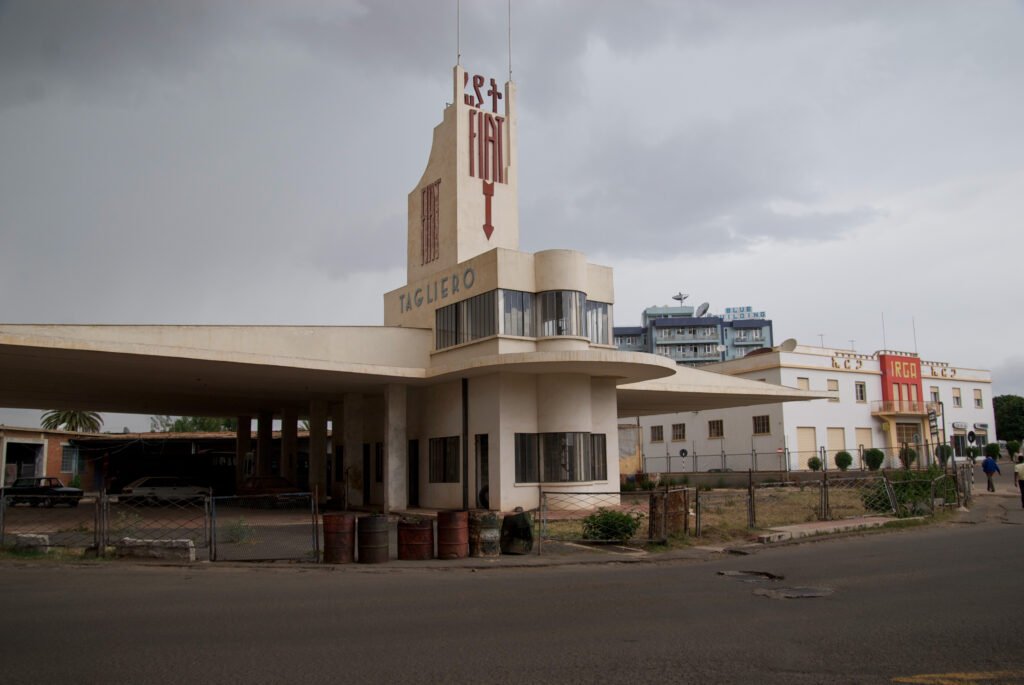
Eritrea occupies a long stretch of the Red Sea coast in the Horn of Africa. Its capital, Asmara, sits on a highland plateau and preserves one of the world’s largest and best-preserved collections of early twentieth-century Italian modernist architecture, a legacy of Italian colonial rule that earned the city UNESCO World Heritage status in 2017.
Where Is Eritrea Located?
Eritrea lies in the Horn of Africa, bordered by Sudan to the west, Ethiopia to the south, and Djibouti to the southeast, with a Red Sea coastline running along its entire eastern edge. That coastline, along with the Dahlak Archipelago offshore, gives Eritrea a strategic position near one of the world’s busiest shipping corridors linking the Red Sea to the Gulf of Aden.
Geography of Eritrea
The country’s terrain ranges from a hot, arid coastal plain along the Red Sea to a cooler central highland plateau, where Asmara sits at an elevation of roughly 2,300 meters, and down again to lowlands bordering Sudan and Ethiopia. This range of elevation produces sharply different climates within a relatively small area, from near-desert conditions on the coast to a temperate highland climate in the capital.
A Brief History of Eritrea
Italy colonized the territory beginning in 1890, naming it Eritrea after the Latin name for the Red Sea, and developed Asmara as a showcase colonial capital, building it up extensively with modernist architecture through the 1930s. After Italy’s defeat in the Second World War, Britain administered the territory before the United Nations federated Eritrea with Ethiopia in 1952. Ethiopia annexed Eritrea outright in 1962, triggering a war for independence that lasted three decades until Eritrean forces prevailed in 1991, with independence formally recognized after a 1993 referendum. A further border war with Ethiopia from 1998 to 2000 caused tens of thousands of deaths before a peace agreement was eventually signed between the two countries in 2018.
Government and Economy
Eritrea is a one-party state that has not held national elections since independence. According to the World Bank, its lending program in the country is inactive due to repayment arrears, and World Bank engagement is currently limited to technical assistance, analytical work, and preparation for broader re-engagement, reflecting the country’s constrained access to international financing. The economy relies heavily on agriculture and mining, including gold and other minerals.
Culture and People
Eritrea is home to several ethnic groups, including the Tigrinya, who form the largest group and are concentrated in the highlands, and the Tigre, along with smaller communities near the coast and lowlands. Tigrinya and Arabic serve as de facto working languages, and the population is divided roughly between Christianity, mainly the Eritrean Orthodox Tewahedo Church, and Islam.
What Is Eritrea Known For?
Eritrea is known internationally for Asmara’s remarkably intact collection of Italian Futurist, Art Deco, and Rationalist buildings, a body of architecture so distinctive that UNESCO inscribed the city as a World Heritage Site under the name “Asmara: a Modernist City of Africa.” The Fiat Tagliero Building, a former petrol station completed in 1938 with dramatically cantilevered wings resembling an airplane, is the single most photographed and recognizable structure in the city.
Why Eritrea Matters
Eritrea’s decades-long struggle for independence and its subsequent isolation make it one of the least externally engaged states in the Horn of Africa, even as Asmara’s architecture preserves an unusually complete record of a specific moment in early twentieth-century urban design found almost nowhere else in the world.
Key Takeaways
- Eritrea sits on the Red Sea coast of the Horn of Africa, bordering Sudan, Ethiopia, and Djibouti.
- Its capital, Asmara, is a UNESCO World Heritage Site for its Italian modernist architecture.
- The Fiat Tagliero Building, a 1938 Futurist former petrol station, is Asmara’s most iconic landmark.
- Eritrea gained independence from Ethiopia in 1991 after a thirty-year war, formalized by a 1993 referendum.
- The World Bank reports its lending program in Eritrea is currently inactive due to repayment arrears.
Sources
- World Bank, Eritrea Overview
- UNESCO World Heritage Centre, Asmara: a Modernist City of Africa
- Encyclopaedia Britannica, Eritrea
Key facts
- Capital Asmara is a UNESCO World Heritage Site for Italian modernist architecture2
- The Fiat Tagliero Building (1938) is Asmara's most iconic landmark2
- Independence from Ethiopia in 1991 after a thirty-year war, confirmed by referendum in 19933
- One-party state; no national elections held since independence3
- World Bank lending program currently inactive due to repayment arrears1
Quick checkWhat UNESCO World Heritage Site is Eritrea's capital known for?Show answer
Asmara is inscribed as "Asmara: a Modernist City of Africa" for its Italian colonial-era Art Deco and Futurist architecture.
Sources
- World Bank. Eritrea Overview. Undated (accessed 2026-09-23)
- UNESCO World Heritage Centre. Asmara: a Modernist City of Africa. 2017 (accessed 2026-09-23)
- Encyclopaedia Britannica. Eritrea. Undated (accessed 2026-09-23)
Editorially reviewed by Specialty Digest Editorial TeamLast reviewed September 23, 2026Researched and drafted with AI assistanceReport an issue