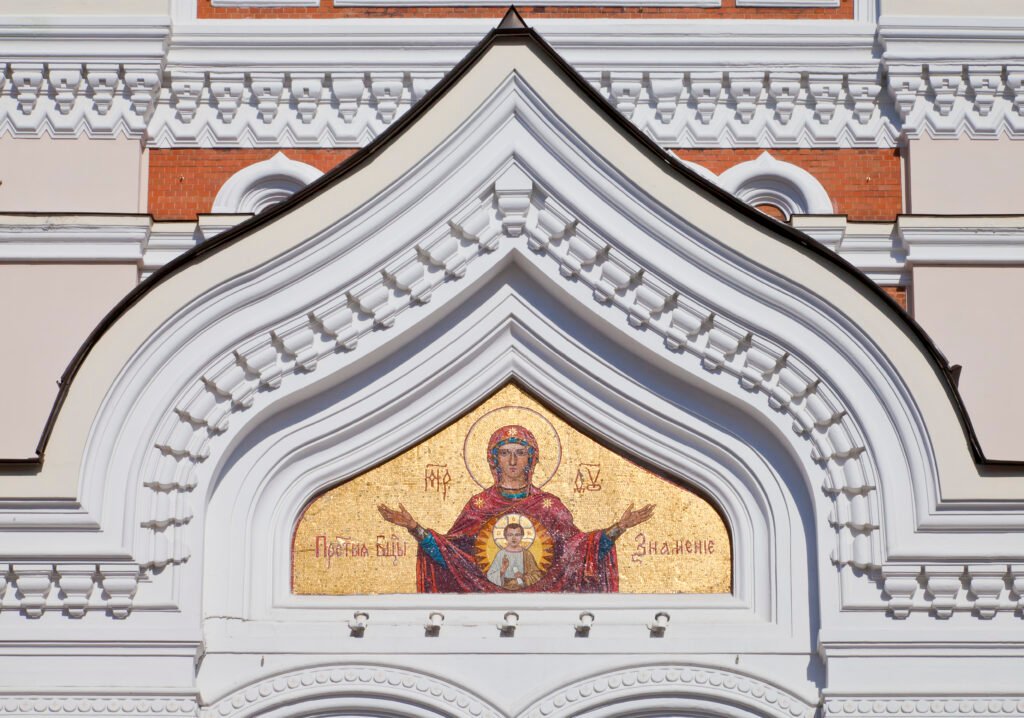
Estonia is the northernmost of the three Baltic states, facing the Gulf of Finland and the Baltic Sea. Its capital, Tallinn, preserves one of Europe’s best-maintained medieval old towns, a UNESCO World Heritage Site whose skyline is dominated by the onion domes of the Alexander Nevsky Cathedral rising above the surrounding city walls and spires.
Where Is Estonia Located?
Estonia sits in Northern Europe along the eastern shore of the Baltic Sea, bordered by the Gulf of Finland to the north, Latvia to the south, and Russia to the east across Lake Peipus and a land frontier. More than 2,000 islands, most notably Saaremaa and Hiiumaa, lie off its western coast.
Geography of Estonia
The country is low-lying and heavily forested, with roughly half its territory covered by woodland and a further significant share made up of wetlands, bogs, and small lakes. Its highest point, Suur Munamagi, reaches only about 318 meters, making Estonia one of the flattest countries in Europe.
A Brief History of Estonia
Estonia’s territory came under the control of Danish and German crusading orders in the thirteenth century, later passing to Swedish and then Russian imperial rule by the early eighteenth century. Estonia declared independence in 1918 as the Russian Empire collapsed, only to be occupied by the Soviet Union in 1940, then by Nazi Germany from 1941 to 1944, before being re-annexed by the USSR until the end of the Cold War. Estonia restored its independence in 1991 during the peaceful “Singing Revolution” and joined both the European Union and NATO in 2004, later adopting the euro in 2011.
Government and Economy
Estonia is a parliamentary republic and a high-income European Union member state. The World Bank classifies Estonia among the countries with which it partners on shared development priorities rather than as a borrowing client, reflecting its status as a developed, high-income economy. Estonia is widely recognized for its advanced digital government services, including nationwide electronic ID and online voting systems that other countries have studied as a model for digital public administration.
Culture and People
Estonian, a Finno-Ugric language closely related to Finnish, is the official language, distinguishing Estonia linguistically from its Baltic neighbors Latvia and Lithuania, whose languages belong to the separate Baltic branch of Indo-European. Estonia is one of the least religious countries in Europe by self-identification, and its culture places a strong emphasis on choral singing, reflected in its tradition of massive national song festivals held in Tallinn.
What Is Estonia Known For?
Estonia is best known for the medieval Old Town of Tallinn, inscribed by UNESCO as a World Heritage Site in 1997 for its well-preserved Hanseatic-era architecture, city walls, and winding cobblestone streets. Within that skyline, the Alexander Nevsky Cathedral, an ornate Russian Orthodox cathedral built between 1894 and 1900 on Toompea Hill, is the city’s most photographed single landmark, its dark onion domes standing in deliberate visual contrast to the surrounding Gothic spires.
Why Estonia Matters
Estonia’s rapid transformation from a Soviet republic into one of Europe’s most digitally advanced states in little more than a generation has made it a frequently cited case study in digital governance, even as Tallinn’s Old Town preserves a physical record of the centuries of Danish, German, Swedish, and Russian rule that shaped the wider Baltic region.
Key Takeaways
- Estonia is the northernmost Baltic state, bordering Latvia, Russia, and the Gulf of Finland.
- Tallinn’s Old Town is a UNESCO World Heritage Site for its preserved medieval architecture.
- The Alexander Nevsky Cathedral, built 1894 to 1900, is Tallinn’s most recognizable landmark.
- Estonia restored its independence from the Soviet Union in 1991 and joined the EU and NATO in 2004.
- Estonia is widely regarded as a global leader in digital government services.
Sources
- UNESCO World Heritage Centre, Historic Centre (Old Town) of Tallinn
- World Bank, Estonia Overview
- Encyclopaedia Britannica, Estonia
Key facts
- Tallinn's Old Town is a UNESCO World Heritage Site inscribed in 19971
- Estonian is a Finno-Ugric language related to Finnish, not to Latvian or Lithuanian3
- Restored independence from the USSR in 1991; joined the EU and NATO in 20043
- Adopted the euro in 20113
- A high-income World Bank development partner rather than a borrowing client2
Quick checkWhat UNESCO-listed landmark defines Tallinn's skyline?Show answer
Tallinn's medieval Old Town, a UNESCO World Heritage Site, with the Alexander Nevsky Cathedral as its most photographed single landmark.
Sources
- UNESCO World Heritage Centre. Historic Centre (Old Town) of Tallinn. 1997 (accessed 2026-09-23)
- World Bank. Estonia Overview. Undated (accessed 2026-09-23)
- Encyclopaedia Britannica. Estonia. Undated (accessed 2026-09-23)
Editorially reviewed by Specialty Digest Editorial TeamLast reviewed September 23, 2026Researched and drafted with AI assistanceReport an issue