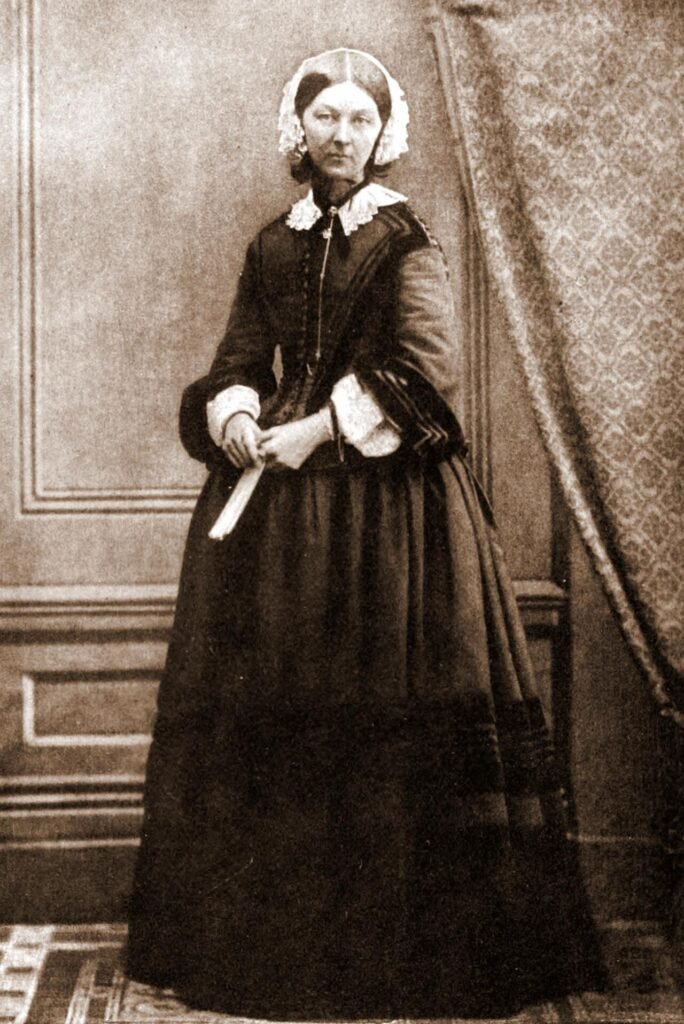
Florence Nightingale (1820 to 1910) was an English nurse, reformer and statistician who is regarded as the founder of modern nursing. She became famous for her work in army hospitals during the Crimean War and later used data and public campaigns to improve sanitation, hospital design and nurse training.
Early life of Florence Nightingale
Florence Nightingale was born on 12 May 1820 in Florence, Italy, while her parents were traveling in Europe, and she was named after the city. Her father, William Edward Nightingale, had been born William Shore and took the Nightingale name after inheriting an estate. Her mother was Frances Smith. The family spent its time at Lea Hurst in Derbyshire and Embley in Hampshire, with trips to London.
Her father educated her himself after her early governesses. She studied the classics, history and politics, and she persuaded her parents, after long arguments, to let her study mathematics. Her tutors included the mathematician James Joseph Sylvester. She was also influenced by the Belgian scientist Adolphe Quetelet, who applied statistics to social questions.
In February 1837 she believed she heard a call from God to serve, although the form of that service was not yet clear. Nursing was then considered an unsuitable job for an educated woman, and her family opposed her interest in hospitals. She trained anyway, at a hospital in Alexandria in 1850, at Pastor Theodor Fliedner’s institution at Kaiserswerth in Germany in 1851, and at a hospital run by the Sisters of Mercy near Paris. In 1853 she took charge of a small London nursing home for sick gentlewomen.
Career and the Crimean War
Britain, France and the Ottoman Empire went to war with Russia in 1854, and newspaper reports described the suffering of British soldiers. Sidney Herbert, the Secretary at War and a friend of Nightingale, asked her to lead a group of nurses for the military hospitals in Turkey. She arrived at Scutari, a suburb of Istanbul, in early November 1854 with 38 nurses.
The main barracks hospital was dirty and infested with vermin, lacked basic supplies, and held more men suffering from disease than from battle wounds. Army doctors at first resisted help from women, but after heavy casualties from the Battle of Inkerman they accepted it. Nightingale and her nurses improved supplies, set up kitchens, laundered linen, wrote letters for soldiers and opened reading rooms. A report in The Times described her walking the wards at night with a lamp, and the image of the Lady with the Lamp made her a celebrity.
In May 1855 she traveled to the Crimea, where she caught what became known as Crimean fever. She recovered slowly and, according to the accounts of the time, suffered for years from the effects. She left the region in August 1856.
Ideas and contributions
Nightingale believed that decisions about health should rest on data. At Scutari she had deaths recorded and later analyzed. By her calculations, mortality at the hospital had been very high, with the rate reaching about 42 percent by February 1855. It fell to about 2 percent in the spring after fresh water, supplies and better sanitation were put in place. Historians note that some of the gains came from the sanitary commission that repaired sewers and improved ventilation, which she supported, and that she had first wrongly blamed poor nutrition.
She used the numbers to show that far more soldiers had died of preventable disease than of wounds. To make the point clear to officials who would not read tables, she drew charts known as polar area diagrams, or coxcombs, in which the area of each wedge represents a figure. They are an early and well-known example of data visualization, and the underlying approach has a close kinship with modern epidemiology. She was elected the first woman member of the Royal Statistical Society, in 1858 or 1859, depending on the source.
Her pressure helped bring about the Royal Commission on the Health of the Army in 1857. She also advised the British War Office and, later, the United States government on army health. In 1860 she opened the Nightingale Training School for nurses at St Thomas’ Hospital in London, funded by public donations to the Nightingale Fund. Students received practical training in hospital wards and lived in a supervised home. Her books Notes on Hospitals and Notes on Nursing, from 1859 or 1860 depending on the edition cited, became foundations of nursing practice.
Later life and legacy
For much of her later life Nightingale was in poor health and spent long periods in bed. A museum account says that her condition would now be described as chronic fatigue syndrome, although the cause is uncertain. She nevertheless wrote about 200 books, reports and pamphlets and campaigned on health standards and sanitary reform, including for the army in India. Queen Victoria awarded her the Royal Red Cross in 1883, and in 1907 she became the first woman to receive the Order of Merit.
She died on 13 August 1910 at age 90. Her family declined an offer of burial at Westminster Abbey, and she was buried at St Margaret’s Church in East Wellow, Hampshire. The International Nurses Day is held on her birthday, 12 May, and the Florence Nightingale Medal is the highest international honor for a nurse.
Criticism and a changing reputation
Nightingale’s image as a gentle lamp-bearer was partly the product of newspapers and poems, including one by Henry Wadsworth Longfellow. Some contemporaries found her hard to work with. One senior officer thought she liked to govern and showed little warmth to equals or superiors. Modern historians also say that the media exaggerated her results in the Crimea, and that sanitation reforms by others contributed to the fall in deaths.
What historians agree on is her later influence. Before her, nursing was often done by women with little training and a poor reputation. Her school and her writing helped change nursing into a respected profession for educated women, and her use of statistics showed that good data can drive public health reform.
More in Public Health
Key facts
- Florence Nightingale was born on 12 May 1820 in Florence and died on 13 August 1910.1
- She reached Scutari with 38 nurses in November 1854.1
- She used statistics and polar area diagrams to show that most Crimean deaths were from preventable disease.1
- The Nightingale Training School opened at St Thomas Hospital in London in 1860.2
- She received the Royal Red Cross in 1883 and the Order of Merit in 1907.1
Related concepts
Quick checkWhy is Florence Nightingale called the founder of modern nursing?Show answer
She turned nursing into a trained profession for educated women through her school at St Thomas Hospital and her writings, and she used statistics to push for cleaner, better-run hospitals.
Sources
- MacTutor History of Mathematics, Florence Nightingale, https://mathshistory.st-andrews.ac.uk/Biographies/Nightingale/
- National Army Museum, Florence Nightingale: The Lady with the Lamp, https://www.nam.ac.uk/explore/florence-nightingale
Editorially reviewed by Specialty Digest Editorial TeamLast reviewed November 4, 2026Researched and drafted with AI assistanceReport an issue