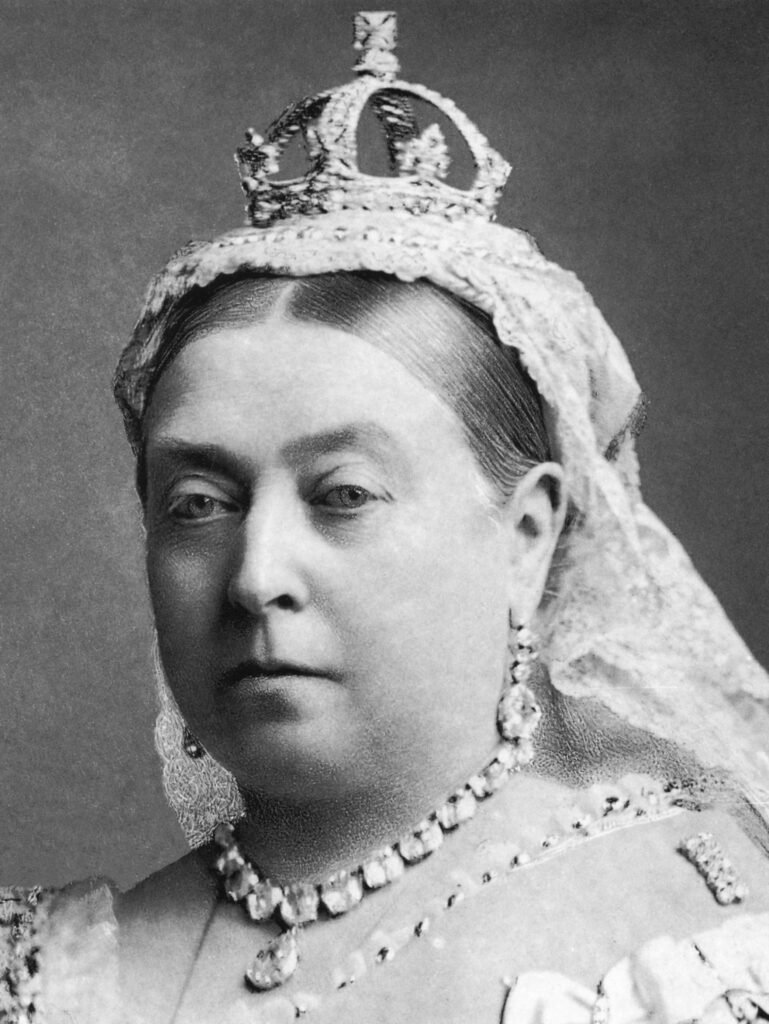
Queen Victoria (1819 to 1901) was the monarch of the United Kingdom of Great Britain and Ireland from 1837 until her death and, from 1877, Empress of India. Her reign of almost 64 years was the longest in British history up to that time, and it gave its name to an era of industrial growth and imperial expansion. She died at Osborne House on the Isle of Wight on 22 January 1901.
Early life of Queen Victoria
Victoria was born at Kensington Palace in London on 24 May 1819, the only daughter of Edward, Duke of Kent, the fourth son of George III. Her father died within a year, and she became heir to the throne because her three uncles who were ahead of her in the line of succession left no legitimate children who survived. Her mother and a German governess, Baroness Louise Lehzen, were the main influences on a lonely childhood in Kensington Palace. She kept a diary throughout her life.
William IV died on 20 June 1837, and Victoria became queen at the age of 18. She was crowned at Westminster Abbey on 28 June 1838. Her first prime minister, Lord Melbourne, taught her how a constitutional monarchy worked, in which the ruler has few powers but can use real influence.
Career and major work of Queen Victoria
Victoria married her cousin, Prince Albert of Saxe-Coburg-Gotha, on 10 February 1840 at St. James’s Palace. Because she was the sovereign, protocol required her to propose to him. The couple had nine children between 1840 and 1857, and most of them married into other royal families of Europe. Albert took an active interest in the arts, science, trade and industry, and the project for which he is best remembered is the Great Exhibition of 1851, whose profits helped establish the South Kensington museums. The family bought Osborne House on the Isle of Wight in 1845, and Albert bought Balmoral in Scotland in 1852.
Albert died of typhoid fever on 14 December 1861, at the age of 42, and Victoria fell into deep depression. She wore black for the rest of her life and rarely appeared in public until the late 1860s. She nevertheless kept up her official correspondence and continued to see ministers. Seven attempts were made on her life between 1840 and 1882, and her courage during these attacks added to her popularity.
Her return to public duties came with the encouragement of her family and the attention of Benjamin Disraeli, prime minister in 1868 and from 1874 to 1880. After the Indian Mutiny of 1857 the government of India passed from the East India Company to the Crown, and in 1877 Victoria became Empress of India under the Royal Titles Act.
Ideas and contributions of Queen Victoria
Victoria’s reign saw direct political power move away from the sovereign. Reforms such as the Second Reform Act of 1867, the secret ballot of 1872 and the Representation of the People Act of 1884 widened the electorate. During this period the modern idea of a constitutional monarch, who stays above party politics, began to take shape.
She was not always neutral, and in private she sometimes gave her opinions forcefully. She mediated between the Commons and the Lords during the passage of the Irish Church Disestablishment Act of 1869 and the Reform Act of 1884. In 1880 she tried and failed to stop William Gladstone, whom she disliked, from becoming prime minister. Her influence on foreign policy in the middle of her reign usually favored peace. In 1864 she urged her ministers not to intervene in the war between Prussia and Denmark, and a letter she wrote to the German emperor in 1875 that helped avoid a second Franco-German war.
She tended to support measures to help the poor, such as a Royal Commission on housing, and she backed charities working in education and hospitals. Like many people of her time she opposed votes for women. She was also the first reigning monarch to travel by train, making her first trip in 1842, and the spread of newspapers and photography meant the royal family was seen on an unprecedented scale.
Legacy of Queen Victoria
The Golden Jubilee of 1887 and the Diamond Jubilee of 1897 marked the 50th and 60th anniversaries of her accession with large public ceremonies, and colonial prime ministers attended conferences held at both. In her later years she became a symbol of the British Empire. Despite her age she carried out her duties to the end, including an official visit to Dublin in 1900. The Boer War in South Africa overshadowed the final years of her reign, and as in the Crimean War nearly half a century earlier she reviewed troops and visited hospitals.
She was succeeded by her son, Edward VII, and was buried at Windsor beside Prince Albert in the Frogmore Royal Mausoleum, which she had built for them both. Most of her children married into other royal families of Europe, and her reign helped shape the modern idea of a constitutional monarchy. It is also associated with Britain’s great age of industrial expansion, a later phase of the Industrial Revolution.
Controversies and criticism
Victoria’s long seclusion after Albert’s death drew public criticism. She was persuaded to open Parliament in person in 1866 and 1867, but she was widely criticized for living away from public life, and a fairly strong republican movement developed. Her political preferences also caused friction, as in her dislike of Gladstone.
Her association with empire is another source of debate. After 1857 the government of India passed to the Crown, and she was a strong supporter of the empire, which brought her closer to Disraeli and to her last prime minister, Lord Salisbury. The empire with which she is associated remains a subject of historical debate, and it is a central theme in the history of the United Kingdom.
More in History
Key facts
- Victoria was born at Kensington Palace on 24 May 1819 and became queen at age 18 in 1837.12
- She married Prince Albert on 10 February 1840, and they had nine children.12
- Albert died on 14 December 1861, and Victoria wore black for the rest of her life.12
- She became Empress of India in 1877.1
- She died on 22 January 1901 after a reign of almost 64 years, then the longest in British history.1
Related concepts
In the news
Quick checkHow long did Queen Victoria reign?Show answer
Almost 64 years, from 1837 to 1901, which was the longest reign in British history up to that time.
Sources
- The Royal Family, Victoria (r. 1837-1901), https://www.royal.uk/queen-victoria
- World History Encyclopedia, Queen Victoria, https://www.worldhistory.org/Queen_Victoria/
Editorially reviewed by Specialty Digest Editorial TeamLast reviewed November 4, 2026Researched and drafted with AI assistanceReport an issue