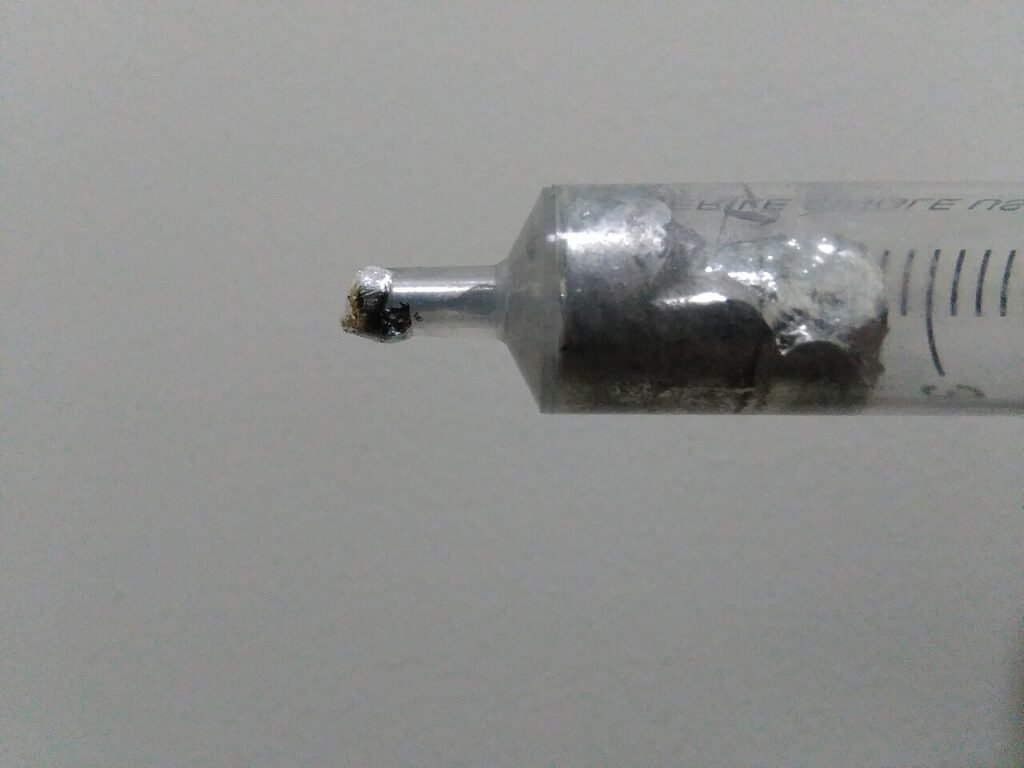
Gallium is the chemical element with atomic number 31 and the symbol Ga. It is a soft, silvery-white metal in group 13 of the periodic table, similar in appearance to aluminum. Gallium melts at a temperature just below that of the human body, and it is an important ingredient in modern semiconductors and light-emitting diodes.
History of gallium
Gallium was discovered in Paris in 1875 by the French chemist Paul-Emile Lecoq de Boisbaudran. He observed a new violet line in the atomic spectrum of some zinc that he had extracted from a sample of zinc blende ore from the Pyrenees. An atomic spectrum is the set of colored lines of light that an element gives off or absorbs, and each element has its own pattern. The new line told him that an unknown element was present.
Lecoq de Boisbaudran did not realize that the existence and properties of the element had already been predicted by Dmitri Mendeleev. Mendeleev’s periodic table showed a gap below aluminum that was yet to be filled, and he forecast that the missing element would have an atomic weight of around 68 and a density of 5.9 grams per cubic centimeter. The values eventually measured for gallium were 69.723 and 5.91.
By November 1875 Lecoq de Boisbaudran had isolated and purified the new metal and shown that it was like aluminum. In December 1875 he announced it to the French Academy of Sciences. The name comes from the Latin name for France, Gallia. The Royal Society of Chemistry adds that he may also have been punning on his own name, since Lecoq, which means the rooster, translates to Gallus in Latin.
Mendeleev’s forecast was an early success for the periodic table. The gap below aluminum was filled by a real element whose density in particular matched his prediction.
Properties of gallium
Gallium is a soft metal, similar in appearance to aluminum, and it belongs to group 13 directly below aluminum in the periodic table.
Gallium has a standard atomic weight of 69.723, and NIST lists the value with an uncertainty of 1 in the last digit. A gallium atom has 31 protons and an electron configuration of [Ar] 3d10 4s2 4p1, meaning the arrangement of argon plus ten electrons in the 3d level, two in the 4s level and one in the 4p level. PubChem classes gallium as a post-transition metal, one of the metals that sit to the right of the transition metals in the periodic table.
The melting point of gallium is 29.76 degrees Celsius, or about 302.9 kelvins, according to the Royal Society of Chemistry. At normal body temperature of around 37 degrees Celsius it is therefore already a liquid, even though it is a solid at 20 degrees Celsius. Its boiling point is high. The Royal Society of Chemistry gives 2,229 degrees Celsius and PubChem gives 2,477 kelvins, which is about 2,204 degrees Celsius, so published values differ by a few tens of degrees. The density is 5.91 grams per cubic centimeter.
The common oxidation state of gallium is plus 3. PubChem records an electronegativity of 1.81 on the Pauling scale, a first ionization energy of 5.999 electronvolts and an atomic radius of 187 picometers. Gallium readily forms alloys with most metals, and it is particularly used in low-melting alloys.
Occurrence and production of gallium
Gallium is present in trace amounts in the minerals diaspore, sphalerite, germanite and bauxite, and in coal. It is mainly produced as a by-product of zinc refining, which means it is recovered from the processing of another metal.
The metal can be obtained by electrolysis of a solution of gallium(III) hydroxide in potassium hydroxide. Electrolysis uses an electric current to drive a chemical change in a solution, and in this case it deposits pure gallium metal.
Uses of gallium
The best-known uses of gallium are in electronics. Gallium arsenide has a similar structure to silicon and is a useful silicon substitute for the electronics industry. It is an important component of many semiconductors, which are materials that conduct electricity better than insulators but worse than metals, and whose behavior can be tuned. Gallium arsenide is also used in red light-emitting diodes, or LEDs, because of its ability to convert electricity into light, and the solar panels on the Mars Exploration Rover contained it.
Gallium nitride is also a semiconductor, and the Royal Society of Chemistry describes it as particularly versatile. It has important uses in Blu-ray technology, mobile phones, blue and green LEDs and pressure sensors for touch switches.
The high boiling point of gallium makes it ideal for recording temperatures that would vaporize an ordinary thermometer. Gallium also alloys with most metals, and the low-melting alloys it forms are used where a material that turns liquid at low temperatures is needed.
Red LEDs rely on the ability of gallium arsenide to convert electricity into light, whereas blue and green LEDs rely on gallium nitride. Both compounds pair gallium with an element from group 15, arsenic or nitrogen.
Isotopes of gallium
NIST lists two stable isotopes of gallium: gallium-69 and gallium-71. Gallium-69 makes up about 60.108 percent of natural gallium, and gallium-71 makes up about 39.892 percent. An isotope is a form of an element with a particular number of neutrons, and the number after the name is the combined count of protons and neutrons. The Royal Society of Chemistry lists gallium-69 as the key isotope of the element.
Health and environmental effects of gallium
Gallium has no known biological role. According to the Royal Society of Chemistry it is non-toxic. In nature it is present only in trace amounts, in minerals such as bauxite and in coal.
Gallium arsenide and gallium nitride devices appear in products such as mobile phones and LED lighting, as described above. The information here is general background rather than health advice.
Key facts
- Array
Related concepts
In the news
Quick checkWho discovered gallium and how?Show answer
The French chemist Paul-Emile Lecoq de Boisbaudran discovered gallium in 1875. He saw a new violet line in the spectrum of zinc extracted from zinc blende ore from the Pyrenees.
Sources
- Array
Editorially reviewed by Specialty Digest Editorial TeamLast reviewed November 4, 2026Researched and drafted with AI assistanceReport an issue