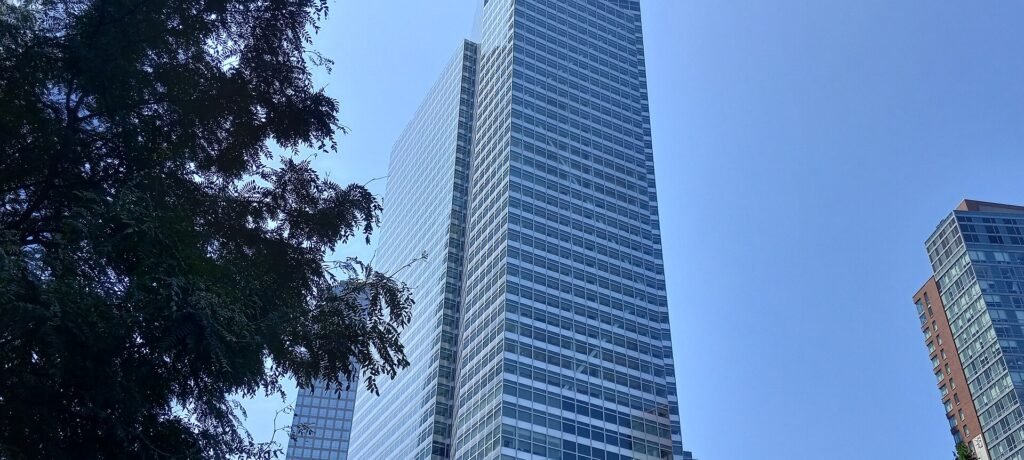
The Goldman Sachs Group, Inc., commonly called Goldman Sachs, is an American global financial institution headquartered at 200 West Street in New York City. It advises corporations, financial institutions, governments and individuals on raising capital, trading and investing, and it also manages wealth. The firm traces its origins to a small brokerage opened in 1869 and reported net revenues of $58.3 billion for 2025.
History of Goldman Sachs
In 1869, Marcus Goldman, a 48-year-old German Jewish immigrant and former street peddler with no background in finance, hung a sign reading M. Goldman, Broker and Banker at 30 Pine Street in New York. His small family partnership grew over the next five decades into one of the best-known banks on Wall Street.
The firm later reached beyond the family for leadership. Waddill Catchings led it through ever more daring schemes that ended in financial catastrophe after the crash of 1929. The Sachs family stayed with the firm and entrusted its recovery to Sidney Weinberg, a high-school dropout, whose career defined the firm for roughly four decades. Gus Levy took over in 1969, and John Whitehead and John Weinberg shared leadership from 1976.
Under those two men, the firm expanded overseas for the first time in 1989, beginning in London and extending across Europe. In the spring of 1999, after 130 years as a private partnership, Goldman Sachs became a publicly traded company under Hank Paulson. In 2008, under Lloyd Blankfein, it faced the worst financial crisis since the crash of 1929. It marked its 150th anniversary in 2019 under David Solomon.
Today the parent company is a bank holding company under the U.S. Bank Holding Company Act of 1956 and a financial holding company under the Gramm-Leach-Bliley Act of 1999, and the Federal Reserve Board is its primary regulator. Its principal U.S. subsidiaries include GS Bank USA and Goldman Sachs & Co. LLC.
Products and services of Goldman Sachs
Goldman Sachs reports three business segments. Global Banking & Markets earns revenue from investment banking fees, including advisory work and equity and debt underwriting. It also earns revenue from intermediation and financing in fixed income, currencies and commodities, known as FICC, and in equities, along with relationship lending, acquisition financing and transaction banking.
Asset & Wealth Management provides investment services to institutions and individuals, and earns management and other fees, incentive fees, and revenue from private banking, lending and investments. It also raises deposits from consumers through Marcus by Goldman Sachs. The firm offers investment strategies in equity, fixed income and alternatives, and tailored wealth advice to ultra-high-net-worth clients.
Platform Solutions is the third segment. Substantially all its revenue comes from issuing credit cards to Apple Card customers and raising deposits from them, along with businesses the firm has exited. The firm’s annual report also refers to its effort to transition the Apple Card program to another issuer, so this segment is in a period of change.
Corporate structure and operations of Goldman Sachs
The Goldman Sachs Group, Inc. is incorporated in Delaware and its shares trade on the New York Stock Exchange under the symbol GS. In 2025 it reported net revenues of $58.28 billion, 9 percent higher than in 2024, pre-tax earnings of $21.85 billion and net earnings of $17.18 billion. Diluted earnings per common share were $51.32, up from $40.54 a year earlier, and book value per common share was $357.60 as of December 2025.
The firm reports return on equity, which divides earnings available to common shareholders by average common equity. Its return on equity was 15.0 percent in 2025 and 12.7 percent in 2024, and its through-the-cycle target is a range of 14 percent to 16 percent. Return on tangible equity was 16.0 percent. In 2025 it said that about 20,000 employees took part in around 1,500 volunteer community projects with about 700 nonprofit organizations, contributing about 104,000 hours.
The firm describes its goal, called One Goldman Sachs, as delivering its full range of services and expertise to clients in a more accessible and efficient way across businesses and product areas. It states a purpose of advancing sustainable economic growth and financial opportunity.
Impact of Goldman Sachs
Goldman Sachs is a major intermediary in the capital markets, which are the markets where companies and governments raise money by selling shares and bonds. Its advice on mergers and its underwriting of securities help determine how businesses in the United States and abroad raise funds and change ownership. Its history also shows how an investment bank moved from partnership to public ownership and later to bank holding company regulation.
Changes in interest rates and market activity affect the firm’s revenue, since a large share comes from advising on deals, underwriting and trading. Because the firm is a bank holding company, regulators set capital requirements for it, including expected stress capital buffer and global systemically important bank surcharge requirements that determine how much extra capital it must hold. Its results rose between 2023 and 2025, when net revenues grew from $46.3 billion to $58.3 billion.
Criticism and legal matters
The most significant legal matter in the firm’s recent history involves 1Malaysia Development Berhad, known as 1MDB, a Malaysian state development fund. Between 2012 and 2013, subsidiaries of the firm acted as arrangers or purchasers of about $6.5 billion of 1MDB debt securities. In 2018, the U.S. Department of Justice unsealed a criminal information and guilty plea by Tim Leissner, a former participating managing director of the firm, and an indictment against Ng Chong Hwa, a former managing director.
On October 22, 2020, the firm announced settlements of government and regulatory investigations relating to 1MDB with authorities in the United States, the United Kingdom, Singapore and Hong Kong. Group Inc. entered a three-year deferred prosecution agreement with the Department of Justice, and the charge was dismissed on May 6, 2024. Its Malaysian subsidiary pleaded guilty to one count of conspiracy to violate the Foreign Corrupt Practices Act and was sentenced on June 9, 2021. The firm also guaranteed that the Government of Malaysia would receive at least $1.4 billion in assets and proceeds from assets seized worldwide related to 1MDB.
More in Finance
Key facts
- Marcus Goldman opened the business in 1869 at 30 Pine Street in New York, with a sign reading M. Goldman, Broker and Banker.1
- Goldman Sachs became a publicly traded company in the spring of 1999 after 130 years as a private partnership.1
- Goldman Sachs reported net revenues of $58.28 billion and net earnings of $17.18 billion for 2025.2
- It reports three segments: Global Banking & Markets, Asset & Wealth Management and Platform Solutions.2
- The firm is a bank holding company supervised by the Federal Reserve Board, and its headquarters are at 200 West Street in New York.2
Related concepts
Quick checkWhen did Goldman Sachs go public?Show answer
Goldman Sachs became a publicly traded company in the spring of 1999, after 130 years as a private partnership.
Sources
- [1] Goldman Sachs, Goldman Sachs at 150 (company history), https://www.goldmansachs.com/our-firm/history/goldman-sachs-at-150.html
- [2] The Goldman Sachs Group, Inc., Annual Report on Form 10-K for fiscal year 2025, U.S. Securities and Exchange Commission, https://www.sec.gov/Archives/edgar/data/886982/000088698226000091/gs-20251231.htm
Editorially reviewed by Specialty Digest Editorial TeamLast reviewed November 4, 2026Researched and drafted with AI assistanceReport an issue