Where Guyana Is and What Kind of Place It Is
Guyana is a small country on the northern coast of South America, bordered by Venezuela to the west, Brazil to the south and southwest, Suriname to the east, and the Atlantic Ocean to the north. It is the only country in South America where English is the official language, a legacy of nearly two centuries of British colonial rule, according to the Encyclopaedia Britannica. Guyana’s capital and largest city is Georgetown, and the country’s population stood at 878,674 in the 2022 national census, the most recent full count conducted by Guyana’s Bureau of Statistics. Despite its small population, Guyana has drawn outsized global attention in recent years, both for offshore oil discoveries that have made it one of the fastest-growing economies in the world and for a long-running border dispute with Venezuela that is now before the International Court of Justice.
Geography
Guyana covers approximately 214,969 square kilometers, according to the United Nations Statistics Division, an area roughly comparable to the United Kingdom. Its name comes from an Indigenous word generally translated as “land of many waters,” a fitting description for a country threaded by major rivers including the Essequibo, Demerara, Berbice, and Potaro. Nearly all Guyanese live on a narrow coastal plain that lies below the level of the mean high tide, according to coastal research published through Florida Institute of Technology, which means the country depends on an extensive system of sea walls and drainage canals to hold back the Atlantic Ocean. That coastal strip covers less than 7 percent of Guyana’s land area, and the 2022 census recorded roughly 87 percent of the national population living in the coastal regions.
South and west of the coast, the land rises into the Pakaraima and Kanuku mountain ranges and opens onto the Rupununi savanna near the Brazilian border. Roughly 85 percent of Guyana’s total land area remains forested, one of the highest forest-cover ratios of any country in the world, and more than 90 percent of that forest is intact primary tropical forest, according to the World Bank-hosted Forest Carbon Partnership Facility. This largely unbroken rainforest sits on the Guiana Shield, one of the oldest geological formations on Earth, and is central to Guyana’s identity as a global reservoir of biodiversity and stored carbon.
A Brief History
Indigenous peoples had inhabited the region now called Guyana for thousands of years before Europeans arrived. Dutch traders established the first European settlements along the Essequibo River beginning in the late sixteenth century, and by the mid-seventeenth century the Dutch were importing enslaved Africans to work sugar plantations along the coast, according to the Encyclopaedia Britannica. Britain and France repeatedly seized the Dutch colonies during the wars of the late eighteenth and early nineteenth centuries, and in 1814 Britain formally purchased the three colonies of Demerara, Berbice, and Essequibo, uniting them in 1831 as the single colony of British Guiana.
Parliament abolished the transatlantic slave trade within the British Empire in 1807, and slavery itself ended with full emancipation in 1838, when roughly 100,000 enslaved people gained freedom across the three former colonies. Many freed people left the plantations to found independent farming villages, and the resulting labor shortage led planters to bring indentured workers from India, whose descendants today form the largest single ethnic group in Guyana. A new constitution introducing universal adult suffrage took effect in 1953, and Guyana gained independence from the United Kingdom on May 26, 1966, under a coalition government led by Forbes Burnham, according to Britannica. Four years later, on February 23, 1970, the country was proclaimed a cooperative republic within the Commonwealth.
Government and Economy
Guyana is a parliamentary republic with an executive president as head of state and government, under a constitution that has been amended repeatedly since the country became a republic in 1970. For decades after independence, its economy centered on sugar, rice, bauxite, and gold, and growth was modest. That changed after 2015, when offshore exploration confirmed major oil deposits. Production reached about 225 million barrels in 2024, with estimated reserves of 11.2 billion barrels, and the World Bank projects output will exceed 1.3 million barrels a day by 2027. The resulting expansion has been extraordinary: Guyana’s gross domestic product grew by 43.4 percent in 2024, and GDP per capita reached an estimated $29,883, among the fastest income growth recorded anywhere in the world in recent years. Non-oil sectors of the economy also grew 13.1 percent that year, driven largely by public infrastructure investment.
The oil boom has not yet closed longstanding development gaps. The share of Guyanese living in poverty fell from 60.9 percent in 2006 to 48.4 percent in 2019, the most recent figure available from the World Bank, and hinterland regions still have far more limited access to services than the coast.
Culture and People
Guyana’s population reflects its colonial and indentured-labor history. According to the Encyclopaedia Britannica, Guyanese of Indian descent make up roughly two-fifths of the population, the largest single group, followed by Guyanese of African descent at about three-tenths, people of mixed ancestry at about one-fifth, and Indigenous peoples at roughly one-tenth, divided among coastal groups such as the Arawak and Carib and interior groups such as the Wapishana and Macushi. English is the official language, though most Guyanese also speak Guyanese Creole day to day, and the country’s major religions are Christianity, chiefly in its Anglican and Roman Catholic forms, and Hinduism, alongside a sizable Muslim minority, most of South Asian descent, per Britannica.
That layered history also shapes Guyana’s regional standing. Georgetown hosts the permanent headquarters of the Caribbean Community, known as CARICOM, the main organization for political and economic cooperation among Caribbean states, even though Guyana sits on the South American mainland rather than in the Caribbean archipelago, according to the CARICOM Secretariat. Guyana’s dual identity, Caribbean by culture and political alignment, South American by geography, is one of the more distinctive features of its place in the region.
The Guyana-Venezuela Border Dispute
Guyana’s western border is the subject of a long-running dispute with Venezuela, one of the oldest active territorial disputes in the Western Hemisphere. At issue is the validity of an 1899 international arbitration award that set the boundary between British Guiana and Venezuela; the award assigned Guyana the land east of a line running roughly along the Essequibo River, territory that makes up more than two-thirds of Guyana’s current land area, according to the International Court of Justice. Venezuela has long argued that the 1899 award was invalid because of flaws in the arbitration process, and Venezuelan governments have periodically asserted sovereignty over the disputed Essequibo region, including through a contested 2023 national referendum. Guyana maintains that the 1899 award is final, valid, and binding, and in 2018 it asked the ICJ to confirm the boundary the award established.
The ICJ ruled in 2020 that it has jurisdiction to decide the case, and in December 2023 the Court unanimously ordered Venezuela to refrain from any action that would alter the situation on the ground, under which Guyana administers and controls the disputed territory, while directing both countries not to take steps that would aggravate the dispute, according to the ICJ’s summary of that order. Public hearings on the merits of the case concluded at the Court in The Hague on May 11, 2026, and a final judgment on the boundary’s validity is now pending. Both governments continue to state their own positions publicly, and the outcome remains unresolved.
What Guyana Is Best Known For Globally
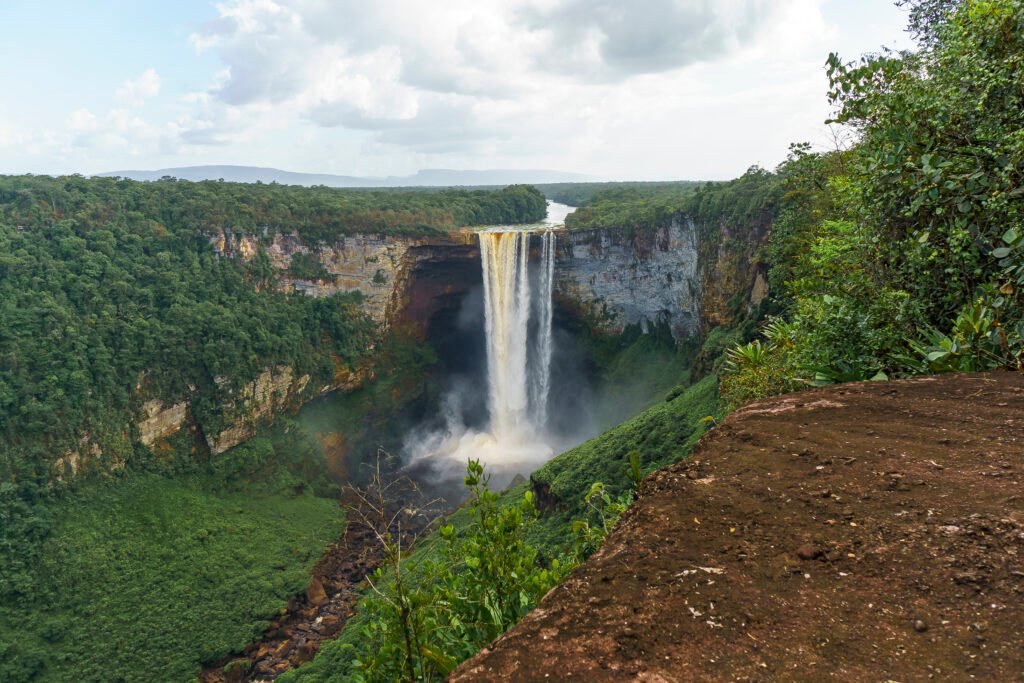
Internationally, Guyana is most closely identified with Kaieteur Falls, a single-drop waterfall on the Potaro River with a sheer drop of 226 meters (741 feet), more than four times the height of Niagara Falls, and widely described as the most powerful waterfall in the world measured by the volume of water passing over a single drop, according to Guyana’s Protected Areas Trust. The falls sit inside Kaieteur National Park, established in 1929 and recognized as the first national park created anywhere in the Amazon region. The park spans 62,700 hectares of rainforest on the ancient Guiana Shield and shelters species found nowhere else on Earth, including the golden rocket frog, which breeds only in the giant bromeliad plants growing near the falls.
Beyond Kaieteur, Guyana has become known globally over the past decade as one of the fastest-growing oil economies anywhere, a reputation built almost entirely on offshore discoveries made from the mid-2010s onward. It also remains the only country in South America where English is the official language, a distinction that continues to set it apart from every other country on the continent.
Why Guyana Matters Globally
Guyana’s significance extends well past its small population. Its forests, among the largest remaining blocks of intact primary tropical rainforest on Earth, store vast quantities of carbon and have made Guyana an important test case for international efforts that pay tropical countries to keep forests standing rather than clear them, an approach generally known as REDD+. As one of the world’s newest major oil producers, Guyana’s rapid production growth is also reshaping regional energy markets and drawing close attention from international financial institutions studying how a small state manages a sudden resource windfall. And as the site of an active case before the International Court of Justice over the validity of a 127-year-old boundary award, Guyana has become a closely watched test of whether international law can resolve a dispute that a much larger neighbor continues to contest, with implications for how territorial disputes are handled elsewhere in the world.
Key facts
- Guyana's population was recorded at 878,674 in the 2022 national census, up nearly 18 percent from 20121
- The country covers about 214,969 square kilometers and is the only nation in South America where English is the official language2
- Guyana's GDP grew 43.4 percent in 2024, among the fastest expansions in the world, driven by a rapidly scaling offshore oil industry3
- Roughly 85 percent of Guyana's land area is forested, one of the highest forest-cover ratios of any country on Earth11
- Kaieteur Falls drops 226 meters in a single sheer plunge, described as the most powerful single-drop waterfall in the world by volume12
Quick checkWhat is the height of Kaieteur Falls' single drop?Show answer
226 meters (741 feet), according to Guyana's Protected Areas Trust, making it the most powerful single-drop waterfall in the world by volume.
Sources
- Guyana Bureau of Statistics. Preliminary Report: Guyana National Population and Housing Census 2022. 2023 (accessed 2026-09-23)
- United Nations Statistics Division. Guyana Country Profile. Undated (accessed 2026-09-23)
- World Bank. Guyana Overview. Undated (accessed 2026-09-23)
- International Court of Justice. Case: Arbitral Award of 3 October 1899 (Guyana v. Venezuela). Undated (accessed 2026-09-23)
- International Court of Justice. Summary of the Order of 1 December 2023. 2023-12-01 (accessed 2026-09-23)
- Encyclopaedia Britannica. Guyana. Undated (accessed 2026-09-23)
- Encyclopaedia Britannica. Guyana: Independence. Undated (accessed 2026-09-23)
- Encyclopaedia Britannica. Guyana: History. Undated (accessed 2026-09-23)
- Encyclopaedia Britannica. Guyana: People. Undated (accessed 2026-09-23)
- CARICOM Secretariat. CARICOM Secretariat (Headquarters, Georgetown, Guyana). Undated (accessed 2026-09-23)
- Forest Carbon Partnership Facility (World Bank). Guyana. Undated (accessed 2026-09-23)
- Protected Areas Trust (Guyana). Kaieteur National Park. Undated (accessed 2026-09-23)
- Florida Institute of Technology, Coastal Climate Adaptation Library. Dalrymple, R. (2006). Sea-level Rise Implications for the Coast of Guyana. 2006 (accessed 2026-09-23)
Editorially reviewed by Specialty Digest Editorial TeamLast reviewed September 23, 2026Researched and drafted with AI assistanceReport an issue