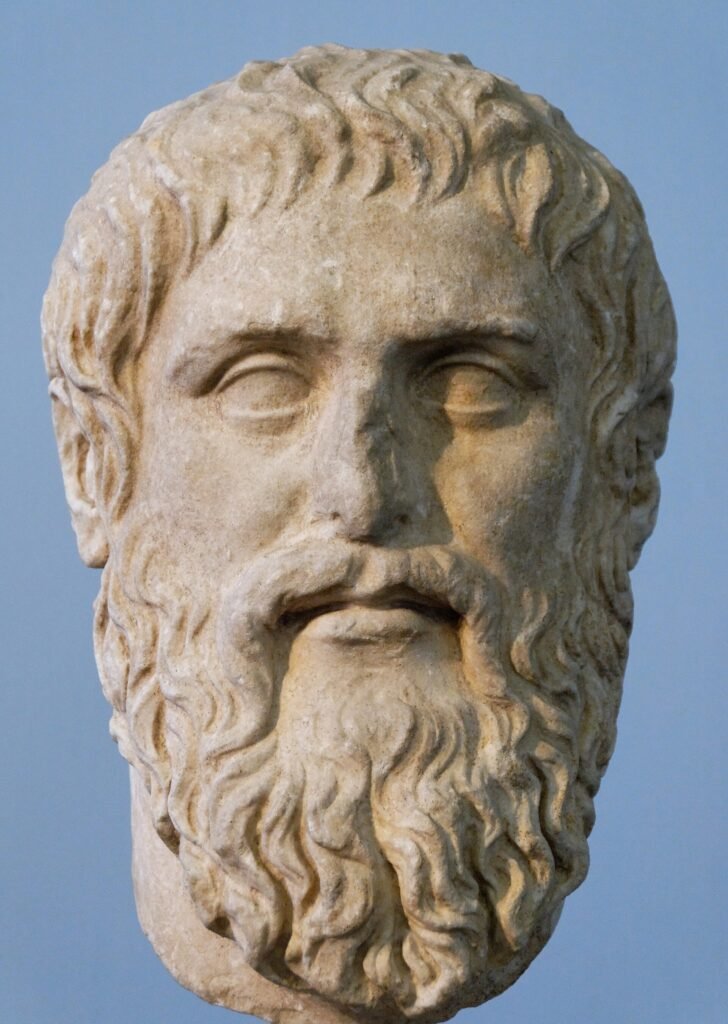
Plato was an Athenian philosopher who lived from about 428 or 427 BCE to about 348 or 347 BCE. He studied under Socrates, taught Aristotle, and wrote dialogues such as the Republic that shaped Western thought. He also founded the Academy, a school outside Athens that is traditionally regarded as the first university in the Western world.
Early life of Plato
Plato was born in Athens into a family of high standing. Ancient writers disagree about the exact dates. The Internet Encyclopedia of Philosophy accepts 428 or 427 BCE for his birth and says he died at the age of eighty or eighty-one, while the World History Encyclopedia gives 424 or 423 BCE for his birth.
Plato had two older brothers, Adeimantus and Glaucon, who appear as speakers in the Republic, and a sister named Potone. A later tradition says his birth name was Aristocles and that Plato was a nickname, but it comes from writers who lived centuries afterward.
He became a follower of Socrates and stayed with him until Socrates was convicted of impiety and executed in 399 BCE. Plato then left Athens and stayed first in Megara. Ancient accounts also place him in Cyrene, Italy, Sicily and Egypt, but only the trips to Italy and Sicily are reasonably well supported.
Career and major work of Plato
After his travels Plato returned to Athens and founded a school known as the Academy. It took its name from a grove sacred to the hero Academus, about a mile outside the city walls, and the English word academic comes from it. Apart from two later trips to Sicily, the Academy remained his home for the rest of his life.
His first visit to Sicily came when he was about forty, according to the Seventh Letter, a text whose authenticity is debated. In Syracuse he taught Dion, the brother-in-law of the tyrant Dionysius I. Later stories say Dionysius had Plato sold into slavery, but the Internet Encyclopedia of Philosophy calls them doubtful.
After Dionysius I died, Dion persuaded the young Dionysius II to invite Plato back, hoping to train a philosopher-ruler of the kind described in the Republic. The visit went badly. Dion was sent into exile within months, and Plato was effectively held under house arrest until the tyrant let him return to Athens.
Plato wrote dialogues, in which characters work through a question by argument. Socrates is the main speaker in most of them. The best known include the Apology, Phaedo, Symposium, Republic, Phaedrus, Timaeus and Laws. The Apology differs in form because it presents the speech Socrates gave at his trial. Plato never speaks in his own voice in any of them. A set of 13 letters also circulates under his name, but most scholars doubt that many of them are his.
Ideas and contributions of Plato
Plato wrote about ethics, metaphysics, epistemology, psychology and politics. His early dialogues stay close to the thought of Socrates, who questions others about virtue and admits his own ignorance, a practice later called the Socratic method. The middle and later works, including the Republic, are generally taken to express Plato’s own views.
The best-known of these views is the theory of Forms. It holds that the world known through the senses is an imitation of a pure, eternal and unchanging world of Forms, such as Beauty or the Good, which can be grasped only by thought. In books six and seven of the Republic, Plato illustrates this with the simile of the sun, the divided line and the parable of the cave.
The Republic also divides the soul into three parts: a rational part that loves truth, a spirited part that loves honor, and an appetitive part that desires food, drink and sex. Justice in a person, Plato argues, means each part doing its own work under the guidance of reason. He then compares this to a city, which he imagines being ruled by a small group of educated guardians.
Other dialogues add further teachings. The Meno and Phaedo present knowledge as a kind of recollection, and several dialogues describe the soul as immortal and able to be reborn. The Symposium examines love, and the Republic criticizes the arts for stirring up the passions. In his late work the Timaeus gives an account of how the universe was made, and the Timaeus and Critias contain the story of Atlantis.
Legacy of Plato
Plato taught Aristotle, whose own work built on his teacher’s and also departed from it. The World History Encyclopedia notes that later religious traditions owe much to Platonic thought, whether directly or through Aristotle.
His writings reached later readers in uneven ways. According to the Internet Encyclopedia of Philosophy, all of his works except the Timaeus were lost to the Western world until medieval times and were preserved by Muslim scholars in the Middle East. In 1578 the printer Henri Estienne published an edition of the Greek text.
The Academy continued after his death and became a model for later schools of higher learning. The word academy still names institutions of study, and modern philosophy keeps returning to his questions about knowledge, justice and the good life.
Scholarly disputes about Plato
Much about Plato remains debated. His dates of birth and death are uncertain because ancient chronologies conflict. The division of his dialogues into early, middle and late periods is widely used, but the Stanford Encyclopedia of Philosophy notes that scholars still dispute whether it reflects the true order of writing.
Because Plato never speaks directly, readers also disagree about when Socrates in a dialogue represents the historical Socrates and when he speaks for Plato. The Parmenides raises serious objections to the theory of Forms, and scholars argue over whether Plato was revising the theory or defending it. Finally, the authenticity of the Seventh Letter and the other letters is contested, so biographical details drawn from them are less certain.
More in Philosophy
Key facts
- Plato was born in Athens around 428 or 427 BCE and died around 348 or 347 BCE, though ancient sources differ.1
- He was a student of Socrates and the teacher of Aristotle.1
- He founded the Academy, a school in a grove outside Athens, after returning from his first trip to Sicily.1
- His writings are dialogues, among them the Apology, Republic, Symposium, Phaedo and Timaeus.2
- Except for the Timaeus, his works were lost to the Western world until medieval times.1
Related concepts
In the news
Quick checkWhat did Plato found in Athens?Show answer
He founded the Academy, a school in a grove just outside Athens that gave the English language the word academic.
Sources
- Internet Encyclopedia of Philosophy, Plato, https://iep.utm.edu/plato/
- Stanford Encyclopedia of Philosophy, Plato, https://plato.stanford.edu/entries/plato/
- World History Encyclopedia, Plato, https://www.worldhistory.org/plato/
Editorially reviewed by Specialty Digest Editorial TeamLast reviewed November 4, 2026Researched and drafted with AI assistanceReport an issue