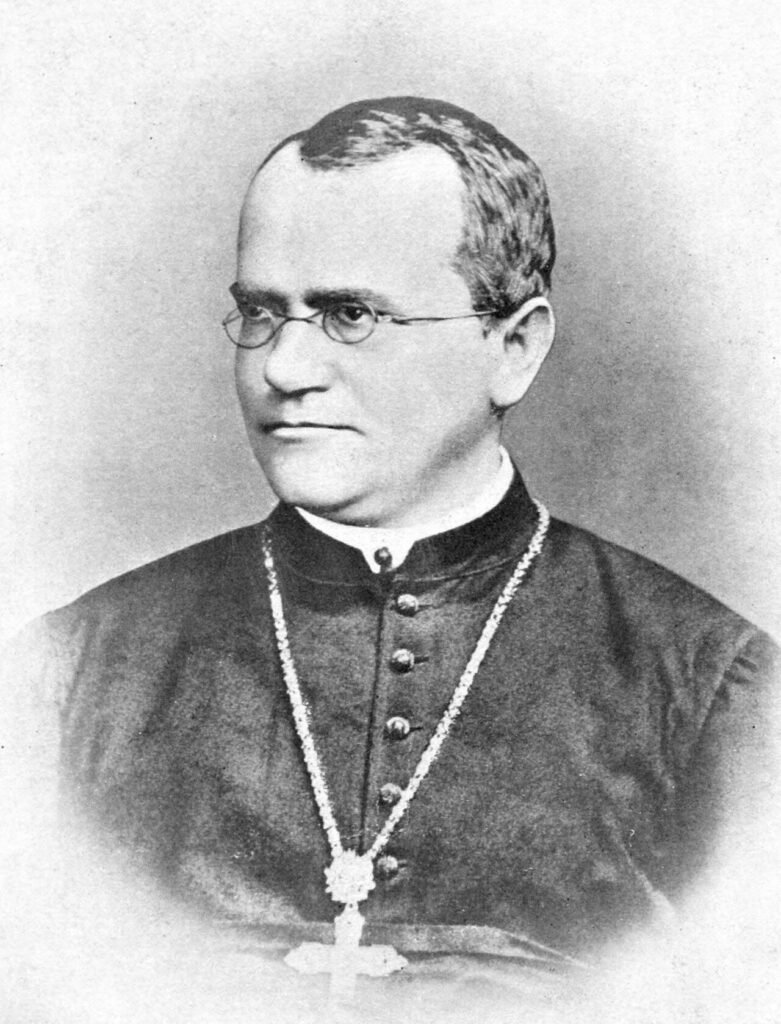
Gregor Johann Mendel (1822 to 1884) was a Moravian friar and scientist whose experiments with pea plants revealed basic patterns of inheritance. His work, carried out mainly between 1856 and 1863, went largely unnoticed in his lifetime. When it was rediscovered in 1900 it became the foundation of genetics.
Early life of Gregor Mendel
Mendel was born on July 20, 1822, in the village of Heinzendorf, in Silesia, now Hyncice in the Czech Republic. His parents were peasant farmers who recognized his intelligence early. His sister Theresia gave up part of her dowry so that he could continue his education, so his schooling depended on family sacrifice as well as on his own talent.
In 1843, at age 21, he entered the Augustinian monastery of St Thomas in Brno as a novice. The Linda Hall Library notes that he was motivated less by religious conviction than by the hope that joining a brotherhood would ease his financial and educational worries. The monastery was also a center of cultural and scientific life, and it sent him on for further study. In an autobiographical note, Mendel said that circumstances, rather than a sense of calling, decided his choice of vocation.
From 1851 to 1853 he studied at the University of Vienna, where he learned physics from Christian Doppler and took courses in chemistry and zoology. Back in Brno, he taught science at local secondary schools and was remembered as a kind teacher.
Career and major work of Gregor Mendel
In 1856 Mendel began to study plant hybridization. Over about eight years he bred thousands of pea plants of the genus Pisum and recorded how particular traits passed from parents to offspring. The Cold Spring Harbor Laboratory’s DNA Learning Center gives the span as 1856 to 1863, while other summaries describe the experiments as lasting until the mid-1860s.
Mendel read two papers on his results to the Natural History Society of Brno in 1865, and they were published in the society’s proceedings in 1866. He found that some traits, such as the form of a seed, did not blend. A trait could vanish in one generation and then return in the next in a ratio of about 3 to 1. In practice, about three plants in four of the second generation showed one form of a trait and about one in four showed the other. Peas suited the study well because they have many clearly different traits, grow quickly and can be pollinated under the experimenter’s control.
To explain this pattern he proposed that each parent contributes a paired hereditary particle to its offspring. These particles were later called genes. Mendel himself called them elements, and in 1865 he knew nothing about DNA or genes in the modern sense.
In 1868 he was elected abbot of the monastery. His new duties left little time for experiments, and he gave up his work on hybrids. In his last decade he was drawn into a civic dispute with the authorities over taxes on the monastery, which was not settled in his lifetime. He died in 1884.
Ideas and contributions of Gregor Mendel
Mendel’s most important idea was that inheritance works through discrete units that stay intact from one generation to the next. This challenged the common belief that offspring simply blend the traits of their parents. He also saw that some traits are expressed strongly while others stay hidden but can reappear, which later became known as dominant and recessive traits.
His method was as important as his findings. Nature Education notes that his lasting influence rests less on the pea data than on his careful testing of hypotheses and his use of mathematical models in biology. By counting large numbers of plants and looking for ratios, he turned heredity from a loose idea into something that could be measured.
His particles later found a physical home in structures inside cells. Chromosomes carry the units of heredity, and a chromosome is where the genes he predicted are physically arranged. The modern study of how traits are inherited, from human disease to crop breeding, builds on his basic rules.
Why Mendel was overlooked
The Linda Hall Library describes how modern genetics was born with Mendel’s 1866 papers, but the work then lay almost unnoticed for 34 years. The Brno society was respectable and its proceedings were distributed fairly widely, and a copy reached the library of the Linnean Society of London. Even so, readers who saw the papers either misunderstood them or ignored them.
Charles Darwin never saw the papers, and it is not clear that he would have grasped their importance. They were about hybrids, not about new varieties or species, and they did not look like a contribution to the debate on evolution that dominated science at the time. Mendel was baffled by the silence that greeted his work.
Legacy of Gregor Mendel
In 1900 three plant researchers working independently, Hugo de Vries, Carl Correns and Erich von Tschermak, repeated Mendel’s kind of experiments and found his papers. Because Mendel had described his crosses and counts in detail, others could repeat them, and the confirmation came quickly. Soon afterward his name became attached to the basic rules of inheritance, and the field of genetics grew rapidly. When he died, he was unaware that he had laid the foundation of modern genetics.
Mendel is often called the father of genetics. A museum in Brno remembers his life and work, and his experiments remain one of the most frequently taught examples of the scientific method. Researchers still use his ideas, adjusted for what is now known about DNA and gene regulation, to predict how traits and diseases pass through families.
More in Genetics
Key facts
- Gregor Johann Mendel was born on July 20, 1822, in Heinzendorf, then in Silesia and now Hyncice in the Czech Republic, and died in 1884.1
- He entered the Augustinian monastery in Brno in 1843 and studied at the University of Vienna from 1851 to 1853.2
- His pea plant experiments ran for eight years, from 1856 to 1863.2
- He read two papers on his results to the Natural History Society of Brno in 1865, and they were published in 1866.1
- He became abbot of the Brno monastery in 1868, and his work was rediscovered in 1900.1
Related concepts
Quick checkWhat did Gregor Mendel discover?Show answer
Mendel showed through experiments with pea plants that inherited traits are passed on in separate units, which later came to be called genes. He found that a trait can disappear in one generation and reappear in the next in a regular 3 to 1 ratio.
Sources
- Linda Hall Library, Scientist of the Day: Johann Gregor Mendel, https://www.lindahall.org/about/news/scientist-of-the-day/johann-gregor-mendel
- DNA Learning Center, Cold Spring Harbor Laboratory, Gregor Mendel (1822-1884), https://dnalc.cshl.edu/view/16167-Biography-2-Gregor-Mendel-1822-1884-.html
- Nature Education, Scitable, Gregor Mendel and the Principles of Inheritance, https://www.nature.com/scitable/topicpage/gregor-mendel-and-the-principles-of-inheritance-593/
Editorially reviewed by Specialty Digest Editorial TeamLast reviewed November 4, 2026Researched and drafted with AI assistanceReport an issue