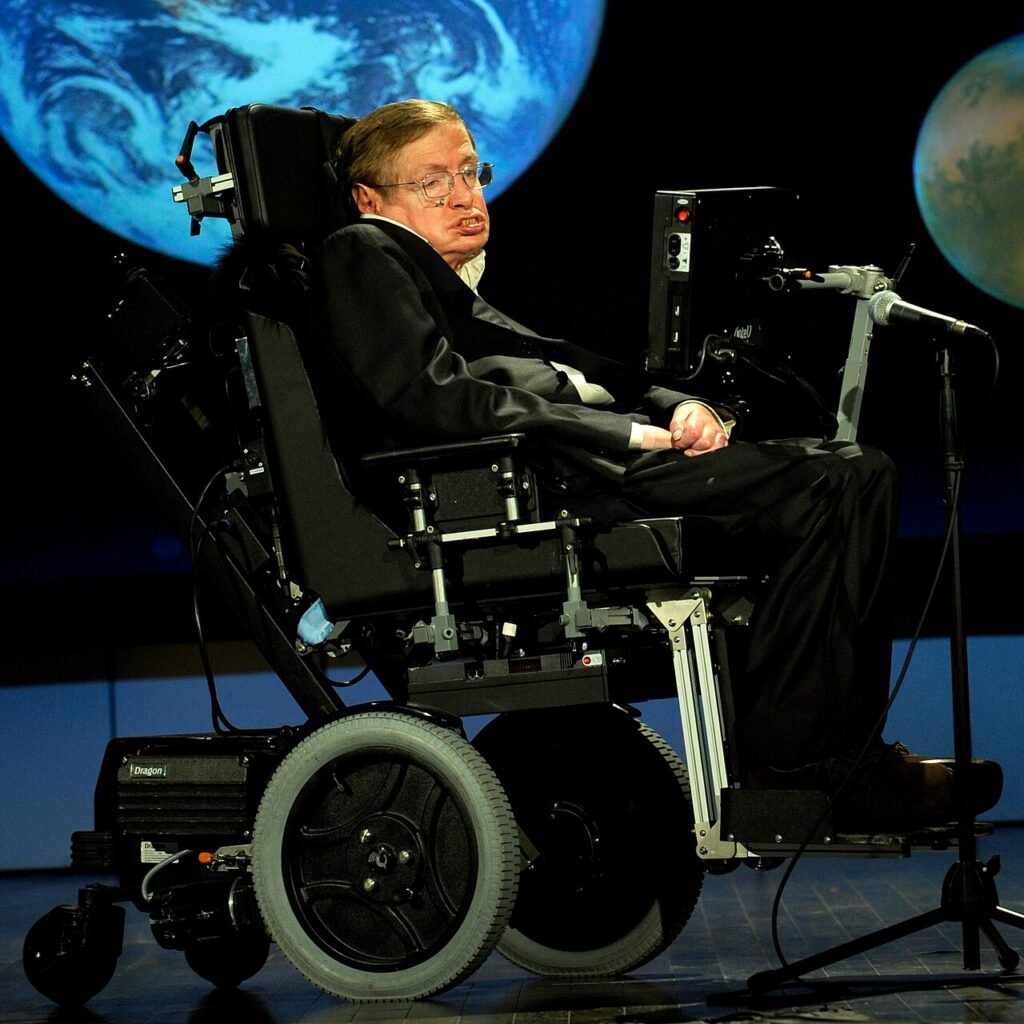
Stephen Hawking (1942 to 2018) was an English theoretical physicist who worked on black holes, the early universe and the nature of space and time. He showed that black holes can emit radiation, a result now called Hawking radiation. His book A Brief History of Time, published in 1988, became one of the best-selling popular science books.
Early life of Stephen Hawking
Hawking was born in Oxford on January 8, 1942. In 1950 his father moved to the Institute for Medical Research in Mill Hill, London. In March 1959 Hawking took the scholarship examinations with the aim of studying natural sciences at Oxford.
He only just earned a First Class degree in 1962. MacTutor records his own view that the attitude at Oxford then was strongly against hard work. He went to Cambridge in 1962 as a PhD student.
During his last year at Oxford he had noticed that he was becoming clumsy. At Christmas 1962 his mother persuaded him to see a doctor, and in early 1963, after two weeks of tests in hospital, he was diagnosed with motor neurone disease. He completed his doctorate in 1966 and received a fellowship at Gonville and Caius College, Cambridge.
Motor neurone disease, called Lou Gehrig’s disease in the United States, is a progressive condition that affects the nerve cells controlling muscles. In Hawking’s case it gradually limited his movement and speech, and he eventually used a wheelchair and a computerized voice that became instantly recognizable.
Career and major work of Stephen Hawking
Between 1965 and 1970 Hawking worked on singularities in the theory of general relativity, the places where its equations break down. He devised new mathematical techniques for the study of these problems and collaborated with Roger Penrose. In 1973 he joined the Department of Applied Mathematics and Theoretical Physics at Cambridge, and in 1977 he became Professor of Gravitational Physics.
He was elected a Fellow of the Royal Society in 1974, one of its youngest fellows. In 1979 he was appointed Lucasian Professor of Mathematics, the Cambridge chair that was once held by Isaac Newton. His honors included the CBE in 1982, the Wolf Prize in Physics in 1988, the Companion of Honour in 1989, the Royal Society’s Copley Medal in 2006 and the US Presidential Medal of Freedom in 2009. He was also a Member of the Pontifical Academy of Sciences and of the US National Academy of Sciences, and he received the Albert Einstein Award, the Gold Medal of the Royal Astronomical Society and the Fundamental Physics Prize. A symposium held in Cambridge in January 2002 celebrated his 60th birthday.
In 1982 he decided to write a popular book on cosmology, and by 1984 he had a first draft. In 1985 he fell ill again while at CERN in Geneva, and he had to revise the draft under great difficulty. A Brief History of Time appeared in 1988. By May 1995 it had spent 237 weeks on The Sunday Times best-seller list, and the 1998 Guinness Book of Records recorded the feat. The paperback edition, published on April 6, 1995, reached the top of the best-seller list within three days. By April 1993 the book had gone through 40 hardback editions in the United States and 39 in the United Kingdom.
Ideas and contributions of Stephen Hawking
Hawking’s early work with Penrose helped show that, under general relativity, singularities are a natural consequence of gravitational collapse and of the expansion of the universe. This work builds on the theory of Albert Einstein and helped establish the modern study of black holes.
General relativity, published by Einstein in 1915, describes gravity as the bending of space and time by mass and energy. A singularity is a point where that description gives infinite values, which signals that the theory is incomplete there.
From 1970 he applied these ideas to black holes. Using quantum theory together with general relativity, he showed that black holes can emit radiation. The University of Cambridge describes his finding that black holes have a temperature and produce radiation, which is now called Hawking radiation. In plain terms, a black hole can slowly lose mass and energy over very long times, so it is not perfectly black. In 1971 he also predicted that the early universe could have produced mini black holes, objects of great mass but only the size of a proton.
In 1983 he and Jim Hartle of Santa Barbara made the no-boundary proposal, which describes the beginning of the universe in a way that has no sharp edge in space and time. In 2004 and 2005 he returned to the question of whether information is lost when a black hole evaporates, and he proposed a solution to this information loss paradox.
Limits and debate
Hawking radiation is a theoretical prediction, and it has not been observed directly from an astrophysical black hole. Physicists continue to debate what happens to information that falls into a black hole, and Hawking changed his own position on the problem. Such open questions are normal for work at the edge of physics.
His popular books are credited by many readers with introducing cosmology and black holes to a general audience.
Legacy of Stephen Hawking
Hawking died in Cambridge on March 14, 2018, at age 76. The University of Cambridge called him one of the most brilliant minds of his time, known for his science, his books, his lectures and biographical films. He also became a champion for people with disabilities around the world, and he used a computerized voice to communicate in his later years.
He edited a collection called On the Shoulders of Giants in 2002, which brought together works by Copernicus, Galileo, Kepler, Newton and Einstein. He was also among the scientists who supported the campaign to clear the name of the codebreaker Alan Turing, who received a royal pardon in 2013.
More in Astronomy & Space
Key facts
- Stephen Hawking was born in Oxford on January 8, 1942, and died in Cambridge on March 14, 2018, aged 76.1
- He was diagnosed with motor neurone disease in early 1963.1
- He became Lucasian Professor of Mathematics at Cambridge in 1979.1
- His book A Brief History of Time was published in 1988.1
- His work showed that black holes can emit radiation, now known as Hawking radiation.2
Related concepts
Quick checkWhat is Hawking radiation?Show answer
Hawking radiation is the emission of particles by a black hole, which follows from combining quantum theory with general relativity. Stephen Hawking showed that black holes have a temperature and can slowly lose mass.
Sources
- MacTutor History of Mathematics, University of St Andrews, Stephen William Hawking, https://mathshistory.st-andrews.ac.uk/Biographies/Hawking/
- University of Cambridge, Professor Stephen Hawking 1942-2018, https://www.cam.ac.uk/stephenhawking
Editorially reviewed by Specialty Digest Editorial TeamLast reviewed November 4, 2026Researched and drafted with AI assistanceReport an issue