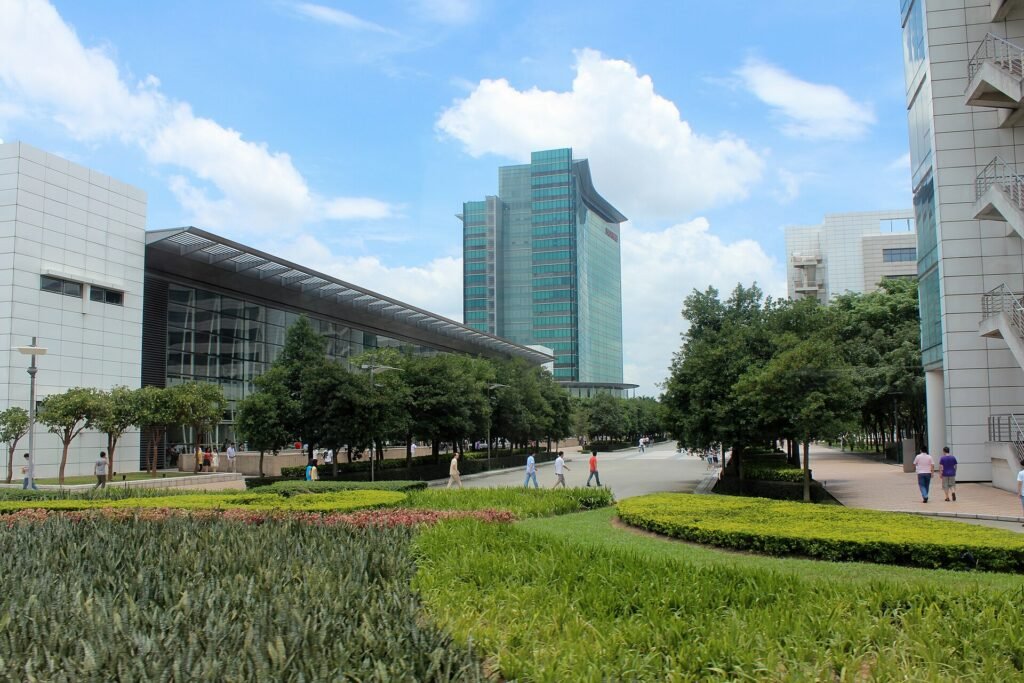
Huawei is a Chinese technology company that designs and sells telecommunications network equipment, cloud and IT products, digital power products, intelligent vehicle solutions and consumer devices such as smartphones. Its legal parent is Huawei Investment & Holding Co., Ltd., and its head office is at Huawei Base in Shenzhen, China. According to the company’s April 2026 fact sheet, it has 213,000 employees and operates in more than 170 countries and regions.
History of Huawei
Huawei’s corporate fact sheet gives 1987 as its year of establishment, and its Our Company page says it was founded in that year. The company’s founder is Ren Zhengfei, who is named in the fact sheet as the holder of a small ownership stake. The sources read for this entry do not give a detailed account of the company’s earliest years, so this entry does not describe them.
Over the decades since 1987 the company grew from a single enterprise in Shenzhen into a supplier to telecommunications carriers, enterprises and consumers. Its corporate pages describe its vision as bringing digital to every person, home and organization for a fully connected, intelligent world. The company says it now serves more than 3 billion people around the world.
Huawei’s own statements in 2025 and 2026 emphasize artificial intelligence. Its Our Company page says that the company will go all in on AI in the intelligent era and will focus its innovation efforts on strategic businesses and on breakthroughs in basic theory application.
Businesses and products of Huawei
The fact sheet states that Huawei and its subsidiaries principally provide end-to-end information and communications technology solutions. It lists the research, design, manufacture and marketing of telecom network equipment, IT products and solutions, cloud technology and services, digital power products and solutions, intelligent vehicle solutions, and smart devices for telecom carriers, enterprises and consumers.
The company’s website organizes products into consumer products and business products. Consumer products include smartphones, PCs, tablets, wearables, audio devices and routers. Business products include carrier network equipment, enterprise networking, enterprise optical networking, enterprise wireless, data storage, Huawei Cloud and digital power, with industry solutions for telecommunications, education, finance, electric power, manufacturing, airports and urban rail. Huawei also lists an intelligent automotive solution.
Several of these businesses connect to topics covered elsewhere on this site. Network equipment supports mobile networks such as 5G, handsets are described in the entry on the mobile phone, and Huawei also sells cloud services.
Corporate structure and operations
Huawei describes itself as 100 percent privately owned by its employees. The fact sheet says that Huawei Investment & Holding Co., Ltd. is a private company wholly owned by 169,054 of its employees and retired beneficiaries. As of December 31, 2025, it says, founder Ren Zhengfei’s investment accounts for nearly 0.59 percent of the company’s total share capital. This is the company’s own description of its ownership.
The company publishes an annual report, and its 2025 report is available on its website. According to the fact sheet, in 2025 Huawei achieved revenue of CNY 880.9 billion and net profit of CNY 68 billion. These are company-reported figures in Chinese yuan for the year ended December 31, 2025.
Research and development is a large part of the company’s spending. The company says its R&D spending in 2025 reached CNY 192.3 billion, or 21.8 percent of revenue, and that its total R&D investment over the past decade exceeds CNY 1.382 trillion. At the end of 2025, according to the Our Company page, 114,000 employees, about 53.7 percent of the workforce, worked in R&D. The company reports that it held 165,000 active granted patents globally, had signed more than 260 patent licensing and cross-license agreements, and ranked sixth in the 2025 EU Industrial R&D Investment Scoreboard.
Impact of Huawei
Huawei matters because of the role that telecommunications infrastructure plays in modern economies. Carrier networks carry voice, data and internet traffic, and the equipment inside them is made by a small number of global suppliers. Huawei describes itself as a leading global provider of information and communications technology infrastructure and smart devices.
The company also matters as a case study of research spending. A 21.8 percent ratio of R&D spending to revenue is high for a company of its size, according to the figures it publishes, and its patent holdings are a stated part of its strategy of cross-licensing technology with other large patent holders. Chips are one technology area that depends on this kind of investment, as described in the entry on semiconductors.
Challenges and controversies
The best-documented challenge in Huawei’s recent history involves United States export controls. On May 16, 2019, the Bureau of Industry and Security of the U.S. Department of Commerce added Huawei Technologies Co., Ltd. to the Entity List, a list of parties subject to additional license requirements for exports of certain U.S. items. The final rule, published in the Federal Register, states that the U.S. government had determined there was reasonable cause to believe that Huawei had been involved in activities contrary to the national security or foreign policy interests of the United States. The same rule added 68 non-U.S. affiliates of Huawei in 26 destinations, on the ground that those affiliates posed a significant risk of such involvement.
Huawei responded the same day with a media statement. It said that it was against the decision, that the decision was in no one’s interest, that it would do significant economic harm to American companies with which Huawei does business and affect tens of thousands of American jobs, and that it would seek remedies immediately. This entry reports both positions as they were stated and does not adjudicate between them. The U.S. rule describes a government determination, not a court finding.
The listing shows how technology supply chains can become the subject of national security policy. Because many components and software products have a U.S. connection, export restrictions can affect a company that is not itself based in the United States. The sources used for this entry do not cover later changes in the rules, so readers should consult current guidance from the Department of Commerce before relying on the status described here.
More in Networks & Telecommunications
Key facts
- Array
Related concepts
Quick checkWho owns Huawei according to the company?Show answer
Huawei says it is wholly owned by 169,054 employees and retired beneficiaries through Huawei Investment and Holding, with founder Ren Zhengfei holding nearly 0.59 percent as of December 31, 2025.
Sources
- Array
Editorially reviewed by Specialty Digest Editorial TeamLast reviewed November 4, 2026Researched and drafted with AI assistanceReport an issue