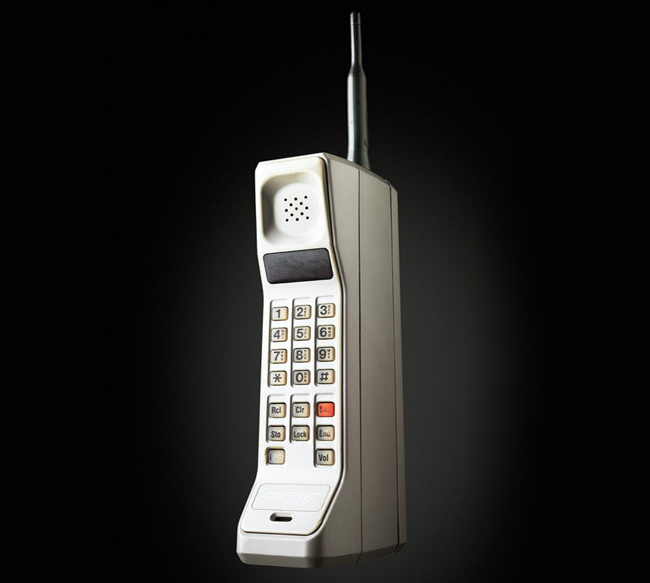
A mobile phone is a portable telephone that sends and receives calls and data by radio through a network of base stations. Martin Cooper of Motorola placed the first call from a handheld cellular phone in New York on April 3, 1973, and by 2025 the International Telecommunication Union counted about 9.2 billion mobile-cellular subscriptions worldwide.
History of the mobile phone
Mobile telephony began with car phones. According to Motorola, radiotelephone service started in the United States in 1946, and the company made phones that were installed in vehicles. These systems were two-way radios linked to the landline network, and they could handle only a few calls at a time because few radio frequencies were available. Callers often waited a long time. By the early 1970s, car phones cost between $2,000 and $4,000, and a waiting list for a new account could run to three years.
The cellular idea, which came from Bell Laboratories, offered a way out. In 1968 the United States Federal Communications Commission (FCC) proposed setting aside frequencies in the 800 to 900 megahertz range for a new technology, and by the early 1970s both AT&T and Motorola had announced high-capacity systems based on cells.
AT&T planned car-based service, but Cooper and his Motorola colleagues wanted a phone people could carry. Industrial designer Rudy Krolopp and his team shaped a prototype that they called the shoe phone, and by February 1973 Motorola had a working DynaTAC, short for Dynamic Adaptive Total Area Coverage, to show the FCC. On April 3, 1973, Cooper stood on a Manhattan street and called Joel Engel, a rival at Bell Labs, from the prototype. The device weighed 30 ounces, nearly two pounds, and measured ten inches long, three inches deep and one and a half inches wide.
The New York Times reported the demonstration the next day under the headline “Motorola Introduces Wire-Less Telephone.” The reporter predicted that the network could be ready for subscribers by 1976, with service costing $60 to $100 a month and possibly falling to $10 by the early 1990s. The prediction proved optimistic. The first commercial portable cellular phone, Motorola’s DynaTAC 8000X, was released in 1983.
Who invented the mobile phone?
Martin Cooper was born in Chicago on December 26, 1928, and joined Motorola in 1954. He worked on the company’s first portable handheld police radios, introduced in 1967, before he led the cellular portable project.
Credit depends on what is meant by mobile phone. Cooper is often called the father of the mobile phone because his team made the first call from a handheld cellular device. The cellular network concept behind it was developed earlier at Bell Laboratories, and the two companies were rivals when the first call was made. Car-based mobile telephones had existed for years before either project.
The phone itself was also a product of many hands. Motorola credits its industrial design team and its earlier experience with two-way radios and semiconductors, since the company already held patents on much of the electronics needed. In practice the mobile phone is a product of several inventions: radio, the cellular network, miniaturized electronics and the handset.
How a mobile phone works
A mobile phone connects by radio to the nearest base station, which links it to the wider telephone network. Cellular systems divide geographic areas into small adjacent cells. Each cell has a base station, and a network of cell sites is supported by switching equipment that tracks users as they move and passes their calls from one cell to the next automatically.
Cells solved the main problem of car-phone systems. Earlier systems used high-powered base stations, and radio channels could not be reused in nearby areas because of interference. Smaller cells with lower power allow the same frequencies to be reused in different places, so many more people can make calls at once. The system is a descendant of the telephone, with radio replacing the wire to the user.
Types of mobile phones and networks
The earliest mobile phones were car phones, built into vehicles and powered from the car. The portable DynaTAC changed this by putting the phone, battery and antenna in a unit one person could carry. Modern handsets typically rely on rechargeable lithium-ion batteries and, in many models, a touchscreen.
Networks are grouped by generation. The International Telecommunication Union separates mobile-cellular subscriptions, which cover all mobile service, from mobile broadband subscriptions, which carry data. In 2025, 36 percent of mobile broadband subscriptions worldwide were on 5G networks, though adoption varies by region.
Impact of the mobile phone
The mobile phone has spread faster than almost any earlier communication technology. The ITU reports 112 mobile-cellular subscriptions for every 100 people in 2025, which means there are more subscriptions than people. That does not mean everyone has one, since some people hold several subscriptions and some belong to connected devices.
Access is uneven. High-income countries had about 142 mobile-cellular subscriptions per 100 inhabitants, twice the 70 in low-income countries. Mobile broadband shows a larger gap, at 132 subscriptions per 100 inhabitants in the Americas and 56 in Africa. Meanwhile, fixed-telephone subscriptions have fallen by about 3 percent a year over the past five years.
Cooper put the original idea simply. People, he said, did not want to talk to cars or desks. They wanted to talk to other people.
Uses of mobile phones today
Voice calls remain central, but most mobile subscriptions are now for data. Mobile broadband made up 89 percent of all mobile subscriptions in 2025, up from less than 50 percent in 2015, as voice-only plans are gradually phased out. The ITU ties this shift to changing consumption, with demand moving toward data-based services.
Key facts
- Array
Related concepts
Quick checkWho made the first mobile phone call?Show answer
Martin Cooper of Motorola placed the first call from a handheld cellular phone on April 3, 1973, to Joel Engel at rival Bell Labs, although the cellular network idea came from Bell Laboratories.
Sources
- Array
Editorially reviewed by Specialty Digest Editorial TeamLast reviewed November 4, 2026Researched and drafted with AI assistanceReport an issue